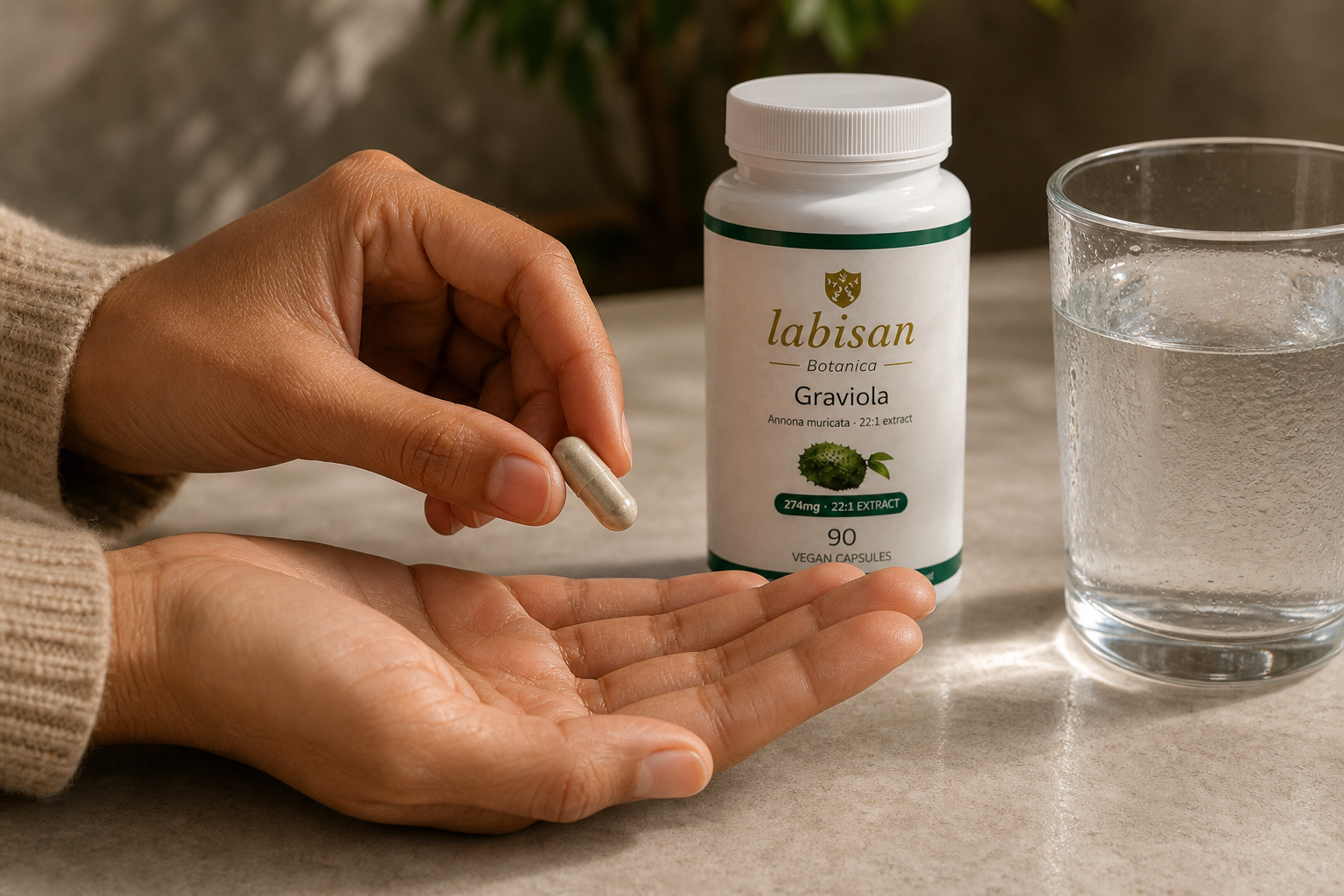
The numbers up front. A 22:1 graviola fruit water-extract delivers an 8,000mg bioactive equivalent at the 3-capsule daily protocol, with each 500mg capsule equal to roughly 11 grams of raw fruit pulp (3 capsules per day equals 33 grams). The capsule is 274mg of standardised extract, equivalent to roughly 6,028mg of raw graviola fruit pulp per cap. Each 90-capsule bottle is one month at 3 capsules per day, $44.99 per bottle, with batch certificates of analysis on request. The flavonoid plus phenolic acid stack (quercetin, kaempferol, rutin, gallic acid, chlorogenic acid, caffeic acid, ferulic acid) sits in the same TPC and TEAC range as good-quality green tea extract on a per-capsule basis.
The graviola conversation almost always opens with annonaceous acetogenins. They are interesting compounds, and our deep dive on the acetogenin mechanism covers them. But focusing only on acetogenins misses the larger half of what makes a concentrated Annona muricata extract useful daily. The flavonoid and phenolic acid profile is where most of the everyday antioxidant load comes from. Labisan Graviola Capsules use a water extract from the fruit, not the leaves (fruit vs leaf safety breakdown), manufactured under Austrian EU GMP standards.
What the Analytical Chemistry Actually Shows
HPLC-MS analysis of Annona muricata leaf extracts (the same analytical method pharmaceutical regulators require for compound identity verification) consistently identifies three categories of bioactive compounds:
- Annonaceous acetogenins: the family of long chain fatty acid derivatives unique to the Annonaceae plant family.
- Flavonoids: particularly quercetin, kaempferol, rutin, and their glycoside forms.
- Phenolic acids: gallic acid, chlorogenic acid, caffeic acid, ferulic acid.
The acetogenins draw most of the research interest because they are structurally unique. The flavonoids and phenolic acids draw less spotlight because they appear in green tea, onions, apples, and red wine. A 22:1 graviola fruit water-extract delivers an 8,000mg bioactive equivalent per 3-capsule daily dose, and the flavonoid plus phenolic acid stack within that 8,000mg payload is the layer that most directly supports the daily oxidative stress balance that frames immune resilience.
Quercetin: The Anchor Flavonoid
What Quercetin Does Mechanistically
Quercetin is one of the most studied flavonoids in biomedical literature, with over 30,000 papers indexed in PubMed at the time of writing. Its mechanisms include direct free radical scavenging via its catechol B ring, inhibition of NADPH oxidase enzyme complexes that produce reactive oxygen species, modulation of the NF kB inflammatory pathway, and stabilization of mast cell membranes (the basis for its widely studied antihistamine effect).
Quercetin in graviola leaf is present primarily as quercetin 3 O glucoside (isoquercitrin) and rutin (quercetin 3 O rutinoside), which are absorbed differently from aglycone quercetin. The glycoside forms are released by gut beta glucosidase activity, then taken up via the SGLT1 transporter, which actually produces a more stable plasma profile than direct quercetin supplementation.
Why Glycoside Form Matters
A 500mg 22:1 capsule equals the bioactive load of 11 grams of raw fruit pulp; 3 capsules per day equals 33 grams of raw fruit equivalent. The glycoside-bound flavonoid forms in graviola fruit produce slower, more sustained quercetin availability than free quercetin tablets, which spike and clear within 4 to 6 hours. The combined effect across the 22:1 concentration is meaningful daily antioxidant support without the gastrointestinal load that comes with high-dose isolated quercetin supplementation.
Kaempferol: The Second Tier Flavonoid
Kaempferol is the second most abundant flavonoid in Annona muricata leaf, present in similar glycoside forms (kaempferol 3 O glucoside, kaempferol 3 O rutinoside). The molecular structure differs from quercetin by one hydroxyl group, which subtly changes the antioxidant kinetics: kaempferol is slightly less potent at single radical scavenging events but has longer cellular residence time and stronger activity in modulating the Nrf2 antioxidant response pathway.
The Nrf2 pathway is the master regulator of endogenous antioxidant gene expression. Compounds that activate it (kaempferol, sulforaphane from broccoli, EGCG from green tea) trigger upregulation of glutathione synthesis enzymes, superoxide dismutase, catalase, and other endogenous defenses. This is why daily intake of Nrf2 activating flavonoids produces benefits that compound over weeks, rather than acute single dose effects.
Gallic Acid and the Phenolic Layer
Gallic acid is the dominant phenolic acid in graviola leaf, supported by smaller fractions of chlorogenic acid (the same compound abundant in coffee), caffeic acid, and ferulic acid. The phenolic acid layer extends antioxidant coverage into a molecular weight range that the larger flavonoids cannot reach, providing direct radical scavenging in tissues where flavonoid penetration is limited.
Together, the flavonoid plus phenolic acid stack produces what analytical chemists call a "broad spectrum antioxidant profile." TPC and TEAC values place high-quality 22:1 fruit water-extract in the same antioxidant capacity range as green tea extract on a per-capsule basis, with the additional acetogenin layer (90 percent in-vitro viral suppression at the 0.0005 percent / 5 ppm range against HSV) that green tea does not deliver.
Why the 22:1 Concentration Ratio Changes the Math
Concentration ratio matters disproportionately for the flavonoid and phenolic layer. Our breakdown of the 22:1 extract math explains the underlying calculation: a 500mg 22:1 capsule contains the bioactive equivalent of roughly 11 grams of raw graviola fruit. For acetogenins, this concentration matters because the absolute compound mass per capsule reaches research-relevant levels. For flavonoids and phenolic acids, the same concentration translates into a measurable shift in plasma TEAC across 3 to 6 weeks of consistent 3-capsule daily dosing, alongside the 8,000mg total bioactive equivalent reaching circulating immune tissue every day.
A 1:1 raw leaf product cannot achieve this. The flavonoid density per gram of raw leaf is fixed by botany; you simply cannot deliver a research relevant antioxidant dose without concentrating the leaf material. Most of the graviola products on Amazon are 1:1 raw powder, which means the flavonoid layer is not being delivered at functional doses regardless of how many capsules the user takes per day.
The flavonoid density that 1:1 leaf powder can't reach
Labisan Graviola Capsules 22:1 Extract
Single: $44.99 | 3x Bundle: $119.97 | 5x Bundle: $179.95
Free shipping on orders over $49. 30 day money back guarantee.
Shop Graviola CapsulesWhat This Means for the Daily User
Antioxidant Status Shifts Are Not Acute
Flavonoid-driven antioxidant status changes accumulate over 3 to 6 weeks of consistent 3-capsule daily dosing. The biomarker changes (plasma TEAC, glutathione status, oxidised LDL fraction) move slowly and steadily, not in single-dose responses. The benefit is the cumulative shift in endogenous antioxidant capacity over months, expressed as resilience to oxidative stress events: travel, illness, intense exercise, environmental pollution, occasional poor sleep.
The Stack Layers
Daily graviola sits inside a broader supplementation stack. Our review of the five best immune supplements for 2026 places graviola alongside vitamin D, zinc, and vitamin C. Graviola's role in the stack is the unique flavonoid profile (quercetin and kaempferol glycosides) plus the acetogenin layer no other common botanical delivers.
Frequently Asked Questions
Are the flavonoids in graviola the same as in green tea?
Partially overlapping, but not identical. Green tea is rich in catechins (EGCG, EGC, ECG), which graviola does not contain meaningfully. Graviola is rich in quercetin and kaempferol glycosides, which green tea contains in much smaller amounts. The two extracts are complementary, not redundant.
Do I need to take graviola with food for absorption?
For the flavonoid glycosides, food does not significantly change absorption because the glycoside forms are processed by gut microflora rather than absorbed via simple lipid pathways. For the acetogenin fraction, light food intake can modestly improve absorption. Most users find taking graviola with breakfast or lunch produces the best tolerance.
Can I get the same antioxidant load from eating soursop fruit?
Not really. The fruit pulp contains flavonoids and phenolic acids at concentrations 30 to 100 times lower than leaf extract, and most of the acetogenin mass lives in the leaf rather than the pulp. The fruit is delicious; the supplemental compounds live in the leaf.
Is there an upper limit on daily graviola intake?
Pharmacological caution is reasonable. Most studies that have shown benefit in humans use doses in the 500mg to 1,500mg per day range of standardized extract. Doses above 2 grams per day of high concentration extract have not been well studied for chronic intake. The Labisan recommended dose stays comfortably within the range supported by published evidence.
Will I notice anything in the first week?
The 8,000mg daily bioactive payload starts producing measurable plasma antioxidant capacity within 60 to 90 minutes of the first capsule, and consistent users on the 3-capsule daily protocol describe improved sleep quality and digestive regularity in the first 7 to 14 days. The deeper antioxidant status and immune-resilience benefits build across the first 6 to 12 weeks. For users taking graviola during periods of high oxidative stress (illness, travel, athletic peak loads), the practical benefit becomes most obvious within the first 2 to 3 weeks.
The Bottom Line
The acetogenins make graviola unique. The flavonoid plus phenolic acid layer is what makes it worth taking daily. Both depend on real concentration (22:1 minimum) and real manufacturing quality (Austrian or equivalent pharmaceutical grade standards) to deliver what the label claims.
Most of the graviola category on Amazon delivers neither layer at functional doses. Labisan Graviola Capsules are a 22:1 fruit water-extract manufactured in Austria under EU GMP, with batch-level certificates of analysis available on request. 8,000mg daily bioactive equivalent at $44.99 per 90-capsule one-month bottle ($1.50 per day at the 3-cap protocol), free shipping over $49, 30-day money-back guarantee. The fruit-extract route also delivers the daily payload at 5 to 20x lower acetogenin density than equivalent leaf extract, mitigating the chronic-exposure concern from the Caparros-Lefebvre Guadeloupe case reports on long-term high-dose leaf consumption.