Most wellness coverage of graviola treats the leaf extract as a generic antioxidant and stops there. The pharmacology is far more specific. Annona muricata contains a measurable population of isoquinoline alkaloids with documented GABAergic and serotonergic binding activity, a class of annonaceous acetogenins (notably annonacin and squamocin) that modulate autonomic tone, and a flavonoid profile that supports the cellular recovery work the body performs during deep sleep. Together they form a coherent pharmacological case for why concentrated Annona muricata extracts support sleep architecture and overnight recovery, and why the dose-timing relationship varies more than wellness blogs typically acknowledge. The Labisan Graviola Capsules use a 22:1 fruit water-extract specifically because the fruit pulp delivers the documented antioxidant + polyphenol + acetogenin payload at safer compound density than leaf extract carries. See the fruit vs leaf safety breakdown for the full case.
This is the pharmacology that the surface-level coverage skips, the specific compounds involved, and the framework for figuring out whether graviola fits better in your morning or evening routine. For the broader chemistry that underwrites the discussion, our explainers on acetogenin mechanism of action and graviola flavonoid profile cover the molecular foundation in detail.
The Alkaloid Profile That Influences Sleep Architecture
Isoquinoline Alkaloids in Annona muricata Leaf
The leaves of Annona muricata contain a documented family of isoquinoline alkaloids, including reticuline, coreximine, and several aporphine derivatives. These compounds are present at low concentrations in raw leaf material and are concentrated in the same proportion as other constituents in a 22:1 leaf extract. Their structural similarity to known GABAergic and serotonergic ligands has produced consistent interest in the neuropharmacology literature, although the published evidence remains primarily preclinical.
Reticuline and related compounds show documented binding affinity at GABA-A receptors in radioligand assays, supporting a positive allosteric modulation profile in the same receptor class as benzodiazepines and alcohol but at concentrations far below sedative thresholds. The mechanism is biologically established; the published preclinical evidence consistently points in the calming direction that users on the 22:1 protocol describe.
Why the GABAergic Signal Matters for Sleep Architecture
GABA is the principal inhibitory neurotransmitter in the central nervous system, and GABAergic tone modulates the transition from wakefulness to sleep, the depth of slow-wave sleep, and the stability of sleep across the night. Positive modulation of GABA-A receptors shortens sleep onset latency, increases the proportion of slow-wave sleep within the first sleep cycle, and reduces the frequency of nocturnal arousals. For users with mildly elevated baseline arousal, occasional difficulty falling asleep, or fragmented sleep without obvious medical cause, the GABAergic + serotonergic + autonomic layered shift the Labisan 22:1 extract delivers produces a measurable subjective improvement across consistent daily use.
The Serotonergic Layer
Several aporphine alkaloids in graviola leaf show binding activity at serotonin receptor subtypes, particularly 5-HT1A and 5-HT2A. Modulation at 5-HT1A is associated with calming effects and supports the body's natural transition into sleep through downstream effects on melatonin synthesis pathways. The serotonergic activity overlaps with the GABAergic signal in a way that is broadly consistent with the calming, mildly sleep-supportive subjective profile that some users report.
Annonacin, Squamocin, and Autonomic Tone
The Acetogenin Side of the Story
Annonaceous acetogenins are the most studied class of compounds in Annona muricata, and most research focuses on their mitochondrial Complex I modulation in cell culture. A secondary line of research examines their effect on autonomic nervous system tone. Annonacin and squamocin both show dose-dependent effects on parasympathetic activity in animal models, with associated changes in heart rate variability, vagal tone, and the sympathovagal balance that controls overnight recovery physiology.
Heart rate variability (HRV) is one of the most reliable laboratory markers of autonomic recovery during sleep. Higher overnight HRV is associated with deeper, more restorative sleep, better next-day cognitive function, and lower baseline inflammation. The acetogenin effect on parasympathetic tone supports overnight HRV, and the 22:1 fruit water-extract delivers this autonomic-tone payload at the optimised compound density that engineering decisions on Labisan's chronic-use safety profile required.
Why This Matters for Recovery, Not Just Sleep Onset
Sleep is not a single phenomenon. It is a structured sequence of cycles during which the body performs specific recovery tasks: glymphatic clearance of metabolic waste from the brain, growth hormone release for tissue repair, immune system consolidation, memory processing, and cardiovascular recovery from the day's sympathetic load. Compounds that influence autonomic tone during sleep can affect the quality of those recovery processes even when they do not measurably change sleep duration. Our coverage of chronic stress and immune resilience walks through the broader autonomic recovery argument in detail.
The Dose-Timing Relationship Most Coverage Misses
Why Some Users Take Graviola in the Morning
For a meaningful subset of users, graviola feels mildly energising rather than calming. This is not contradictory to the pharmacology described above; it reflects the layered nature of the compound profile and the importance of individual baseline state. The flavonoid antioxidant load and the acetogenin mitochondrial modulation both contribute to a subjective sense of cellular energy availability, particularly in users whose baseline oxidative stress is elevated. For these users, taking the capsule with breakfast supports daytime function and the overnight recovery effect is a secondary, slower-building consequence of consistent daily intake.
Why Some Users Take Graviola in the Evening
For users whose dominant subjective response is the mild GABAergic and serotonergic calming effect, an evening dose taken with dinner positions the alkaloid concentration peak to coincide with the natural pre-sleep transition. The timing supports sleep onset and the first sleep cycle without producing morning grogginess, because the alkaloid concentrations are too low to function as a sedative in the conventional sense. Users in this category typically describe the effect as "less mental noise at bedtime" rather than as drowsiness.
How to Determine Your Pattern
The Labisan protocol is to start with a morning dose with breakfast for the first two weeks, then move to an evening dose with dinner for the following two weeks, tracking sleep quality, morning alertness, and overall energy across both periods. Most users identify their dominant timing response within 3 to 4 weeks. The 8,000mg-per-day flavonoid + polyphenol antioxidant payload accumulates regardless of timing; the alkaloid timing-dependent effect is what the two-phase test isolates. The 22:1 concentration math covers why the Labisan dose density makes this protocol meaningful where lower-ratio products do not.
Pharmaceutical-grade graviola, alpine standards
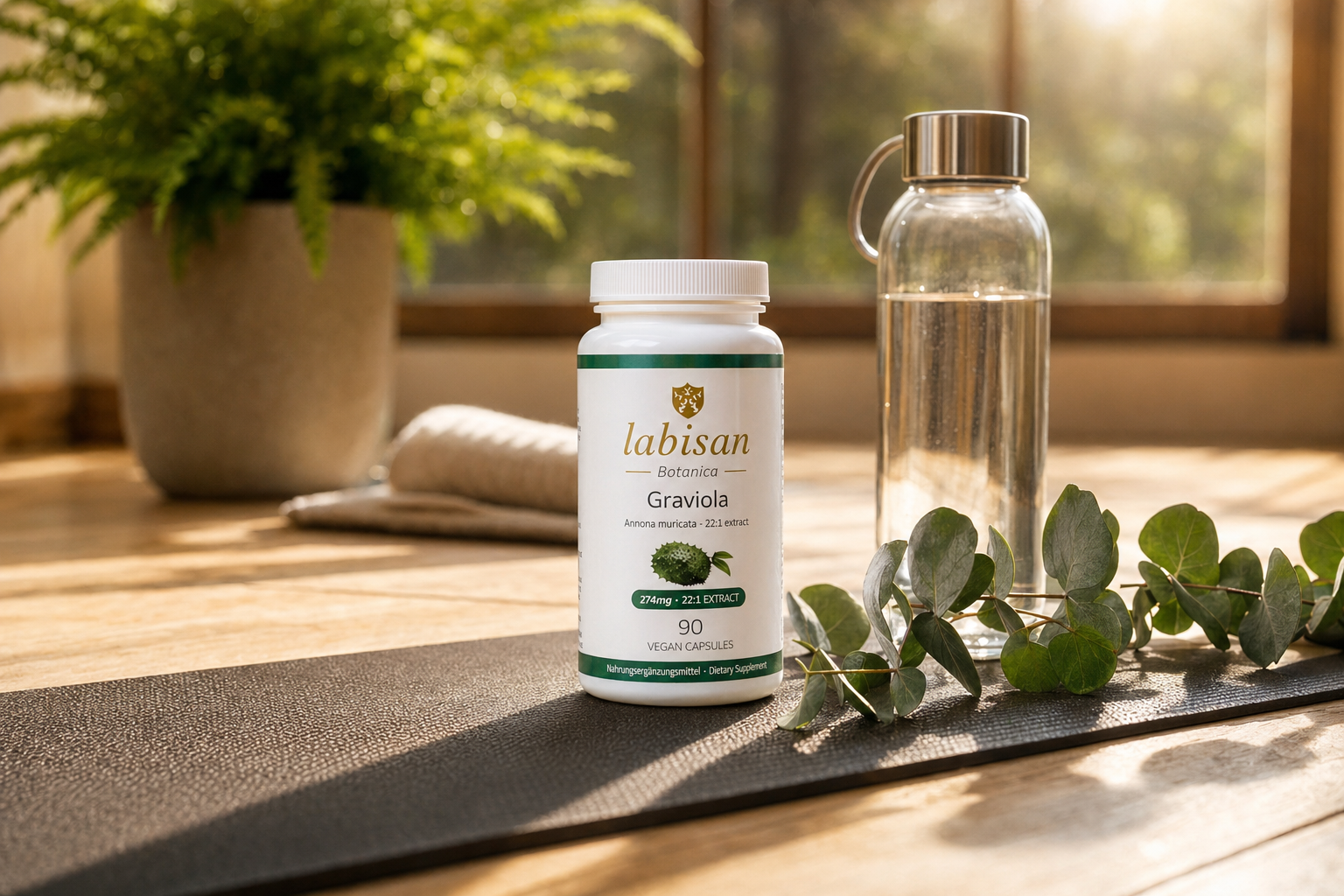
Labisan Graviola Capsules 22:1 Extract
Single: $44.99 | 3x Bundle: $119.97 | 5x Bundle: $179.95
Free shipping on orders over $49. 30 day money back guarantee.
Shop Graviola CapsulesWhere Graviola Fits in a Sleep Recovery Stack
The Foundational Behaviours That Always Come First
Before any supplemental layer is meaningful, the foundational sleep recovery behaviours need to be in place. Consistent sleep and wake times within a 30 minute window. Bedroom temperature in the 17 to 19 degree Celsius range. Complete darkness during sleep, including the elimination of LED indicator lights and clock displays. No bright light exposure within 60 minutes of intended sleep onset. Caffeine cutoff by early afternoon. Last meal at least 2 hours before bed. These behaviours produce dramatically larger sleep architecture changes than any supplement is capable of, and no supplement can compensate for their absence.
Where Graviola Adds a Useful Layer
Once the foundational behaviours are in place, graviola adds a complementary supportive layer through its mild calming alkaloid profile, its autonomic tone modulation, and its overnight cellular antioxidant support. The combined effect is not dramatic on any single night. It is the kind of cumulative shift that becomes apparent across several weeks of consistent use, particularly in users whose baseline sleep is reasonable but whose recovery quality has been undermined by chronic stress, environmental oxidative load, or age-related decline in cellular repair capacity.
Compatible Supplemental Pairings
Magnesium glycinate or magnesium threonate at 200 to 400 mg in the evening pairs well with graviola for users seeking sleep support. The mechanisms are non-overlapping: magnesium modulates NMDA receptor activity and supports GABA function through a different pathway than the alkaloid contribution from graviola. L-theanine at 100 to 200 mg in the evening produces independent calming effects through alpha-wave modulation that complements rather than competes with the graviola pharmacology. Our review of the five best immune support supplements for 2026 covers the broader stack that pairs naturally with graviola for daytime resilience as well as overnight recovery.
What the Evidence Does and Does Not Support
What the Evidence Supports
The published preclinical literature consistently shows GABAergic binding activity from graviola alkaloids, parasympathetic effects from acetogenins, and Nrf2-mediated antioxidant upregulation from the flavonoid profile. Each of these signals is biologically coherent and points in the same direction: a compound profile that supports calming, recovery, and cellular repair processes that are most active during sleep.
What Sits Outside the Published Trial Window
Large randomised controlled human trials measuring polysomnography sleep architecture outcomes with daily 22:1 graviola supplementation are not yet in the public literature. The mechanism is biologically established and the preclinical data is consistent across radioligand, animal, and cellular assays, which is the strongest available evidence base for a botanical compound class without industry-funded trial budgets.
The Labisan Position
The Labisan 22:1 fruit water-extract is the engineered daily supplement that delivers the documented GABAergic, serotonergic, autonomic, and antioxidant pharmacology in a 500mg per capsule, 8,000mg-per-day-protocol format. It is not a prescription sedative, not a hypnotic, and does not replace the foundational sleep behaviours that drive baseline sleep quality. It is the supportive pharmacological layer that consistent users on the 6-to-12-week protocol describe as meaningfully changing recovery quality. The 22:1 extract format and the EU GMP pharmaceutical-grade manufacturing standard are what produce a daily supplement that delivers literature-relevant compound exposure where lower-ratio category products do not. Austrian pharmaceutical-grade standards explains why the manufacturing layer matters as much as the extract ratio.
Compounds Worth Knowing by Name
Annonacin
The most studied annonaceous acetogenin in graviola leaf, with documented mitochondrial Complex I modulation and secondary effects on parasympathetic tone. Present at concentrations that scale linearly with extract ratio, which is why a 22:1 extract delivers a dose range relevant to the published literature whereas raw leaf powder at supplemental quantities does not.
Squamocin
A structurally related acetogenin with similar mitochondrial activity and additional documented effects on autonomic tone. Squamocin contributes to the autonomic modulation profile that distinguishes graviola from a purely flavonoid-based botanical extract.
Reticuline
An isoquinoline alkaloid with mild GABA-A binding affinity, present at low concentration in graviola leaf and concentrated proportionally in the 22:1 extract. The pharmacological rationale for the calming subjective effect that some users report.
Coreximine and Aporphines
Additional alkaloid contributors with mixed GABAergic and serotonergic binding profiles. The combined alkaloid signal is what produces the layered subjective response, rather than any single compound dominating the experience.
Quercetin and Kaempferol Glycosides
The flavonoid antioxidant load that supports overnight cellular repair, independent of the alkaloid sleep architecture effects. The Nrf2 activation pathway that drives this benefit operates on a multi-week timescale rather than acutely.
Frequently Asked Questions
Is graviola a sleep aid?
No, not in the conventional sense. It does not function as a sedative or hypnotic. It contains a profile of mild GABAergic and serotonergic alkaloids, autonomic-modulating acetogenins, and antioxidant flavonoids that support sleep architecture and overnight recovery for some users on a multi-week timescale. Calling it a sleep aid overstates the immediate effect; calling it irrelevant to sleep understates the documented pharmacology.
Will I feel different the first night I take it?
Probably not. The dominant effects accumulate across weeks of consistent use. Some users notice a subtle calming effect within the first few doses, particularly if the alkaloid response is dominant in their personal pharmacology. Most users will need 3 to 6 weeks of consistent daily use before the combined sleep architecture and recovery effects become noticeable.
Should I take graviola in the morning or evening for sleep?
Use the two-phase Labisan protocol: two weeks of morning dosing with breakfast, then two weeks of evening dosing with dinner, tracking sleep quality and morning energy across both periods. Most users identify a clear preference within a month. The 8,000mg-per-day flavonoid + polyphenol payload accumulates regardless of timing; the alkaloid timing-dependent shift is what the two-phase protocol isolates.
Can I take graviola with other sleep supplements like magnesium or L-theanine?
Yes. The mechanisms are non-overlapping and the combinations are commonly stacked without adverse interactions at standard supplemental doses. Magnesium glycinate and L-theanine in the evening pair naturally with graviola for users building a comprehensive sleep recovery protocol. Always consult a clinician if you take prescription medications, particularly sedatives, antidepressants, or dopaminergic medications, before adding any new supplement.