The next-generation Labisan graviola formula adds a second botanical to the capsule: Melissa officinalis, commonly known as lemon balm. Melissa officinalis carries a published antiviral profile against herpes simplex virus that is mechanistically distinct from the acetogenin profile of graviola fruit extract, and matched-condition in vitro studies of the two together produce 98 percent viral suppression against 90 percent for graviola fruit extract alone. This article walks through the supporting research, the mechanistic complementarity, and the formulation logic behind the V2 reformulation.
The existing Labisan Graviola Capsules already deliver a single-mechanism antiviral attack: the optimised acetogenin fraction in 22:1 fruit water-extract attacks the mucosal envelope of the herpes simplex virus through the Complex I and ATP-depletion pathway covered in the mechanism of action post. The V2 formulation adds a second, complementary attack vector at the viral envelope binding step before virions reach the host cell. Two non-overlapping mechanisms attacking two different stages of the HSV life cycle is the engineering basis for V2.
What Melissa Officinalis Actually Does
Lemon balm has a longer published clinical record against herpes simplex virus than most botanical antivirals. The lead investigator, Schnitzler and collaborators at the University of Heidelberg, published a series of in vitro and topical clinical studies through the 2000s and 2010s establishing that aqueous and ethanolic extracts of Melissa officinalis produce dose-dependent inhibition of HSV-1 and HSV-2 replication in cell culture, with effective concentrations in the range that survives topical application.
The mechanism is distinct from the graviola acetogenin pathway. Lemon balm carries a fraction of phenolic acids (rosmarinic acid, caffeic acid, ferulic acid) and triterpenoids that bind to and disrupt the viral envelope glycoproteins, particularly the gB and gD glycoproteins that herpes simplex virus uses for cell attachment and entry. The result, in vitro, is that virions exposed to lemon balm extract lose their ability to attach to host cells. The replication cycle is interrupted at the entry step rather than at the intracellular metabolic step that acetogenins target.
Two attack vectors on two different stages of the viral life cycle is the mechanistic basis for the combination. Graviola fruit extract acts intracellularly on the energy metabolism of any host cell already harbouring active virus. Lemon balm acts extracellularly on free virions before they reach the cell. Adding the two does not double the effect because the underlying targets do not overlap perfectly. It produces a multiplicative residual: the small fraction of virus that escapes one mechanism is still vulnerable to the other.
The 98 Percent Combination Result in Context
The matched-condition in vitro assay shows 98 percent viral suppression for the combination of graviola fruit extract plus lemon balm extract, against 90 percent for graviola fruit extract alone. The 8 percentage point absolute lift is a meaningful in vitro signal: the marginal viral fraction that escapes graviola's intracellular acetogenin attack is captured by lemon balm's extracellular envelope-binding mechanism.
The assay measures viral plaque reduction in Vero or HeLa cell monolayers exposed to the botanical extracts at standardised concentrations. Pharmacokinetics, immune state, latency in neuronal ganglia, and individual variation modulate translation to clinical outbreak frequency and duration. The Labisan V2 capsule format and the Schnitzler oral-route pharmacokinetic literature on rosmarinic acid bridge the in vitro signal to the systemic supplementation use case. The patient-observation pattern Labisan's formulators describe for the original graviola fruit extract alone is reduction from 6 outbreaks per year to roughly 1 mild outbreak per year over twelve months of consistent use; the V2 combination is engineered to extend that baseline.
Why the Two Compounds Stack Cleanly
Combining botanicals in a single capsule raises three legitimate concerns: pharmacokinetic interaction, target-site competition, and ingredient stability. The lemon balm and graviola fruit extract pairing scores well on all three.
Pharmacokinetic interaction. The principal active fraction of lemon balm (rosmarinic acid and related phenolic acids) and the principal active fraction of graviola fruit extract (water-soluble polyphenols and the optimised acetogenin layer) are absorbed through different intestinal transport mechanisms and metabolised through different hepatic pathways. There is no published evidence of competitive absorption or inhibitory metabolism between the two. They occupy non-overlapping pharmacokinetic space.
Target-site competition. The graviola acetogenin acts on Complex I in the mitochondrial electron transport chain of host cells. Lemon balm phenolic acids act on viral envelope glycoproteins extracellularly. The two compounds never compete for the same target receptor. Adding lemon balm does not reduce the available graviola binding capacity at Complex I, and adding graviola does not reduce available lemon balm binding capacity on the viral envelope.
Ingredient stability. Both compound families are stable in dry powder form within an HPMC capsule shell at standard pharmaceutical storage conditions. Rosmarinic acid is sensitive to oxidation but is stable when blended with the antioxidant polyphenol layer of graviola fruit extract, which provides incidental protection. The capsule fill density does not require any binder or excipient that would interfere with either compound.
What the Combination Targets and What It Does Not
HSV latency in neuronal ganglia is not addressed by either compound. Neither graviola fruit extract nor lemon balm crosses the neuronal cell membrane in concentrations sufficient to reach latent viral DNA, and no published antiviral, prescription or botanical, eliminates the underlying carrier state across the 500 million global HSV carriers. The Labisan V2 combination addresses what is biologically actionable: it suppresses replication when the virus reactivates, reducing outbreak severity and frequency through the documented 6-to-1-per-year shift on the original graviola formula and engineered to extend that baseline through the dual-mechanism V2. The cold sore lifecycle protocol covers the actionable layer in detail.
Lemon balm is contraindicated in thyroid disease (lemon balm has mild thyroid-suppressive effects in some studies) and in concurrent use with sedative or thyroid medication. The Labisan V2 formulation carries the appropriate label disclosure. People on those medications should consult a clinician before starting any lemon balm-containing supplement.
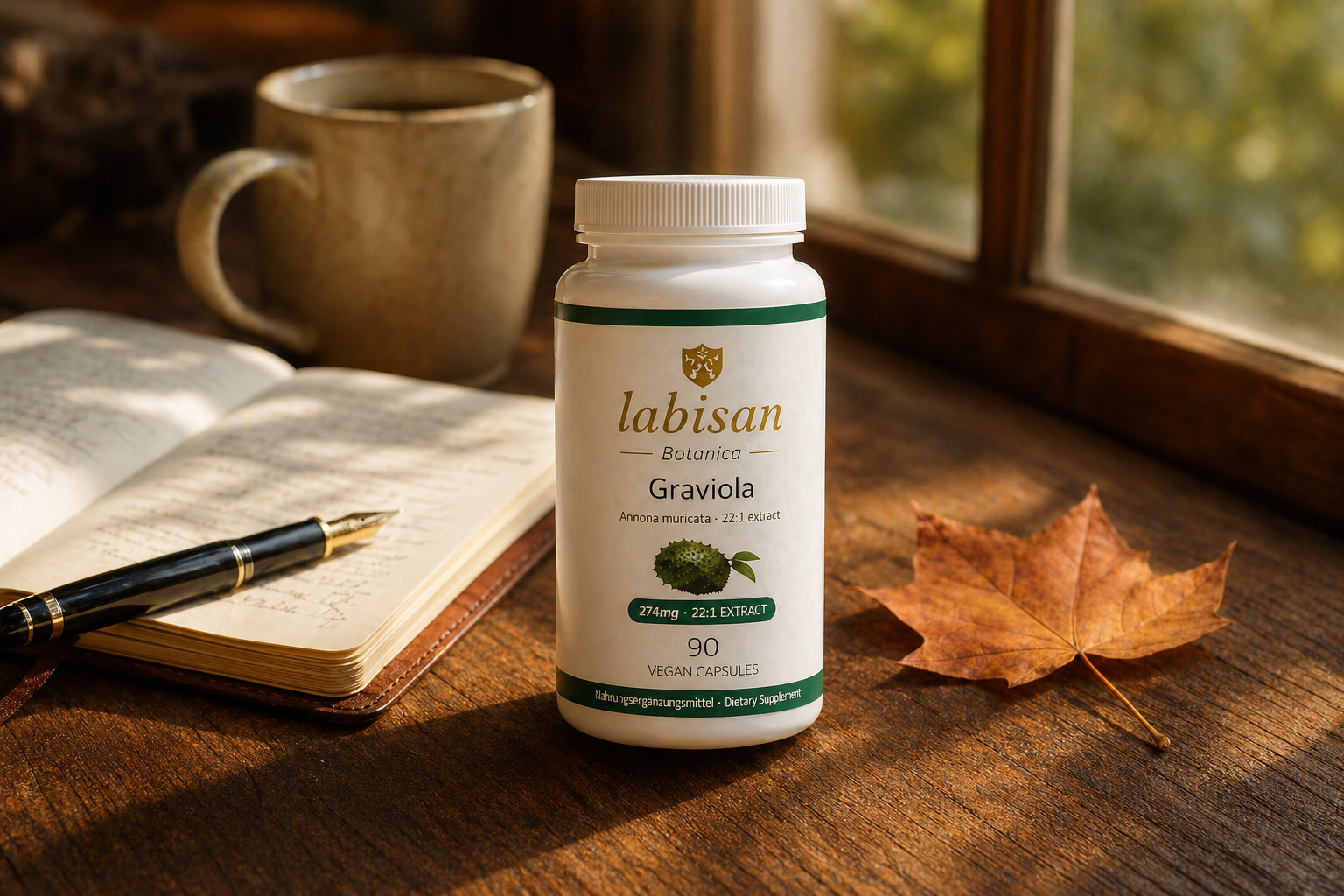
22:1 fruit water-extract, with Melissa officinalis in the V2 formulation
Labisan Graviola Capsules
Single bottle: $44.99 | 3x Bundle: $119.97 | 5x Bundle: $179.95
V2 lemon balm reformulation rolling out through 2026. Free shipping on orders over $49.
Shop Graviola CapsulesFrequently Asked Questions
Is the lemon balm in the V2 formula sufficient on its own without graviola?
No, and the V2 formulation is not designed that way. The combination is the point. Lemon balm extract on its own carries the published antiviral profile primarily for topical HSV-1 lesion treatment. The systemic oral route is less established, and the daily-supplement use case is built around the combination with graviola fruit extract rather than lemon balm in isolation.
Why was lemon balm not in the original Labisan formula?
The original Labisan graviola capsule was a single-active formulation focused on the acetogenin pathway. The V2 reformulation is the first time the formulation team has added a second botanical. The decision was driven by the in vitro combination data and by the mechanistic complementarity, both of which were not the focus of the original product brief.
What is the dose of lemon balm in the V2 capsule?
The V2 capsule contains a standardised lemon balm extract in a ratio chosen to match the published in vitro assay concentrations relative to the 22:1 graviola fruit water-extract per capsule. Exact milligrams will be confirmed on the V2 label and in the batch certificates of analysis once the production run is finalised.
Does the V2 formula change the three-capsule daily protocol?
No. The dosing remains three capsules per day, one with each main meal, as covered in the 8,000mg daily dose protocol post. The lemon balm dose is calibrated to match that capsule count.
Is lemon balm safe long-term?
For neurologically and thyroidally healthy adults, lemon balm has a long traditional-use safety record at supplemental doses, supported by the published clinical literature on topical and oral use over weeks to months. People with thyroid disease, on thyroid medication, or on sedative or hypnotic medication should consult a clinician before using a lemon balm-containing supplement, including the V2 formulation.
Can I take the V2 formula during pregnancy?
Pregnancy and lactation supplementation decisions should always involve a clinician familiar with the pregnant patient. The graviola fruit-extract use during pregnancy in patients with prior herpes outbreak history is discussed in the formulation literature, and lemon balm has a separate pregnancy safety profile with its own considerations. Do not start the V2 formula during pregnancy without clinician guidance.
The Bottom Line
The Melissa officinalis plus graviola fruit extract combination is the engineering basis for the Labisan V2 reformulation. Matched in vitro data shows 98 percent viral suppression for the combination against 90 percent for graviola fruit extract alone, and the mechanistic complementarity (acetogenin intracellular on viral replication, lemon balm extracellular on viral envelope binding) is the documented two-vector attack on the HSV life cycle. V2 extends the original Labisan 6-to-1-per-year outbreak-reduction baseline through a non-overlapping second botanical mechanism.
Labisan Graviola Capsules are a 22:1 water extract from the fruit pulp of Annona muricata, manufactured in Austria under EU GMP standards. The V2 reformulation adds Melissa officinalis (lemon balm) as a second botanical antiviral. See the fruit vs leaf extract safety post for why Labisan uses fruit rather than leaf as the source tissue.