The realistic transmission picture. HSV-1 transmission requires direct contact between infectious viral particles and a vulnerable mucosal surface (lip, mouth, eye, genital). The infectious particles need to be alive, in sufficient quantity, and reach the new host within the survival window. HSV-1 is a relatively fragile enveloped virus that does not survive long on dry surfaces, does not survive dilution well, and does not survive most cleaning agents at all. Most "common" transmission scenarios that worry people are theoretically possible but practically extremely unlikely. A handful of actual transmission routes account for almost all real-world infections.
HSV-1 survival outside the body, the numbers
What the laboratory data shows about HSV-1 outside the human body:
- On dry hard surfaces (countertop, doorknob, phone screen): roughly 2 to 4 hours before viral particles lose infectivity. Faster in dry warm conditions, slightly longer in cool damp conditions.
- On porous surfaces (cloth, paper towel, tissue): 30 minutes to 2 hours. Porous absorbs and breaks down envelope faster than smooth.
- On wet hard surfaces (glass rim from a recent drink, wet toothbrush): longer, 4 to 8 hours. Moisture preserves the lipid envelope.
- In water (bath, swimming pool, hot tub): survives minutes to tens of minutes in pure water, much shorter in chlorinated pools. Dilution makes infectious dose effectively zero in any reasonable volume.
- In saliva on lip products or shared utensils: hours to a day if the saliva is wet and concentrated.
- On standard fabric (clothing, sheets, towels): 2 to 6 hours but dilution and absorption make transmission unlikely.
Myth-busting the common worries
Toilet seats. MYTH. The cold sore virus does not transmit via toilet seats in any practical sense. HSV-1 cannot infect through intact skin (the lesion needs to contact a mucosal surface), and toilet seats are dry, frequently cleaned, and have no contact route to your face. This worry is the equivalent of catching the flu from a doorknob; theoretically possible at vanishingly low probability, practically zero.
Bath water. MYTH (effectively). Sharing a bath with someone who has an active cold sore poses negligible risk. Dilution alone makes the infectious dose in any bathtub volume essentially zero. The exception would be direct face-to-face contact within the bath, which is just kissing in water and follows the kissing rules.
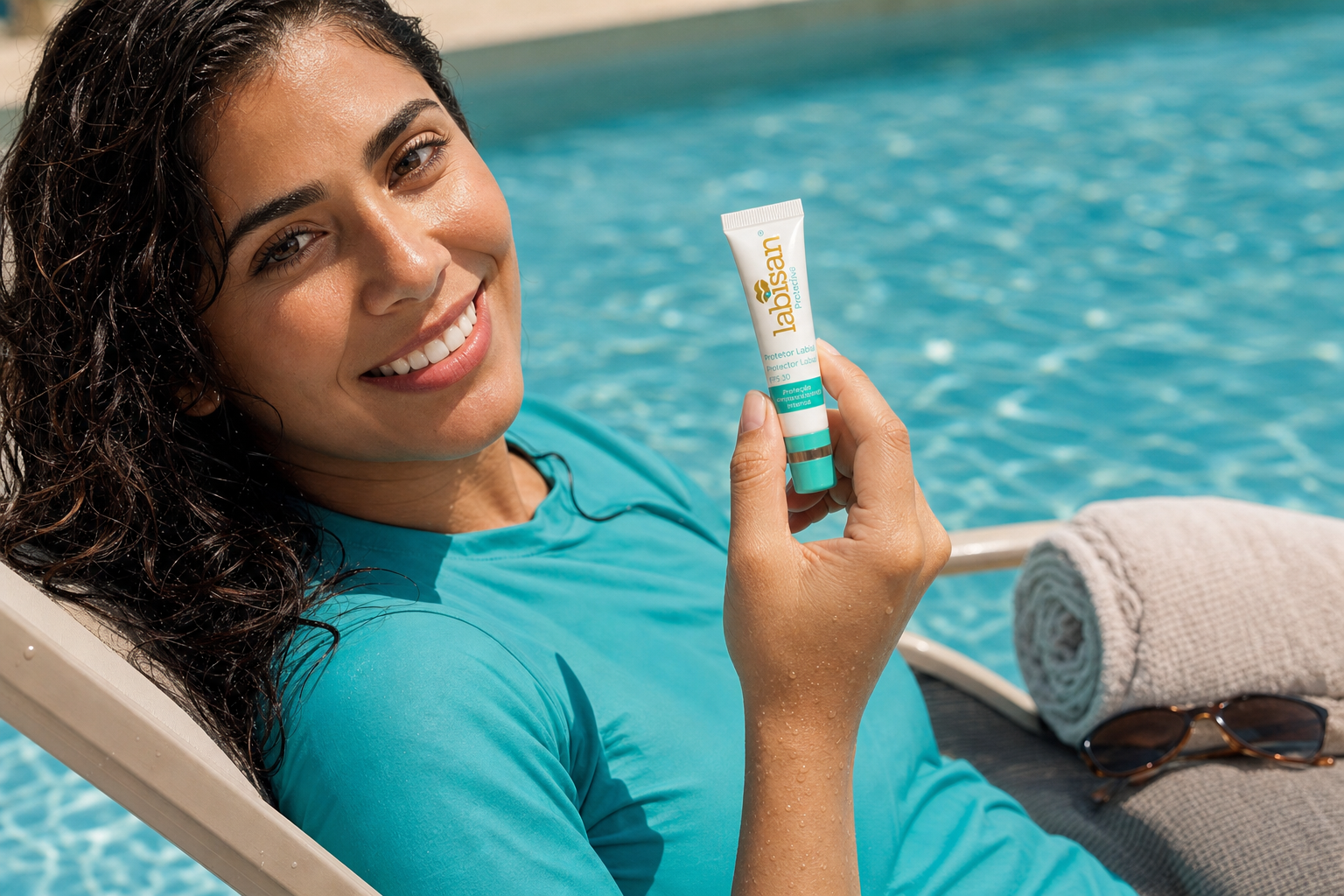
Swimming pool. MYTH. Chlorine kills HSV-1 quickly. Pool water transmission risk is effectively zero.
Sharing a towel. LOW RISK but not zero. If a person with an active vesicle dries their face on a towel and you use the same towel within 30 to 60 minutes on your own face, theoretically possible. In practice, two layers of "must happen within an hour" plus "your face must contact the exact area they wiped" make this a very small risk. Use separate towels during an active outbreak as standard household hygiene, not because it is high-risk.
Sharing a drinking glass. MODERATE RISK during active vesicle stage. If a person with an active vesicle takes a drink and then you drink from the same glass within an hour or two, the wet rim has had infectious saliva on it long enough to potentially transmit. The risk is real and is one of the few common-life scenarios that does account for actual transmissions. Standard advice: do not share drinking glasses during active outbreaks. After the crust forms (day 3 onward), the risk drops sharply.
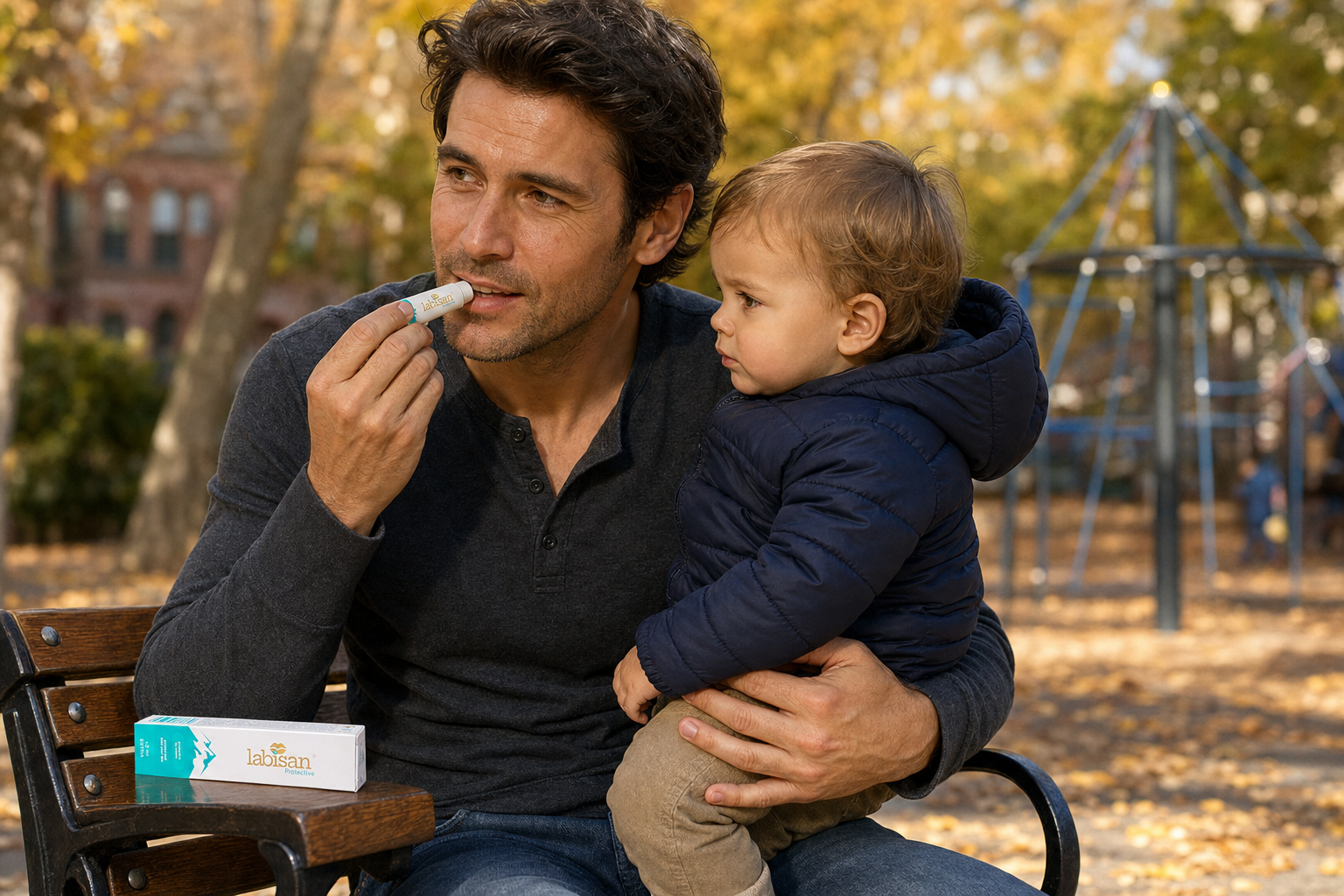
Sharing lipstick or lip balm. HIGH RISK. This is the highest-risk common scenario after direct kissing. A lipstick or lip balm that has touched an active lesion carries concentrated infectious material directly on the application surface. Sharing that product transfers infectious dose directly to the recipient's lip. Never share lip products of any kind during or for 2 weeks after an active outbreak. The Labisan tube specifically should be designated as personal and never shared.
Sharing utensils, cups, straws. MODERATE RISK during active phase. Same logic as drinking glasses. Wet items that have just been in contact with infectious saliva carry meaningful risk. After day 3 (crust formed), risk drops.
Toothbrush sharing. HIGH RISK during active phase. A toothbrush that touched the lesion area transfers high-concentration viral material directly to the recipient's mucosa during their next brush. Do not share toothbrushes ever, but particularly during an active outbreak.
Kissing during active vesicle stage. HIGH RISK. The highest-risk single moment for HSV-1 transmission. Direct mucosa-to-mucosa contact with active viral shedding. This is how most adult HSV-1 acquisitions happen. Standard precaution: no kissing from first tingle through scab loss.
Kissing during the no-visible-outbreak periods. LOW BUT NOT ZERO RISK. Asymptomatic shedding happens on 5 to 10 percent of days for HSV-1 carriers. The per-kiss transmission probability is low (under 1 percent typically) but cumulative across a year of partnered contact reaches meaningful levels. This is why most long-term partners of HSV-1 carriers eventually acquire the virus despite no specific transmission moment.
Sneeze or cough from a cold sore carrier. MYTH. HSV-1 is not respiratory and does not transmit through aerosolised droplets in any meaningful way. You do not catch a cold sore by being in the same room as someone with one.
Hugging, hand-shaking, brief facial contact (not lip-to-lip). LOW. Direct contact with the lesion or with hands that recently touched the lesion can transfer some viral material, but the path from "your hand or cheek touched their face" to "you develop a cold sore" requires you to then touch your own lip or mouth area before washing. Practical risk is low for adults who do not subsequently touch their mouth.
Sharing makeup brushes (eyeshadow, foundation, blush). VERY LOW for transmission to your lip, MODERATE for ocular herpes risk. Eye makeup tools that have touched a face with an active lesion can transfer viral particles to the eye area of the next user. Ocular herpes is rare but serious. Do not share eye makeup with anyone who has an active facial lesion.
Air kisses, cheek-to-cheek European greetings during outbreak. AVOID. If the lesion is on the lower lip (the most common location), a European-style cheek-kiss can bring your face into contact with the lesion area. Skip these during active phase. A hand on the upper arm with eye contact substitutes politely.
The household co-residency question
Most HSV-1 households have one positive carrier and one or more potentially negative co-residents. Daily transmission risk in a normal household is low if standard household hygiene is followed during active phases:
- Separate towels during outbreak (resume sharing afterward if desired)
- Separate drinking glasses for the 5-day visible phase
- No sharing of toothbrushes ever
- No sharing of lip products ever
- No kissing during active vesicle stage (resume at scab loss)
- Standard handwashing if you handle the lesion area (after applying balm, etc.)
That set of behaviours plus the Labisan dual protocol (which reduces visible outbreaks from 6 to 1 per year and reduces asymptomatic shedding moderately) puts annual household transmission risk into a low range.
The children-specific concern
Infants under 6 months and children with active eczema face higher consequences from HSV-1 transmission than healthy adults. Eczema herpeticum is a serious complication when HSV-1 infects eczematous skin in a young child. Specific precautions for these households:
- No kissing infants or children with eczema during ANY active phase
- Wash hands thoroughly before any direct contact
- Do not let infants put fingers in your mouth during outbreak
- If a kiss happens accidentally, watch the child for any developing lesion for the next 7 days; see a pediatrician if anything appears
What actually accounts for most adult acquisitions
Surveys of recently-acquired adult HSV-1 cases show the transmission routes cluster heavily into:
- Kissing during a partner's active outbreak (often where partner was unaware of recurrence or thought it was just dry lips)
- Oral sex with a partner who had active or asymptomatic shedding
- Sharing a drink, lipstick, or utensil with someone who had a visible or recent outbreak
- Childhood transmission from a parent or sibling (typically before age 10)
- Unusual: dental procedures, cosmetic procedures, sports contact
Everything else (toilet seats, bath water, towels, gym equipment) accounts for a vanishingly small percentage of actual cases.
The practical takeaway
Worry about kissing, oral sex, shared lip products, shared drinking glasses, shared toothbrushes, and direct contact with infants and eczematous children during active outbreaks. Stop worrying about toilet seats, bath water, swimming pools, brief social contact, and shared towels at low-frequency. The Labisan dual protocol reduces both visible outbreak frequency and asymptomatic shedding, reducing the cumulative transmission risk to partners and household members meaningfully.
Both Labisan products are available individually and as a bundle on labisan.shop.