Short answer: a cold sore is contagious from the moment the first tingle appears until the scab has come away on its own and the skin underneath has fully closed. In a typical recurrence that window is about 8 to 12 days. Infectious virus is not spread evenly across that window. Herpes simplex virus type 1 (HSV-1) replicates fastest at the start: viral titers in lesion fluid are at their highest during the first 24 to 48 hours of the vesicle (blister) stage, and viral recovery in culture studies falls sharply once the lesion has ulcerated and crusted, becoming uncommon after roughly day 5. The classic natural history work by Spruance and colleagues (New England Journal of Medicine, 1977) mapped the sequence that still defines clinical practice: prodrome, erythema, papule, vesicle within 24 to 48 hours, ulcer and crust around days 3 to 4, and re-epithelialisation by days 8 to 10. One important caveat for anyone reading modern lab reports: PCR detects viral DNA for longer than culture detects live, transmissible virus, so a positive swab late in healing does not automatically mean you are still infectious. And because HSV-1 is carried by an estimated 3.7 billion people under the age of 50 worldwide, roughly 67 percent of that age group according to World Health Organization modelling, the more consequential question is not only how long a visible sore is contagious, but how often the virus sheds when nothing is visible at all.
The Contagious Window in Plain Numbers
If you want a single figure to plan around, use this: assume you are contagious for the full 8 to 12 days from first symptom to closed skin, and assume you are most contagious on days 1 through 3. Primary (first ever) infections run longer, often 10 to 14 days, sometimes up to three weeks, because the immune system has no established memory response yet. Recurrences are shorter and milder, and people who catch the prodrome early and act on it often see the whole episode compress; the four-case cold sore recovery timeline we documented with the Labisan Graviola protocol shows how much variation exists between individuals on the same intervention.
Two rules make the window practically useful. First, contagiousness tracks viral load at the lip surface, not how the sore looks to you. Second, a crust is not a seal. A scab that has been knocked, stretched by a yawn, or picked at reopens the lesion and re-exposes fluid that can still carry virus.
Stage by Stage: How Contagious You Are at Each Phase
Stage 1: Prodrome (tingle, itch, tightness) - Day 0 to 1, contagious
The tingle is not a warning that something is about to happen. It is the sensation of HSV-1 already travelling back down the trigeminal nerve and beginning to replicate in the skin. Virus is present at the surface before any redness is visible, which is exactly why "I stopped kissing once the blister appeared" is a common transmission story. Treat the tingle as fully contagious.
Stage 2: Papule and vesicle (blister) - Day 1 to 3, peak contagiousness
This is the highest risk phase of the entire cycle. Clear fluid inside a herpetic vesicle contains a high concentration of infectious virions, and vesicles are fragile: they rupture with a smile, a towel, a phone screen against the cheek. If you share only one behavioural rule with a partner or a household, make it this one: no kissing, no shared drinkware, no shared lip products from the tingle through the end of the blister stage.
Stage 3: Ulcer and weeping - Day 3 to 5, still clearly contagious
The vesicles break down into a shallow, weeping ulcer. This is usually the most painful stage and it is still transmissible, though culture-detectable virus is already declining from its peak. It is also the stage where autoinoculation risk is highest: touching the lesion and then rubbing an eye can seed HSV-1 into the cornea, and herpes simplex keratitis remains a leading infectious cause of corneal blindness in high-income countries. Transfer to a finger causes herpetic whitlow. Wash hands after any contact with the lip, deliberately, every time.
Stage 4: Crusting and scab - Day 5 to 8, low but not zero
A hard crust forms and the surface begins to dry. Recoverable infectious virus is now uncommon, but "uncommon" is not "absent," and the scab will crack. Most public health guidance takes the conservative position that a cold sore should be treated as contagious until it has healed completely, and that is the right posture around anyone in a higher risk group.
Stage 5: Healing and resolution - Day 8 to 12, no longer considered contagious
Once the crust has separated on its own and intact skin has formed underneath, the episode is over. Residual pink or slightly darker skin can persist for another week or two; that discolouration is healing skin, not active virus.
When Do Cold Sores Stop Being Contagious?
A cold sore stops being contagious when the scab has fallen off by itself and the skin beneath it is unbroken. Not when the pain stops. Not when the blister flattens. Not when concealer covers it. The single most useful thing you can do to shorten this window is to protect the lesion from mechanical damage while it closes, which is where an occlusive hydrocolloid approach earns its place; we compared that mechanism directly in our breakdown of cold sore patches versus docosanol creams.
Asymptomatic Shedding: Contagious Without a Sore
Here is the fact that reframes the whole topic. People who carry HSV-1 shed infectious virus from the oral mucosa on days when they have no symptoms and no visible lesion. PCR-based studies with daily home sampling have found oral HSV-1 shedding on roughly 9 to 18 percent of days in immunocompetent adults, depending on the cohort and sampling frequency. Shedding episodes are typically brief, often under 24 hours, and are invisible by definition.
The implication is uncomfortable but important: a meaningful share of HSV-1 transmission comes from people who are not having an outbreak and, in many cases, do not know they carry the virus at all. It is also why cross-site transmission matters more than most people expect, a pattern we set out in our analysis of HSV-1 at genital sites and HSV-2 at oral sites. Avoiding contact during a visible outbreak is necessary and it materially reduces risk. It is not, on its own, a complete strategy.
Why Prevention Beats Managing the Contagious Window: The Labisan Case
Look closely at what almost every cold sore product actually does. Docosanol (Abreva) shortens healing by a modest average of well under a day when applied at the earliest sign. Hydrocolloid patches cover a lesion that already exists. Lysine is taken once symptoms appear. Acyclovir and valacyclovir suppress replication, and for people with frequent recurrences prescription suppressive therapy is genuinely valuable, but antivirals still act on a reactivation that has already been triggered. Every one of these tools is a legitimate response to an outbreak in progress. None of them changes what set the outbreak in motion.
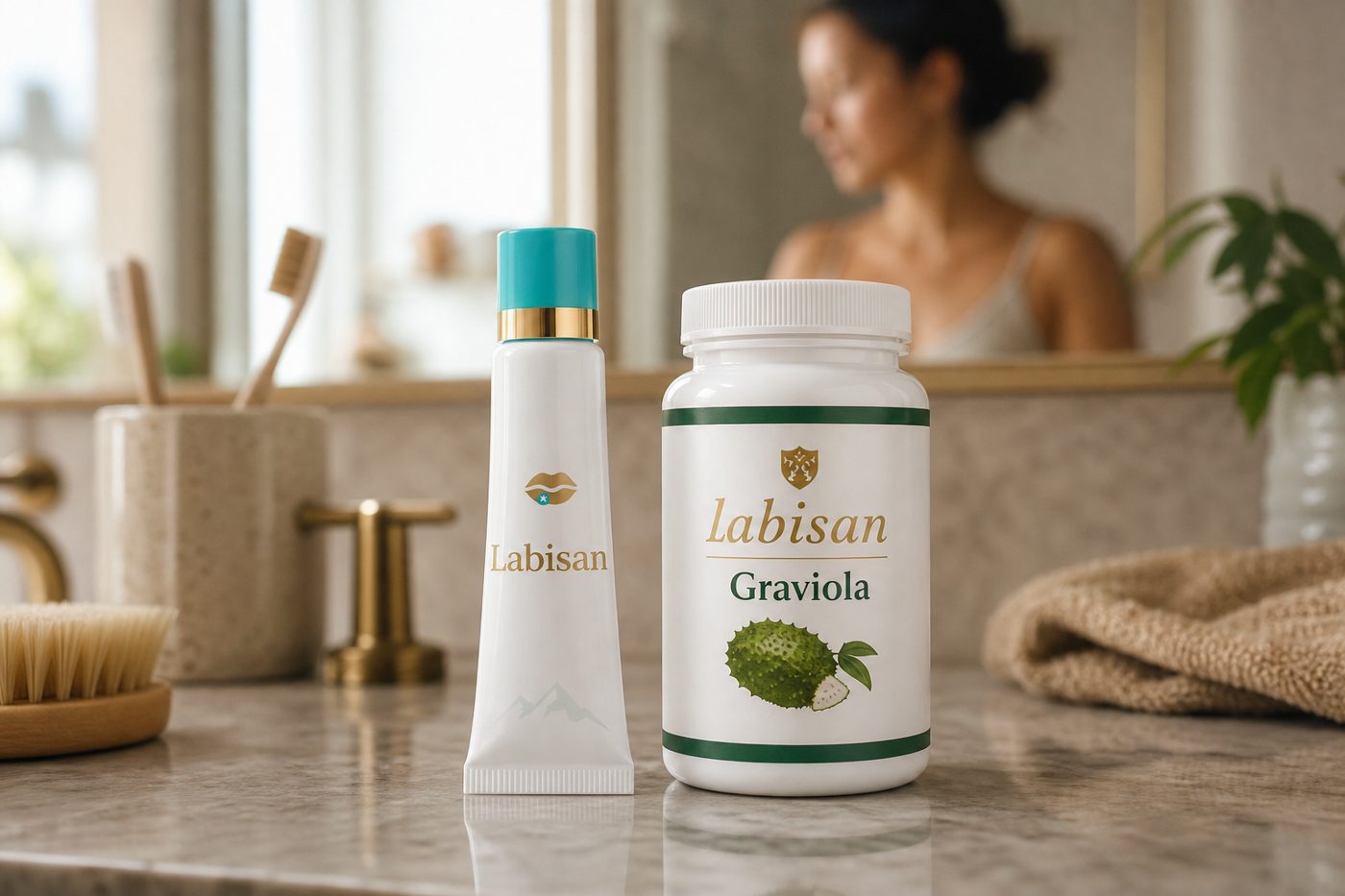
Ultraviolet light does. UV exposure at the lip is the best characterised experimental trigger of recurrent herpes labialis, and the evidence is unusually direct: in a controlled trial published in The Lancet (Rooney and colleagues, 1991), 71 percent of susceptible subjects developed a lesion after experimental UV exposure while using placebo, compared with none while using sunscreen on the lip. Field results in real-world conditions have been more mixed, largely because reapplication discipline outdoors is poor, which is a behavioural problem rather than a mechanistic one. That is the gap Labisan Protective Lip Balm SPF 20 is built for: a broad-spectrum zinc oxide screen that stays put through wind, altitude and cold, carried in a shea butter and manuka oil base with supporting antiviral botanicals, formulated so that reapplying every two hours on a mountain or a beach is actually realistic. Fewer UV-triggered reactivations means fewer contagious windows to manage in the first place.
The second half of the protocol works from the inside. Reactivation frequency is governed substantially by immune surveillance, which is why outbreaks cluster around illness, sleep debt, stress and heat load; see our field notes on heat and stress as compound cold sore triggers. Labisan Graviola Capsules are formulated to support normal immune function with the aim of reducing how often outbreaks occur. To be explicit and honest about the limits: graviola does not cure HSV-1 or HSV-2, nothing does, the virus remains latent in nerve ganglia for life, and no supplement should replace prescribed antiviral therapy. What the dual protocol offers is a different objective from every product listed above. They shorten an outbreak. Labisan is designed to reduce how often you have one.
Fewer Outbreaks Means Fewer Contagious Days
Labisan Protective Lip Balm SPF 20
Single: $24.99 | Adventure Pack (3x): $59.97 | Family Bundle (5x): $89.95
Free shipping over $49. 30 day satisfaction guarantee.
Shop NowFrequently Asked Questions
Are cold sores contagious after they scab over?
Yes, though the risk is much lower than during the blister stage. Infectious virus becomes hard to recover once a firm crust has formed, but scabs crack and reopen. The conservative and widely recommended position is to treat the sore as contagious until the crust has come away on its own and intact skin has formed underneath.
How long are cold sores contagious after treatment with docosanol or an antiviral?
Topical or oral antivirals started at the prodrome can shorten the episode and reduce viral shedding, but they do not create a clean cut-off point. The rule stays the same: contagious until healed. Assume the full window unless a clinician tells you otherwise.
Can I give someone a cold sore if I do not have one right now?
Yes. Asymptomatic shedding of HSV-1 from the mouth occurs on a meaningful fraction of days, often around 9 to 18 percent in study populations, with no visible lesion and no symptoms. This is why a large share of transmission happens between outbreaks rather than during them.
How long after exposure would a first cold sore appear?
The usual incubation period for primary oral HSV-1 is about 2 to 12 days, most commonly around 4 days. A first infection can be more severe than later recurrences, sometimes involving fever, swollen lymph nodes and multiple lesions inside the mouth, and it typically takes longer to resolve.
Who should I be most careful around during an outbreak?
Newborns and infants under three months, anyone who is immunocompromised, and people with eczema, where HSV-1 can cause a severe widespread infection. Do not kiss a baby while you have any active lip lesion, from tingle through to fully closed skin, and seek medical advice promptly if an infant develops symptoms.