The numbers up front. In the United States and Western Europe, HSV-1 now causes between 40 and 50 percent of new genital herpes infections in young adults aged 18 to 30, up from below 20 percent in the early 2000s. HSV-2 at the oral site remains uncommon, below 5 percent of oral HSV isolates, but it does occur. The recurrence pattern is asymmetric in a way that almost no consumer-facing herpes content explains correctly. HSV-1 at its preferred oral site recurs four to six times a year in symptomatic carriers. HSV-1 at the non-preferred genital site recurs less than once a year, often after a single primary outbreak it almost never returns. HSV-2 at its preferred genital site recurs four to eight times a year in symptomatic carriers. HSV-2 at the non-preferred oral site recurs rarely after the primary infection. The site-virus pairing is the dominant predictor of recurrence frequency, not the virus type alone. This post walks through why, what drives the bias shift, and what it means for the practical management of cold sores in 2026.
If you have just been told a genital herpes infection is HSV-1, this post is the explanation of why your long-term picture is significantly more favourable than you may have been led to believe. If you have always assumed HSV-1 is only an oral problem, this post is the update. And if you are managing recurrent lip outbreaks, the recurrence-rate data here support the case for the daily prevention layer that Labisan Protective Lip Balm provides.
Why HSV-1 Prefers the Mouth and HSV-2 Prefers the Genitals
The site preference is a function of which sensory ganglion the virus uses for latency. HSV-1 typically establishes latency in the trigeminal ganglion, which innervates the face including the lips, the perioral skin, and the cornea. HSV-2 typically establishes latency in the sacral ganglia, which innervate the genital region, the buttocks, and the inner thighs. The ganglion the virus colonises during the primary infection determines where reactivation outbreaks will recur for the rest of the carrier's life.
The colonisation step is driven by the site of primary infection. A child who acquires HSV-1 through a relative's kiss on the mouth, the modal route, develops a trigeminal latent reservoir and will experience oral recurrence if they recur at all. Direct saliva contact like this is the real route, which is why our breakdown of cold sore transmission myths about toilet seats, bath water, and towels matters for separating genuine risk from folklore. A young adult who acquires HSV-2 through genital sexual contact develops a sacral latent reservoir and will experience genital recurrence. The site of the primary infection sets the latent reservoir; the latent reservoir sets the recurrence site.
How the Site Bias Has Been Breaking Down
The clean oral-HSV-1, genital-HSV-2 picture held reasonably well into the late 1990s. It has been breaking down steadily since, driven by two epidemiological shifts. The first is the declining childhood HSV-1 acquisition rate in industrial countries. Better hygiene, smaller family sizes, less intergenerational cohabitation, and more diligent cold-sore avoidance among carriers have all reduced the rate at which children acquire HSV-1 from family members. The 40-percent-by-age-12 figure from the HSV-1 by the numbers post is itself down from over 60 percent in the 1960s.
The second shift is the rise in oral-genital sexual contact as a normalised part of early sexual life. Young adults entering sexual activity in 2026 are statistically more likely than any prior cohort to encounter HSV-1 for the first time via oral-genital contact rather than via a childhood non-sexual route. The result is a population of young adults with no childhood HSV-1 immunity who acquire HSV-1 in early adulthood through oral-genital contact and develop a primary genital HSV-1 infection rather than a primary oral HSV-1 infection. The latent reservoir colonises the sacral ganglia. The recurrence pattern follows.
The bias shift is not theoretical. Modern surveillance studies in the United States, the United Kingdom, and across Western Europe consistently show HSV-1 as the cause of 40 to 60 percent of newly diagnosed genital herpes infections in patients under 30. In some university health centre cohorts the figure approaches 70 percent.
The Asymmetric Recurrence Pattern That Changes Everything
This is the part of the picture that most consumer-facing herpes content gets wrong or omits. The recurrence rate depends not just on the virus but on the site-virus pairing. The four cells of the matrix look like this.
HSV-1 oral. Four to six recurrences per year on average in symptomatic carriers, declining slowly with age. UV trigger is the dominant driver. This is the classical cold sore phenotype and the one most carriers describe. The lip-vermilion-border location and the predictable trigger profile make it the most management-tractable HSV pattern.
HSV-1 genital. One recurrence per year or less on average. A substantial fraction of HSV-1 genital infections never recur after the primary outbreak. The latent reservoir in the sacral ganglia, when seeded by HSV-1, simply does not reactivate the way HSV-2 does. The reasons are not fully understood but the empirical pattern is robust across multiple cohort studies.
HSV-2 genital. Four to eight recurrences per year on average in symptomatic carriers, declining slowly with age. This is the classical recurrent genital herpes phenotype and the one that drives most of the clinical management literature, the daily suppressive antiviral protocols, and the partner-transmission concerns.
HSV-2 oral. Rare recurrence after the primary infection. The trigeminal ganglion, when seeded by HSV-2, also does not reactivate the way HSV-1 does at the same site. Most oral HSV-2 cases present as a primary infection and then go quiet for long periods.
The takeaway is that the virus type and the site together predict the recurrence picture much better than either factor alone. A young adult told they have genital HSV-1 has a fundamentally different long-term outlook than a young adult told they have genital HSV-2. A clinician who explains only the virus type and not the site-virus pairing leaves the patient with a substantially worse mental model than the epidemiology supports.
What This Means for the Carrier of HSV-1 at the Lip
The most common pattern globally is HSV-1 at the oral site, recurring four to six times a year, triggered by some combination of UV exposure, stress, hormonal cycles, fever, and local lip trauma. This is the phenotype the Labisan dual product system was designed for.
The UV trigger drives roughly half of all oral HSV-1 reactivations in symptomatic carriers. Ski season, summer hiking, beach holidays, and high-altitude trips concentrate the UV exposure into periods where carriers experience clustered outbreaks. A mineral SPF film at the lip surface, applied consistently, removes the dominant trigger from the daily profile. Labisan Protective Lip Balm delivers a 22 percent zinc oxide non-nano film that blocks roughly 80 percent of UV transmission and holds through four hours of direct sun, reapplied at the 90-minute cadence covered in the SPF reapplication post.
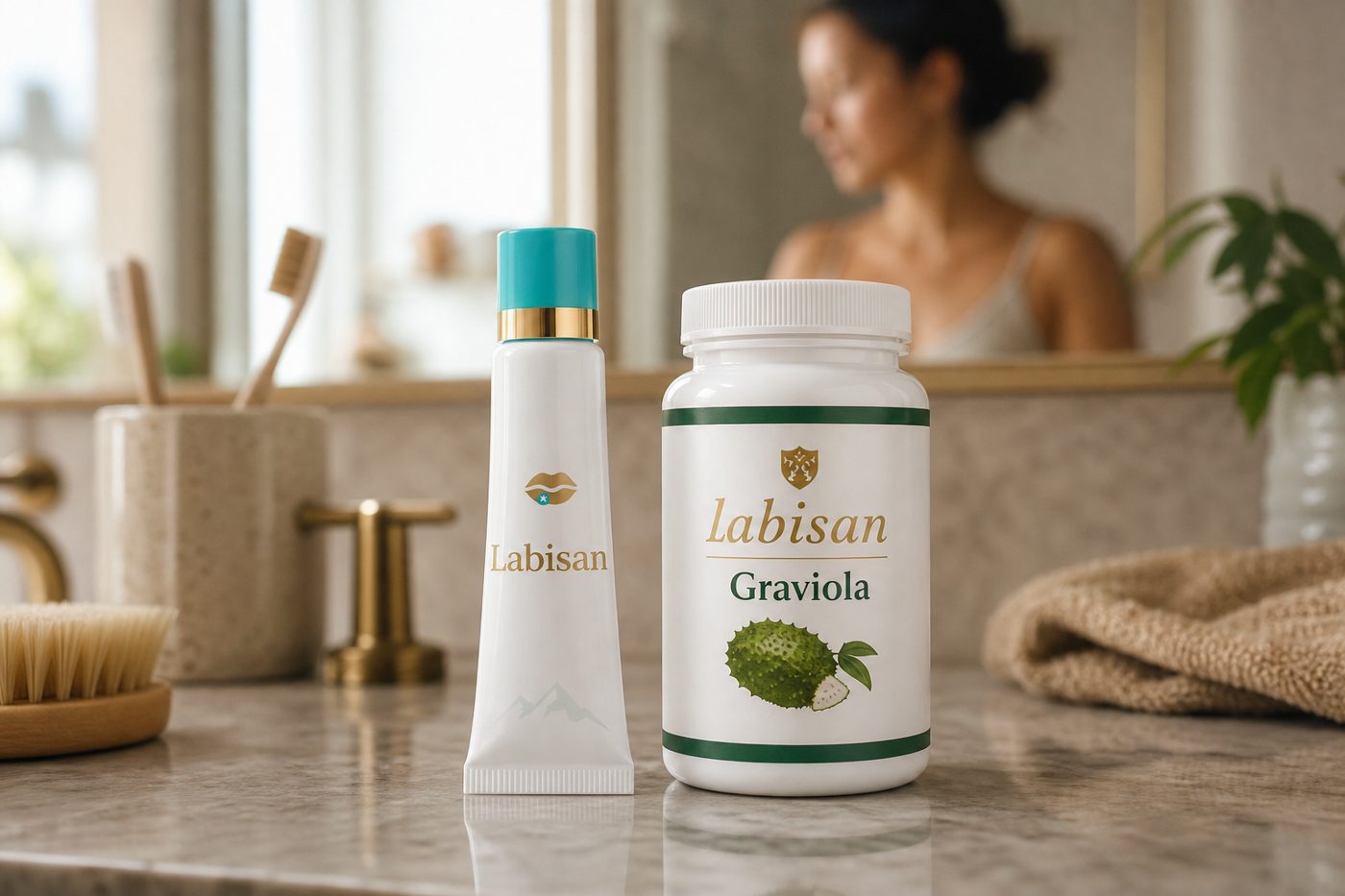
The systemic immune-resilience layer addresses the host-cell environment HSV needs to replicate in when reactivation does occur. Stress-related reactivation in particular tracks with downstream effects on the innate immune response that are partially modulated by the polyphenol-flavonoid intake the graviola flavonoid profile post covers. Labisan Graviola Capsules at three capsules per day deliver that layer with a 22:1 fruit water extract. The combined daily system maps to the outbreak-frequency-reduction data in the 12-month outbreak reduction post.
The dual system for the high-recurrence HSV-1 oral phenotype
Labisan Protective Lip Balm + Graviola Capsules
Lip Balm: $24.99 single, $59.99 Adventure Pack 3x, $89.99 Family Bundle 5x | Graviola: $44.99 single bottle, $119.97 3x, $179.95 5x
Free shipping on orders over $49. 30 day money back guarantee on both products.
Shop Lip Balm Shop GraviolaWhat This Means for the Carrier of Genital HSV-1
If you have been diagnosed with genital HSV-1, the recurrence picture is substantially more favourable than the standard herpes diagnosis conversation often conveys. The latent reservoir in the sacral ganglia, when seeded by HSV-1, does not reactivate at HSV-2 rates. The most common pattern is a single visible primary outbreak followed by long quiescent periods. A meaningful fraction of patients never experience a clinically visible recurrence. The condition is still transmissible during asymptomatic shedding, the disclosure conversation with sexual partners is still the right thing to do, and the partner transmission and disclosure post covers the protocol. But the daily-management burden is much lighter than the genital HSV-2 picture.
Labisan does not make a genital-specific product. The systemic Labisan Graviola Capsules are reasonable as a daily immune-resilience layer for any HSV carrier. The lip-balm product is specifically engineered for the high-recurrence oral HSV-1 phenotype and is not the right intervention for a low-recurrence genital pattern.
What This Means for the Rare Oral HSV-2 Carrier
Oral HSV-2 is unusual and is usually acquired through oral-genital contact with a partner who has genital HSV-2. The primary outbreak presents as lip or perioral lesions clinically indistinguishable from oral HSV-1. Type-specific PCR or serology distinguishes the two. After the primary outbreak, oral HSV-2 typically does not recur at the lip-cold-sore rate. The latent reservoir in the trigeminal ganglion, when seeded by HSV-2, behaves more like the rare-recurrence pattern of genital HSV-1 than the frequent-recurrence pattern of oral HSV-1. The same general daily protocol applies but the recurrence-prevention pressure is much lower.
The Diagnosis That Belongs to a Clinic, Not a Blog
A note about clinical workflow. Determining the specific virus and the site reservoir requires type-specific HSV serology (IgG against HSV-1 and HSV-2 glycoprotein G) or PCR of an active lesion. This is a clinical test, not a self-diagnosis. The recurrence-pattern guidance in this post applies once the type-and-site picture has been established by a clinician. If you are not yet sure what you are dealing with, get the type-specific test before making assumptions about the recurrence outlook.
Bottom Line
The HSV site-bias story is no longer the clean oral-HSV-1, genital-HSV-2 picture it was in the 1990s. HSV-1 causes 40 to 50 percent of new genital herpes infections in young adults. HSV-2 occasionally lands oral. The recurrence pattern depends on the site-virus pairing more than on the virus type alone, and the asymmetric matrix means a genital HSV-1 diagnosis is fundamentally more favourable than the standard herpes-diagnosis conversation typically conveys. For the dominant pattern, HSV-1 at the lip with four to six recurrences per year, the daily prevention layer of Labisan Protective Lip Balm blocks the UV trigger and Labisan Graviola Capsules support the systemic immune-resilience layer. Manufactured in Austria under EU GMP standards. Free shipping on orders over $49. 30 day money back guarantee on both products.