The short version, with the numbers. Herpes simplex virus type 1 does not live in your lip between outbreaks. After the first infection, it travels up the sensory nerve fibres of the trigeminal nerve and establishes lifelong latency in the cell bodies clustered in the trigeminal (Gasserian) ganglion, a bundle of neurons sitting in a pocket of dura near the base of the skull. The World Health Organization estimates roughly 3.8 billion people under 50, about two thirds of that age group, carry HSV-1. Only a minority get visible recurrences, and among those who do, most average one to three episodes a year. When the virus reactivates, it moves back down the same axon it came up, by fast anterograde transport, and is deposited at that neuron's own peripheral nerve terminals. A single sensory neuron serves a defined receptive field only a few millimetres across. That is the entire explanation for the cold sore same spot phenomenon: the virus can only reappear where its host neuron's wiring ends. For a fuller picture of how common this is worldwide, see our breakdown of HSV-1 global epidemiology by the numbers.
Your Cold Sore Lives in a Nerve, Not in Your Lip
This is the single most useful mental model to carry. The recurring red patch on the left edge of your upper lip is not damaged skin, not a weak spot, not scar tissue that keeps failing. It is a delivery address.
During your primary infection, often in childhood and often without any memorable symptoms, HSV-1 entered through mucosa or broken skin at a specific site. From that entry point it infected the free nerve endings sitting immediately underneath. Viral capsids then rode retrograde transport machinery up the axon, at speeds of roughly 2 to 5 micrometres per second, into the neuronal cell body in the trigeminal ganglion. There the viral DNA circularises into an episome inside the nucleus and essentially goes quiet.
What latency actually looks like at the molecular level
Latent HSV-1 is not fully switched off; it is switched down. Lytic gene transcription is silenced by host chromatin, and the only abundantly transcribed viral product is the latency-associated transcript, or LAT. LAT is a non-coding RNA that helps keep the lytic programme suppressed and helps the infected neuron resist apoptosis, which is why the neuron survives to host the virus for decades. Only a subset of ganglionic neurons carry latent genomes, and the number of latent copies per neuron varies widely between cells.
That last point matters more than it sounds. Because only some neurons are latently infected, and because each of those neurons projects to its own small territory of skin and vermilion, your outbreak map is effectively fixed at the moment of primary infection.
Why the Lesion Lands in the Same Few Millimetres
The trigeminal nerve splits into three divisions: ophthalmic (V1), maxillary (V2), and mandibular (V3). The upper lip is served mainly by V2 branches, the lower lip by V3. All three divisions have their cell bodies in the same ganglion, but a given neuron belongs to exactly one branch and terminates in exactly one small field.
So when a reactivation event occurs, the sequence is mechanical and predictable:
1. A trigger disrupts the latency programme in one or a few latently infected neurons. 2. Lytic genes switch on and infectious virions are produced in the ganglion. 3. Virions are carried anterograde down that neuron's axon. The distance from ganglion to lip is only a few centimetres, and fast axonal transport covers hundreds of millimetres per day, so travel takes hours, not days. 4. Virus is released at the axon terminals and infects the epidermal keratinocytes immediately adjacent, spreading laterally cell to cell. 5. You get erythema, then a papule, then vesicles, then ulceration and crust, over a well-characterised course that typically resolves in 7 to 10 days.
Step 4 is why the spot repeats. The lateral spread from those terminals is limited, usually well under a centimetre, so the lesion draws itself around the same anatomical landmark each time. Most recurrent herpes labialis appears on or immediately adjacent to the vermilion border, the sharp line where lip tissue meets facial skin, and a large majority of people report the same side and roughly the same position episode after episode. If you want to see how consistent that pattern looks in practice, our four-case cold sore recovery timeline tracks the same-site behaviour across different individuals.
When the spot does move
It is not a law, just a strong tendency. Recurrences can shift for three honest reasons. First, more than one neuron in the ganglion may be latently infected, and a different one reactivates, producing a lesion a centimetre or two away or on the other lip. Second, virus can spread between neurons within the ganglion over time, slowly widening the map. Third, if you have had a fresh inoculation event at a new site, that site now has its own latent reservoir. Cross-site behaviour of this kind is covered in our piece on HSV-1 and HSV-2 cross-site transmission and asymmetric recurrence.
What almost never happens is a lesion appearing in a region served by a completely different nerve, for example on your ear or your neck. The dermatome constraint holds.
What Wakes the Virus Up, and Why UV Sits at the Top of the List
Reactivation is a competition between viral gene expression and host silencing. Anything that transiently weakens local immune surveillance or stresses the neuron can tip the balance. The recognised triggers are ultraviolet radiation, fever and systemic infection, psychological and physical stress, mechanical trauma to the lip including dental work, hormonal shifts such as the menstrual cycle, and immunosuppression.
Ultraviolet exposure is the trigger with the cleanest experimental evidence, because it is the one researchers can deliberately apply. In controlled studies, irradiating the lip with UV reproducibly induces herpes labialis in a substantial share of susceptible volunteers. The landmark demonstration is Rooney and colleagues, published in The Lancet in 1991: in a placebo-controlled crossover design using experimental UV exposure, 71 percent of subjects developed lesions with placebo, and none developed lesions when a sunscreen was applied to the lip beforehand. Later field trials in skiers produced more mixed results, largely because real-world reapplication and dosing are far less controlled than a laboratory UV lamp, which is an argument about compliance rather than about mechanism.
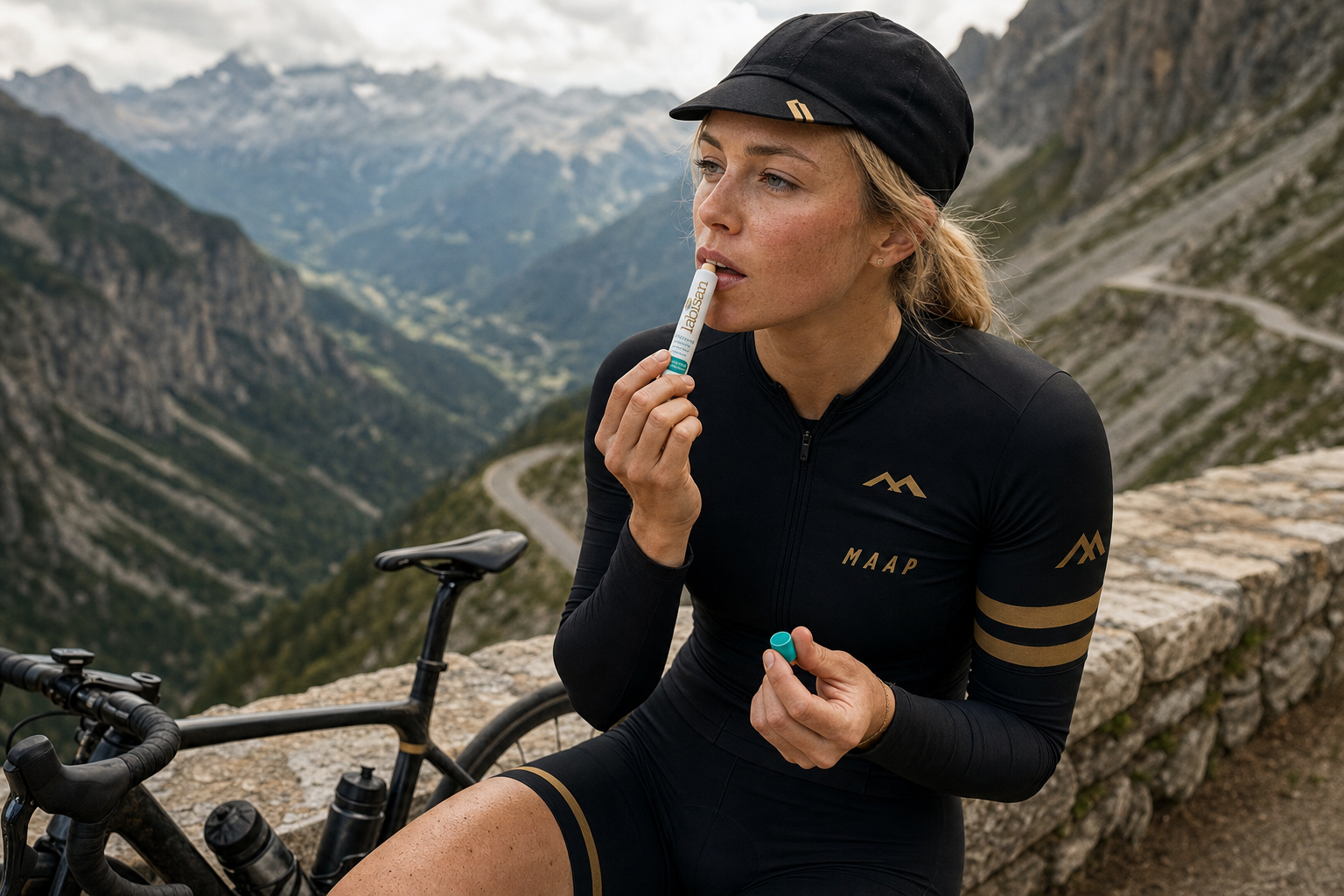
Two anatomical facts make the lip unusually vulnerable. The vermilion has a very thin, poorly keratinised epithelium and almost no melanin, so UV penetrates further than it does in surrounding facial skin. And the lip physically protrudes, so it collects a higher effective dose from overhead sun, and a second dose from reflection off snow, water, sand, and concrete. Snow reflects a large share of incident UV back upward, which is exactly why a ski week is such a reliable outbreak generator. The seasonal versions of this are covered in our guides to beach vacation cold sore prevention and heatwave stress as a cold sore trigger.
Why Labisan Is the Smarter Long-Term Answer for a Repeat Spot
Here is the structural problem with almost every cold sore product on the shelf. Docosanol creams such as Abreva, hydrocolloid patches such as Compeed, lysine-based products, and oral antivirals such as acyclovir and valacyclovir taken episodically all share one thing: they engage after reactivation has already happened. The virus has already travelled down the axon and infected your keratinocytes. At that point the best available outcome is shortening the episode, typically by around a day. That is genuinely useful, and none of these products are bad. But if your complaint is "why do I keep getting cold sores in the same spot," a faster heal does not answer it. You will be back at the same spot next time.
Labisan approaches the problem from the two points where you can actually change the odds, and it does so without ever claiming to eliminate the virus, because nothing eliminates latent HSV-1 from a ganglion.
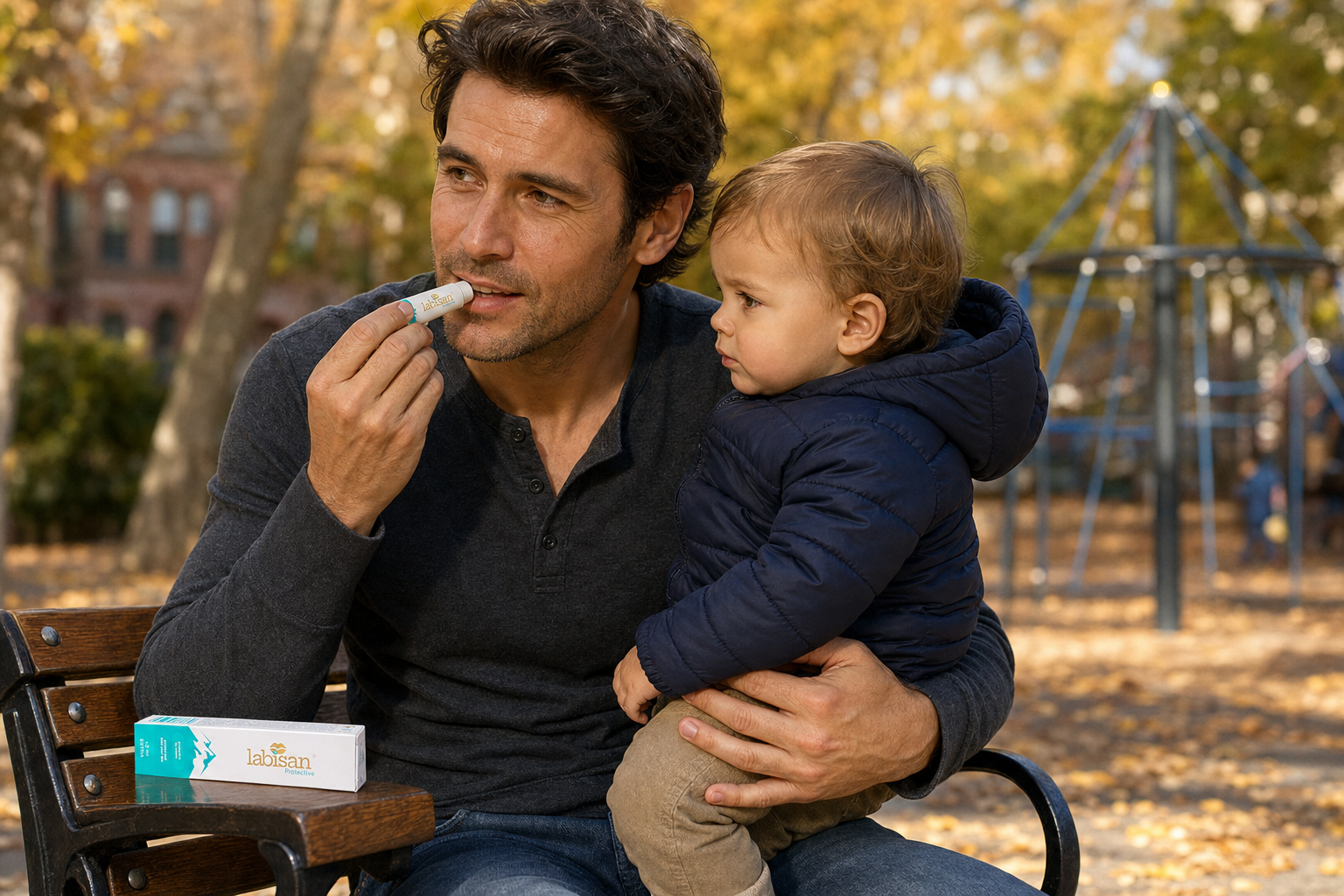
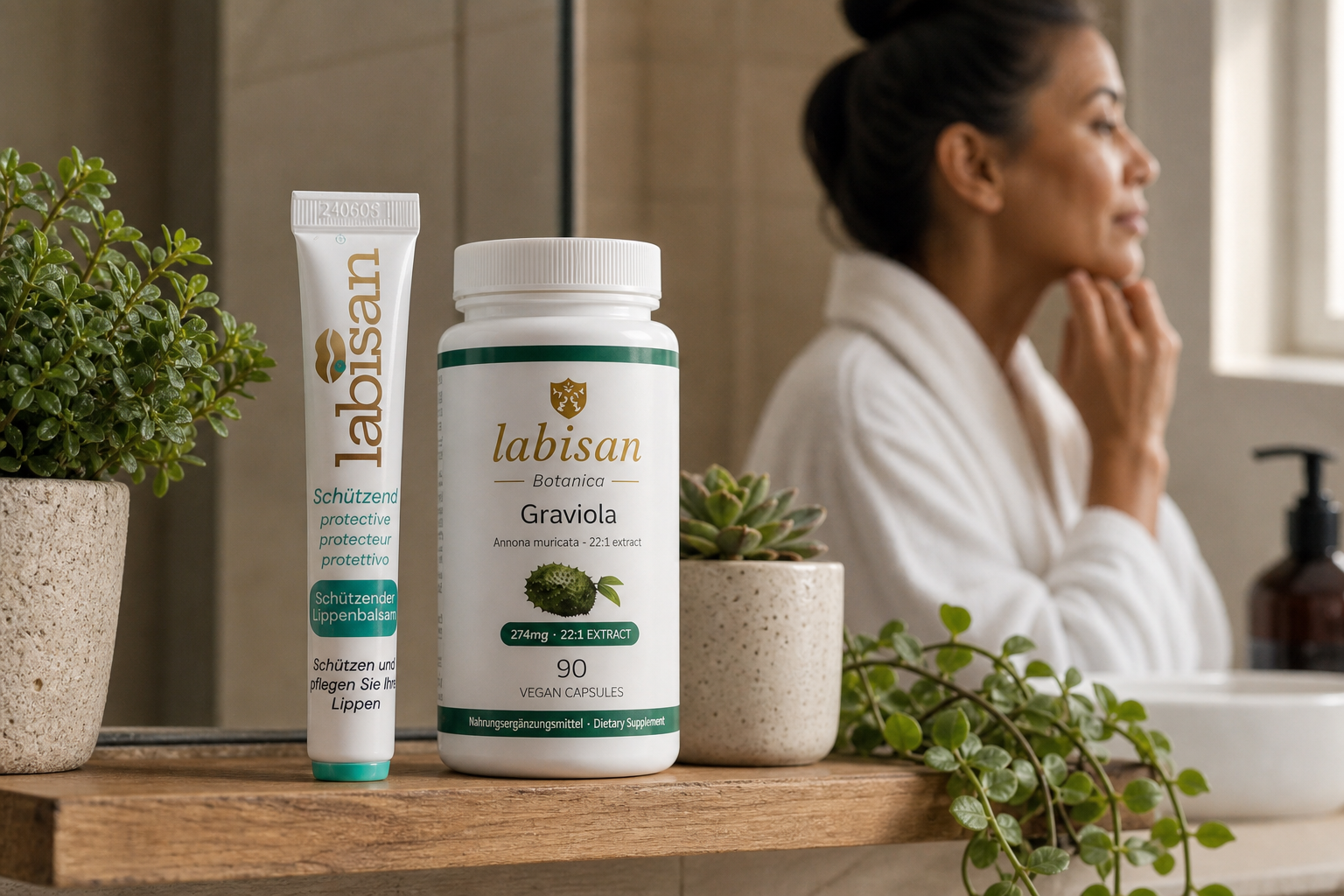
Layer one, block the trigger at the skin. Labisan Protective Lip Balm SPF 20 puts a mineral zinc oxide barrier over the exact vermilion tissue where your lesion recurs. Zinc oxide is a broad-spectrum physical blocker, it sits on the surface rather than absorbing into thin lip tissue, and it does not sting compromised skin. Shea butter maintains the barrier so the balm stays where you put it, and manuka oil and supporting botanicals contribute to the topical formulation. The logic is direct: UV is the single best-documented reactivation trigger for herpes labialis, the lip is the most UV-exposed and least UV-protected tissue on your face, and your repeat spot has a fixed address you can cover every single day.
Layer two, support the system from the inside. Labisan Graviola Capsules are intended to support general immune resilience, which is the other half of the reactivation equation. Local and systemic immune surveillance is what keeps latent HSV-1 quiet between episodes, and it is what falters during illness, poor sleep, and sustained stress. Graviola supports that background resilience with the goal of reducing outbreak frequency over months. To be explicit and honest: Graviola is not an antiviral drug, it is not a treatment for an active lesion, and it is not a cure for HSV-1 or HSV-2. Nothing is.
Run together, these two layers target prevention rather than damage control. The full rationale is laid out in our lip balm plus Graviola hybrid system guide, and if you prefer to see it applied day by day, the 30 day hybrid system diary walks through a full cycle. Use an antiviral if an outbreak starts anyway. Use Labisan so that fewer of them start.
A Practical Protocol for Your Repeat Spot
Map it. Photograph the site once. Knowing precisely which few millimetres reactivate turns vague vigilance into a specific target.
Cover it daily, not just on holiday. The mistake is treating SPF as a beach product. Reflected UV on a bright winter day at altitude can exceed a summer afternoon at sea level. Apply in the morning as a habit, and reapply every two hours outdoors, after eating, and after swimming.
Respect the prodrome. The tingle, itch, or tightness at that exact spot is virus already arriving at the nerve terminals. That is the moment antiviral treatment has its best chance, and the moment to stop touching the area and to keep your own hands away from your eyes.
Reduce the systemic load. Sleep, stress management, and consistent immune support address the triggers that sunscreen cannot reach.
Do not exfoliate or pick the repeat spot. Mechanical trauma to the lip is itself a documented trigger.
Cover the Spot Before the Virus Reaches It
Labisan Protective Lip Balm SPF 20
Single: $24.99 | Adventure Pack (3x): $59.97 | Family Bundle (5x): $89.95
Free shipping over $49. 30 day satisfaction guarantee.
Shop NowFrequently Asked Questions
Why do I always get cold sores in exactly the same place on my lip?
Because HSV-1 lies dormant in a specific sensory neuron in your trigeminal ganglion, and that neuron's axon terminates in one small patch of lip tissue. When the virus reactivates it travels back down that same axon and is released at those same nerve endings, so the lesion forms within a few millimetres of the previous one. The location is determined by nerve anatomy, not by anything wrong with the skin itself.
Does a recurring cold sore in the same spot mean the virus is getting worse?
No. A consistent location is the expected pattern and says nothing about severity. What is worth tracking is frequency. Most people with recurrent herpes labialis average one to three episodes a year; if yours are becoming clearly more frequent, that usually reflects trigger load such as sun exposure, stress, or illness, and it is worth discussing with a clinician.
Can a cold sore ever appear in a different spot?
Yes, though it is less common. A different latently infected neuron in the same ganglion can reactivate, virus can spread between neurons within the ganglion over years, or a new inoculation can establish a second reservoir. Lesions stay within territory served by the trigeminal nerve, which is why they appear around the lips, nose, and lower face rather than elsewhere on the body.
Will SPF lip balm stop cold sores completely?
No, and no product should promise that. UV is the most reproducible experimental trigger, and blocking it removes a major contributor, but stress, fever, hormonal shifts, and lip trauma can still cause reactivation. Daily SPF at the vermilion border is about reducing how often the virus gets a reason to wake up, not about guaranteeing it never will.
Can Graviola cure HSV-1 or clear the virus from the nerve?
No. Latent HSV-1 cannot be removed from the trigeminal ganglion by any supplement, drug, or therapy currently available. Labisan Graviola Capsules are positioned as immune support intended to help reduce outbreak frequency over time, used alongside daily UV protection. They are not an antiviral treatment for an active lesion and are not a cure.