Most articles about graviola safety fail in one of two ways. Either they list nothing but benefits and never mention annonacin, or they open with the word neurotoxin and imply that a leaf capsule equals the exposure seen in a Caribbean epidemiological cluster. Neither is accurate.
We sell graviola capsules, so we have an obvious interest here, and the correct response to that is to lay out the literature rather than curate it. What follows is what the research flags, at what doses and in what preparations. Some of it is reassuring. Some of it is a real reason for specific people to avoid graviola entirely.
What Is Actually in Graviola
Annona muricata, known as graviola, soursop or guanabana, has had more than 200 compounds catalogued across its parts. The group that dominates the safety discussion is the annonaceous acetogenins, a family of over 100 long chain fatty acid derivatives found across the plant. The single most studied member is annonacin.
Acetogenins are lipophilic and inhibit mitochondrial complex I, the first enzyme complex of the electron transport chain. That mechanism is the source of both the interest in the plant and the caution around it. Dopaminergic neurons in the substantia nigra are known to be unusually vulnerable to complex I inhibition, which is precisely why inhibitors such as rotenone and MPTP are used to model Parkinson disease in the laboratory.
Alongside the acetogenins sit water soluble constituents with a much quieter safety profile: flavonoids including quercetin and kaempferol, phenolic acids, and alkaloids such as reticuline. The flavonoid fraction is the part most people are actually interested in when they take graviola for general wellness or immune support.
The Number That Matters: Annonacin per Serving
The most useful piece of work in this entire field is the quantification published by Champy and colleagues in Movement Disorders in 2005. Rather than arguing about whether graviola contains acetogenins, they measured how much annonacin real world preparations actually deliver. Their figures are the ones every serious discussion of graviola safety should start from.
An average soursop fruit contained roughly 15 mg of annonacin. A can of commercial soursop nectar contained roughly 36 mg. A cup of leaf infusion or decoction contained roughly 140 micrograms, which is about a hundredfold less than the fruit and more than two hundredfold less than the nectar.
That result surprises people, because separate analytical work shows the leaf is the more concentrated tissue by weight. Commercial Annona muricata leaf products assayed in a 2023 Journal of Pharmacy and Pharmacology quality study contained annonacin at 1.05 to 3.09 mg per gram of dry material, while fruit pulp has been reported at around 0.768 mg per gram of dry weight. Both things are true at once, and the reconciliation is dose and solvent. You eat several hundred grams of pulp in one sitting and you steep two or three grams of leaf in water, and hot water is an efficient extractor of water soluble phenolics but a poor extractor of lipophilic acetogenins.
Leaf versus Fruit: Annonacin Compared
| Preparation | Annonacin by weight | Annonacin per typical serving | Why |
|---|---|---|---|
| Fresh fruit pulp | About 0.768 mg per g dry weight | About 15 mg per fruit | Lower concentration, but you eat a very large quantity of it |
| Commercial nectar | Varies by concentrate and processing | About 36 mg per can | Highest measured single serving exposure of the three |
| Leaf infusion or tea | 1.05 to 3.09 mg per g dry leaf | About 140 micrograms per cup | Concentrated tissue, tiny quantity, and water extracts lipophilic acetogenins poorly |
| Leaf capsule | Depends entirely on extract ratio and batch | Not fixed, which is the whole point | A measured dose of a variable raw material, so batch testing is what determines the answer |
Two practical conclusions follow. First, habitual consumption of soursop fruit and especially commercial nectar is the highest exposure route by a wide margin, which is exactly the pattern the epidemiological work was investigating. Second, a leaf capsule sits in a middle position whose actual annonacin load is not knowable from the label alone. We wrote about how to read those labels in is graviola effective in capsule form, and the deeper plant part comparison lives in graviola fruit extract versus leaf extract.
The Guadeloupe Research, Described Accurately
In the 1990s, neurologists in Guadeloupe noticed an unusual concentration of atypical parkinsonism, meaning parkinsonian syndromes that did not respond to levodopa and did not fit idiopathic Parkinson disease. Caparros-Lefebvre and Elbaz published a case control study in The Lancet in 1999 examining whether consumption of tropical plants was associated with the cluster.
The study compared 65 patients with atypical parkinsonism, 65 controls, and 22 patients with idiopathic Parkinson disease. Consumption of Annonaceae fruit and herbal tea was significantly higher among the atypical parkinsonism cases, with an odds ratio of 8.3 against controls, 95 percent confidence interval 2.4 to 28.0, and 11.6 against the idiopathic Parkinson group, 95 percent confidence interval 2.1 to 64.0. The authors also reported that some younger patients improved after stopping Annonaceae consumption.
Follow up work strengthened the biological plausibility. Lannuzel and colleagues reported in Movement Disorders in 2002 that Annonaceae compounds were toxic to dopaminergic neurons in culture. Champy and colleagues then ran the key animal experiment, published in the Journal of Neurochemistry in 2004, delivering annonacin to rats by osmotic minipump at 3.8 and 7.6 mg per kg per day for 28 days. Annonacin inhibited complex I in brain homogenates, crossed into brain parenchyma, and reduced brain ATP by 44 percent. Without evident systemic toxicity, the animals showed a 31.7 percent loss of dopaminergic neurons in the substantia nigra, a 37.9 percent loss of cholinergic and a 39.3 percent loss of DARPP-32 immunoreactive GABAergic neurons in the striatum, with increased astrocytes and microglia. The lesion distribution resembled that seen in the human patients. Escobar-Khondiker and colleagues subsequently reported in the Journal of Neuroscience in 2007 that annonacin induces tau pathology in cultured neurons.
What That Evidence Does and Does Not Establish
It establishes a coherent chain: an epidemiological association, a plausible mechanism, cell culture toxicity, and an animal model reproducing a similar lesion pattern. That is a stronger package than most botanical safety signals ever assemble, and it is why French food safety authorities issued caution around habitual Annonaceae consumption.
It does not establish a human dose response curve. The 1999 study is a case control design with dietary recall, in a population with lifelong high frequency consumption of fruit and nectar, the two highest exposure routes. The rat work used continuous intravenous infusion, which bypasses the gut entirely and is not equivalent to oral dosing. Nobody has defined a safe human oral threshold for annonacin, and no responsible source should pretend one exists.
The correct reading is therefore neither dismissal nor alarm. It is that graviola is a botanical with a real, mechanistically supported neurotoxicity signal attached to sustained high exposure, that the highest exposure route is habitual fruit and nectar consumption rather than leaf preparations, and that the sensible posture is a measured leaf dose, batch tested, cycled rather than taken indefinitely, and avoided entirely by people with a reason to avoid it. We go further into this in annonacin and the Caribbean parkinsonism signal.
Why Batch Testing Is the Whole Ballgame
Here is the part of graviola safety that gets the least attention and deserves the most. Even if you accept that a leaf capsule is the lower exposure route, that only holds if the capsule contains what it says it contains.
The 2023 Journal of Pharmacy and Pharmacology quality assessment tested seven commercially available Annona muricata leaf products. The findings were not encouraging. Annonacin concentration ranged from 1.05 to 3.09 mg per gram, a threefold spread across products. Label accuracy was poor, with the difference between labelled and actual weights running from minus 57 percent to plus 33.1 percent, and one product containing less than half its stated content. Recommended total daily doses across the products varied from 500 mg to 4000 mg, an eightfold spread in what manufacturers considered a normal serving. Three of the seven products showed microbial contamination with Bacillus species and one exceeded United States Pharmacopeia microbial limits. Phthalate esters were detected in some samples. Heavy metals, at least, were within permissible limits across all samples. The authors called explicitly for higher quality products and better regulation of herbal product quality and safety.
Combine the threefold concentration spread with the eightfold dosing spread and the theoretical range of daily annonacin exposure across products on the open market is enormous. That is the practical safety issue for a consumer, and it is not solved by reading an ingredients list. It is solved by buying from a manufacturer who tests each batch and will tell you the plant part, the extract ratio and the actual extract weight per capsule. If a bottle says only graviola with a large milligram number and no ratio, you cannot assess its safety, because the number is a raw herb equivalent rather than a measured content. Our best graviola supplement top 5 comparison scores products on exactly these criteria, and where to buy graviola covers the sourcing questions to ask.
Tolerability: What People Actually Report
Separate from the annonacin discussion, graviola has an ordinary side effect profile that is worth knowing.
Gastrointestinal upset. The most common complaint by a wide margin: nausea, stomach discomfort, or loose stools, particularly on an empty stomach or on a single large dose. Taking capsules with food, ideally food containing some fat, and splitting the daily total across two or three doses addresses this for most people.
Lowered blood pressure. Graviola has shown hypotensive effects in animal models. In practice this shows up as lightheadedness on standing, especially in people who already run low.
Lowered blood glucose. Hypoglycaemic effects have likewise been reported in animal models. Most people will not notice anything. People on glucose lowering medication might.
Movement or neurological symptoms. Rare, but given the mechanism above, any new tremor, stiffness, balance problem, or unusual eye movement in someone taking graviola should prompt stopping the supplement and seeing a doctor rather than waiting to see if it passes.
Who Should Not Take Graviola
This list is deliberately conservative. If you are on it, the answer is not a smaller dose, it is a different supplement.
- Pregnancy. Graviola has demonstrated uterine stimulant activity in animal studies and safety in pregnancy has not been established. Avoid.
- Breastfeeding. No adequate safety data. Avoid.
- Anyone with Parkinson disease, atypical parkinsonism or another movement disorder, or a strong family history of one. Given the complex I mechanism and the Guadeloupe literature, this is the clearest avoid here.
- People taking antihypertensive medication. Additive blood pressure lowering is plausible. Discuss with your prescriber before starting.
- People taking antidiabetic medication or insulin. Additive glucose lowering is plausible. Same conversation.
- Liver or kidney disease. Standard herbal caution applies where clearance is impaired.
- Before surgery. Stop at least two weeks ahead because of the blood pressure and glucose effects, and tell your anaesthetist.
- Children. No established paediatric safety data.
- Anyone booked for MIBG or similar nuclear imaging. Graviola has been noted as a potential interferent, so tell the imaging team.
Beyond that list, the general principle we apply is not to load any single botanical indefinitely. Cycling on and off, rather than continuous multi year use, is the position we take across the range and set out in our cycling protocol.
How We Handle This
Our position is that graviola is a reasonable daily wellness supplement for healthy adults who are not in any of the categories above, taken as a measured leaf extract from a tested batch, cycled rather than taken forever, and never framed as a treatment for anything. It is not a cure for any condition, it does not eliminate herpes simplex virus, and any product marketed to you as doing either is making a claim the evidence does not support.
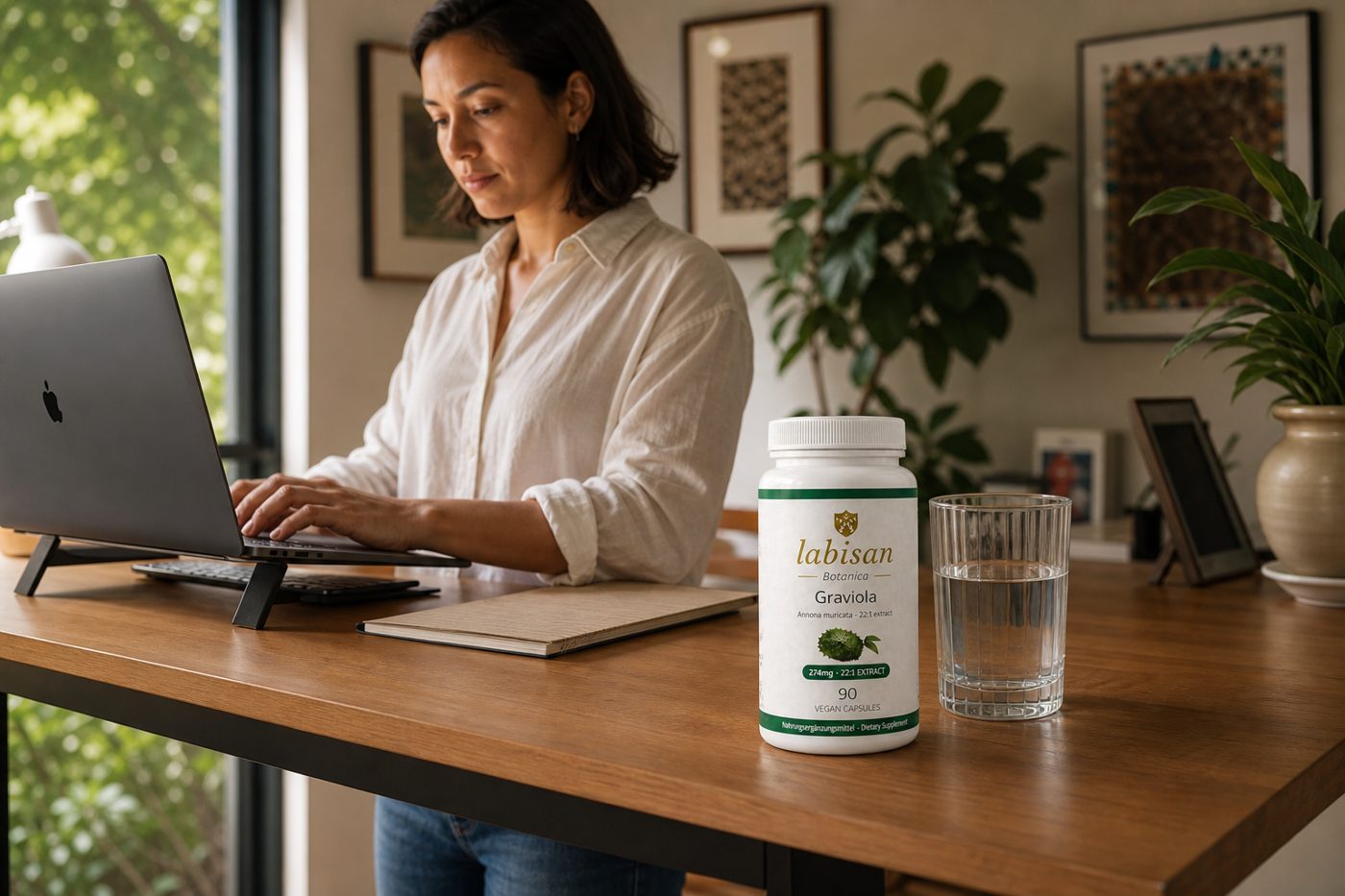
Labisan Graviola Capsules use leaf material rather than fruit or seed, state the extract ratio and the actual extract weight per capsule rather than only a raw herb equivalent, and use HPMC shells that resist the cross linking that stiffens gelatin over time. That does not make graviola risk free. It makes the dose knowable, which is the prerequisite for any safety judgement at all.
A Measured Dose, From a Batch You Can Ask About
Labisan Graviola Capsules
Single: $44.99 | 3-Pack: $119.97 | 5-Pack: $179.95
Free EU shipping over $49, $19.99 worldwide. 30 day satisfaction guarantee.
Shop NowFrequently Asked Questions
Does graviola actually cause Parkinson disease?
No study has shown that a graviola supplement causes Parkinson disease. What exists is a case control study from Guadeloupe published in The Lancet in 1999 linking high habitual Annonaceae consumption to atypical parkinsonism, with an odds ratio of 8.3 against controls, supported by cell culture toxicity and a 2004 rat study in which infused annonacin produced a similar lesion pattern. That is a serious signal tied to sustained high exposure, mostly from fruit and nectar. It is not the same as a demonstrated risk from an occasional leaf capsule, and no human oral threshold has been established either way. People with a movement disorder or a family history of one should avoid graviola.
Is graviola leaf safer than soursop fruit or nectar?
By measured annonacin per serving, yes, and by a wide margin. Champy and colleagues reported about 15 mg of annonacin in an average fruit and about 36 mg in a can of commercial nectar, against about 140 micrograms in a cup of leaf infusion. The leaf is the more concentrated tissue by weight, at roughly 1 to 3 mg per gram, but you consume vastly less of it and water extracts lipophilic acetogenins poorly. Capsules sit between the two, and the actual figure depends on the extract ratio and the batch.
What are the most common graviola side effects in practice?
Gastrointestinal upset is the most frequently reported: nausea, stomach discomfort, or loose stools, usually on an empty stomach or a single large dose. Taking capsules with a meal containing some fat and splitting the daily total across two or three doses resolves it for most people. Lightheadedness can occur because graviola has shown blood pressure lowering effects in animal models. Any new tremor, stiffness or balance problem is a reason to stop and see a doctor.
Can I take graviola with blood pressure or diabetes medication?
Not without talking to your prescriber first. Graviola has shown both hypotensive and hypoglycaemic effects in animal models, and additive effects with antihypertensive or antidiabetic medication are plausible even though the clinical relevance has not been quantified. The same caution applies before surgery, where stopping at least two weeks ahead and telling your anaesthetist is the sensible course.
Why does batch testing matter so much for graviola specifically?
Because the active load varies enormously between products. A 2023 quality assessment of seven commercial Annona muricata leaf products found annonacin ranging from 1.05 to 3.09 mg per gram, labelled versus actual weight differing by minus 57 percent to plus 33.1 percent, recommended daily doses spanning 500 to 4000 mg, and microbial contamination in three of the seven. When the compound of concern varies threefold and the serving size varies eightfold, the label alone tells you almost nothing about your actual exposure. A stated plant part, a stated extract ratio and per batch testing are what make the dose knowable.
This article is educational and is not medical advice. Graviola is a food supplement and is not intended to diagnose, treat, cure or prevent any disease. Talk to a doctor or pharmacist before starting graviola, particularly if you are pregnant or breastfeeding, take prescription medication, have a movement disorder, liver or kidney disease, or have surgery scheduled.