Here is the state of the evidence on graviola and herpes as of 2026, stated precisely. Annona muricata has appeared in antiviral screening literature against herpes simplex virus type 1 since 1998, when Padma and colleagues reported in the Journal of Ethnopharmacology that an Annona muricata extract inhibited HSV-1 in cell culture; Betancur-Galvis and colleagues later included Annonaceae species in broader cytotoxicity and antiviral screens published in Memorias do Instituto Oswaldo Cruz, with results in the same direction. Those are the two most-cited primary sources, and both are in vitro: virus and extract in a well plate. Searches of ClinicalTrials.gov and the published literature return zero randomised controlled trials of graviola in humans with HSV-1 or HSV-2. Zero. Not one small pilot, not one open-label study with outbreak-frequency endpoints. Meanwhile the plant itself is genuinely well characterised: more than 200 identified phytochemicals across three families, annonaceous acetogenins (chiefly annonacin, a mitochondrial complex I inhibitor), isoquinoline alkaloids (reticuline, anonaine, coreximine), and flavonoids including quercetin, kaempferol and chlorogenic acid. So the honest 2026 position is narrow and defensible: graviola has laboratory-stage antiviral signal and better-supported immune-modulating and antioxidant activity, which is why we position it as a long-horizon outbreak-frequency support tool used across a full season, and never as an antiviral treatment or a cure. Nothing cures herpes.
The Evidence Hierarchy, and Where Graviola Actually Sits
Most confusion about supplements comes from collapsing four very different tiers of evidence into the single word "studies." Applied to graviola and HSV, the tiers look like this.
Tier 1: In vitro (this is where the antiviral claims live)
An infected cell monolayer is exposed to extract, viral replication is measured against an untreated control, and a cytotoxicity value is calculated in parallel. A result is interesting when the virus is suppressed at a concentration well below the one that kills the host cells. Graviola extracts have cleared that bar against HSV-1. This tier tells you a compound family is worth investigating. It tells you essentially nothing about what happens after a capsule passes through a human stomach and liver.
Tier 2: Animal models (immune and antioxidant, not HSV)
Rodent work reports macrophage activation, cytokine modulation, measurable antioxidant activity, and mild sedative effects attributable to the alkaloid fraction. Note carefully what this tier is not: there is no established animal model study of graviola reducing HSV reactivation. The animal evidence is about general immune and oxidative-stress endpoints.
Tier 3: Human data on isolated constituents
This is the strongest honest link in the chain, and it is indirect. Quercetin, one of graviola's flavonoids, has human trial data in the respiratory infection literature and documented in vitro activity against herpesviruses. That does not transfer cleanly, because a whole-leaf extract delivers quercetin at a fraction of trial doses alongside dozens of other molecules. We mapped the actual concentrations in our breakdown of the quercetin and flavonoid profile of graviola.
Tier 4: Human RCTs in HSV populations
Empty. Nothing here. Any page that implies otherwise is either citing a tier 1 study as though it were tier 4, or citing nothing at all.
What "Graviola Kills HSV in the Lab" Fails to Account For
Three gaps separate a positive cell-culture result from a clinical effect, and none of them have been closed for graviola.
Achievable plasma concentration. The effective concentration in a dish is set by the experimenter. In a person it is set by absorption, hepatic first-pass metabolism and clearance. Nobody has published human pharmacokinetics showing that oral graviola reaches the concentrations that suppressed HSV-1 in vitro, and it is entirely possible that no safe oral dose does.
Tissue distribution to the right place. Between outbreaks, HSV-1 sits latent in the trigeminal ganglion, behind a nerve-tissue barrier. A compound circulating in plasma is not automatically a compound present in the ganglion. This is a hard problem even for pharmaceutical antivirals.
The latency problem itself. No agent has ever been shown to clear latent HSV from sensory ganglia. Acyclovir and valacyclovir, the two most extensively studied HSV drugs in existence, suppress viral replication during and around reactivation; they do not eradicate the reservoir. If the best-evidenced prescription antivirals cannot do it, a botanical extract with no human trial data certainly has not. We set the two side by side in our graviola versus acyclovir evidence comparison, and the takeaway there is the same one that governs this entire article: different jobs, different evidence grades, no cure on either side.
The Claim That Survives Scrutiny: Immune Terrain and Frequency
Strip away the antiviral overreach and something defensible remains. HSV-1 recurrence is not random. It clusters around identifiable immunosuppressive events: ultraviolet exposure, febrile illness, physical trauma to the lip, hormonal shifts, sleep debt and sustained psychological stress. The mechanism is reasonably well described. Elevated cortisol suppresses cell-mediated immunity, particularly the CD8+ T cell and natural killer cell surveillance that normally keeps low-level reactivation subclinical. When that surveillance dips, a reactivation that would have been silently contained becomes a visible lesion.
Graviola's plausible contribution is at that layer, not at the virus. Supporting antioxidant status and immune function is a modest, indirect, slow-acting claim. It is also the only one the literature will bear, and it is the one we make. The stress axis specifically is covered in graviola, chronic stress and immune resilience. The practical consequence matters: a frequency effect is invisible over three weeks. If you average four outbreaks a year, you need a written baseline and six to twelve months of consistent use before you have any signal worth interpreting.
Safety: The Part Honest Reviews Include
A 1999 Lancet report by Caparros-Lefebvre and Elbaz associated heavy long-term consumption of Annona muricata in Guadeloupe with an atypical parkinsonism, with annonacin the suspected agent. The exposure pattern involved decades of daily fruit, leaf teas and seed-containing preparations, which is a different exposure from a standardised leaf extract taken in defined cycles. We do not wave this away; we design around it. Use leaf-derived material rather than seed, keep the dose specified rather than open-ended, and cycle rather than dosing continuously for life. Those choices are documented in our fruit extract versus leaf extract safety analysis and the one year on, one year off cycling protocol. Graviola is not appropriate in pregnancy or breastfeeding, and anyone taking antihypertensive or antidiabetic medication, or living with Parkinson's disease or another movement disorder, should clear it with a doctor first.
Why the Labisan Dual Protocol Beats Any Single Product Here
Now look at the whole category honestly. Docosanol creams such as Abreva, hydrocolloid patches, lysine tablets, episodic acyclovir or valacyclovir: every one of these is deployed after reactivation has begun. They are legitimate products and if a lesion is forming you should use what works for you. But they all sit downstream. By the time anything is applied, the virus has already travelled the nerve and the inflammatory response producing the visible swelling is underway. Graviola alone, used as an antiviral, would be making the same mistake in the opposite direction: reaching for weak evidence to do a job it was never suited to.
Labisan is built on the two upstream levers instead, and the evidence grades are deliberately different.
The first lever is ultraviolet light, and here the evidence is the strongest in this entire category. In a controlled crossover study published in The Lancet in 1991, Rooney and colleagues exposed HSV-1 seropositive volunteers with a history of sun-triggered herpes labialis to experimental ultraviolet light. Under placebo, most developed recurrent lesions. With sunscreen applied to the lip before exposure, recurrences were effectively abolished. That is human, controlled and mechanistically clean, a tier 4 result of the exact kind graviola does not have. Labisan Protective Lip Balm SPF 20 is built on that finding: zinc oxide for broad-spectrum UV block, plus shea butter and manuka oil to keep the vermilion border intact, because micro-cracking is its own trauma trigger.
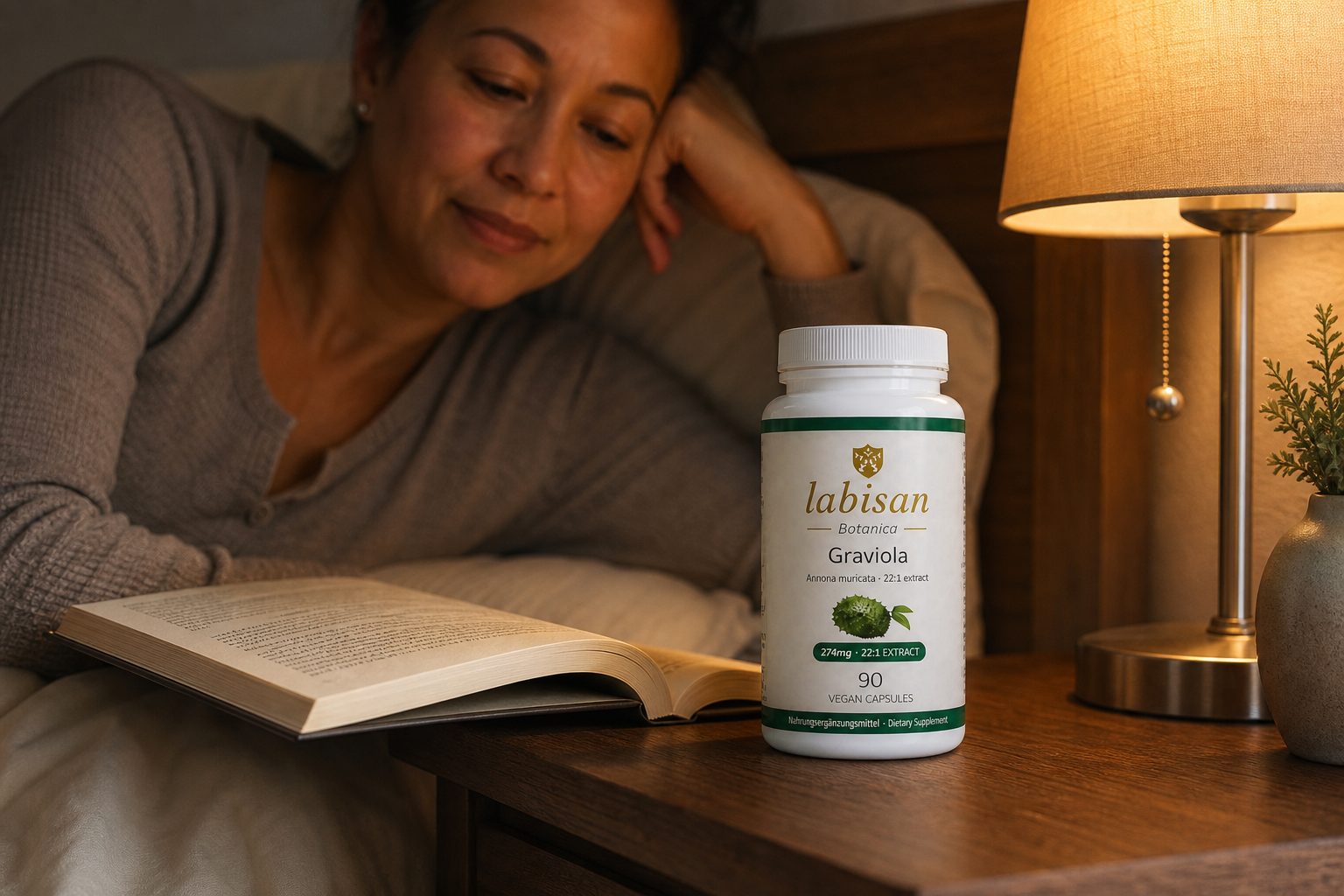
The second lever is immune terrain over time, and that is where Labisan Graviola Capsules sit, honestly labelled as immune support intended to influence how often outbreaks occur rather than what happens to one already forming. Neither product treats an outbreak. Neither cures HSV-1 or HSV-2, and we will never say otherwise. What the pairing does is cover the largest measurable external trigger with the best-evidenced intervention available, while supporting internal resilience with a botanical used at its honest strength. Blocking the trigger and supporting the terrain is a structurally better long game than getting faster at reacting to lesions you could have had fewer of.
Support Immune Resilience Before the Next Outbreak Window Opens
Labisan Graviola Capsules
Single: $24.99 | Adventure Pack (3x): $59.97 | Family Bundle (5x): $89.95
Free EU shipping over $49, $19.99 worldwide. 30 day satisfaction guarantee.
Shop NowFrequently Asked Questions
Does graviola cure herpes?
No. Nothing cures herpes. HSV-1 and HSV-2 establish lifelong latency in sensory nerve ganglia, and no supplement or prescription antiviral has been shown to eliminate that latent reservoir. Graviola is immune support that may help reduce how often outbreaks occur. It is not a treatment and not a cure, and any source telling you otherwise is misrepresenting the literature.
Does graviola help herpes at all, then?
The defensible claim is indirect. Graviola's flavonoid and alkaloid content supports antioxidant status and immune function, and HSV recurrence is strongly tied to periods of immune suppression. That is a plausible frequency effect, not a proven antiviral one, and it should be judged over six to twelve months against a written baseline rather than over a few weeks.
What is the strongest study linking Annona muricata to herpes?
The 1998 Journal of Ethnopharmacology in vitro screen by Padma and colleagues remains the most-cited primary source for HSV-1 activity, supported by later Annonaceae screening in Memorias do Instituto Oswaldo Cruz. Both are cell culture. There is no human trial in an HSV population.
Can I take graviola with acyclovir or valacyclovir?
Many people do, but confirm it with your prescriber. The relevant interaction question is usually not the antiviral itself but blood pressure and blood glucose medication, where graviola may have additive effects, so bring your full medication list rather than a single drug name.
If I only choose one Labisan product, which should it be?
If your outbreaks follow sun, snow glare, altitude or beach exposure, start with the SPF 20 lip balm; the ultraviolet evidence is the strongest in this category by a wide margin. If your outbreaks follow stress, illness or broken sleep with no clear sun pattern, start with the capsules. People with a genuinely recurring pattern usually end up running both.