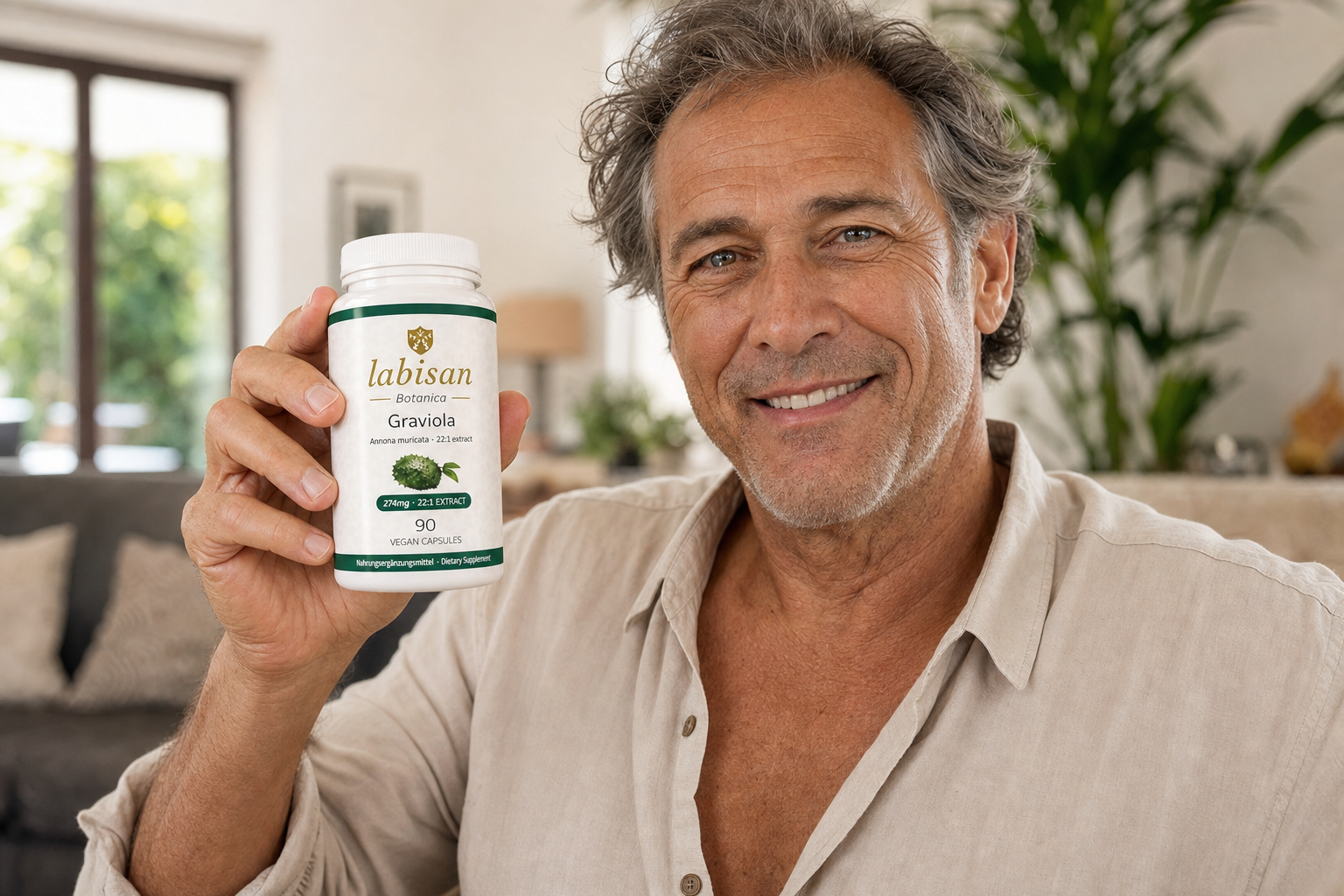
The numbers up front. More than 500 acetogenins have been isolated from the Annonaceae family. Annona muricata alone contributes the largest named subset, including annonacin, annomuricin A through E, and muricatocin A through C. In the published anti-herpes literature, zero of these individual molecules have been cleanly demonstrated as the herpes-active compound in a human study. Whole-extract preparations of Annona muricata have repeatedly shown in-vitro inhibition of HSV-1 and HSV-2 replication. The honest pharmacology read is that the anti-herpes activity is a property of the extract as a chemical matrix, not of any one acetogenin pulled out of it. Labisan Graviola Capsules are formulated explicitly around that finding: a 22:1 fruit water extract that preserves the full polyphenol, flavonoid, and acetogenin layer in one capsule, rather than chasing an isolate that science has not actually named.
This post walks through what the literature does and does not say, names the acetogenins that get marketing attention, explains why no single one is the herpes molecule, and shows how the Labisan formulation choice maps to the honest pharmacology rather than to the marketing one.
What an Acetogenin Actually Is
Acetogenins are long-chain fatty acid derivatives, typically 32 to 34 carbons long, terminated by a methylated gamma-lactone ring and containing one or more tetrahydrofuran rings in the carbon backbone. Structurally they are unusual. Most plant secondary metabolites are alkaloids, terpenes, or flavonoids; acetogenins are their own structural family, almost exclusive to the Annonaceae, with the highest documented diversity in Annona muricata (graviola, soursop), Annona squamosa (sugar apple), and Annona cherimola (cherimoya).
What they do at the cell level is more interesting than what they look like. Acetogenins are mitochondrial complex I inhibitors. Complex I is the first enzyme of the electron transport chain, the cellular respiration system that produces ATP. Inhibit complex I and ATP output drops, oxidative stress rises, and cells that depend on a heavy ATP draw start to malfunction. That is why acetogenins are most famous in the cancer literature, not the antiviral literature. Cancer cells run a high-ATP, high-metabolism phenotype and are exquisitely sensitive to complex I disruption. Healthy quiescent cells tolerate the same exposure much better. The therapeutic window in cell-line studies is real and selective. The neurotoxicity tail is real too, which is why we cover the safety architecture in the fruit vs leaf safety post.
The Named Acetogenins from Annona muricata
The four most studied groups from Annona muricata are these. Annonacin is the structural reference compound and the one with the deepest published file. Annomuricin A, B, C, D, and E are a closely related series isolated from the leaves and seeds, with the bis-tetrahydrofuran ring system that is characteristic of the strongest acetogenins. Muricatocin A, B, and C are mono-tetrahydrofuran variants with their own bioactivity profile. Squamocin is more associated with Annona squamosa but appears at trace levels in some Annona muricata populations. Beyond these named compounds, the published reviews catalogue dozens of further isolates with names like muricins, muricoreacin, longifolicin, and corossolone, most of which have one or two cytotoxicity papers behind them and almost nothing on the antiviral side.
The pattern is the same across the catalogue. The cancer-cell literature is broad and deep. The antiviral literature is shallow and almost entirely whole-extract. When a paper does try to attribute antiviral activity to a single acetogenin, the data are usually one cell line, one virus, no replication. That is not a conspiracy. It is just where the science is in 2026.
Why No Single Acetogenin Is "The Herpes One"
The reason the herpes question has no single-molecule answer is mechanistic, and the same mechanistic wall is why the 2026 herpes cure research pipeline is still working on clearing latent virus rather than announcing a finished cure. HSV-1 and HSV-2 are double-stranded DNA viruses that establish latency in sensory ganglia. The host-cell entry, replication, and reactivation cycle involves at least a dozen viral proteins and host-cell pathways. Any drug that meaningfully inhibits the viral cycle has to act on at least one of these targets specifically. Acyclovir, the reference antiviral, targets viral DNA polymerase with a phosphorylated nucleoside analogue. The targeting is precise.
Acetogenins do not target HSV proteins. The in-vitro antiviral effect that has been observed for graviola extracts appears to be downstream of broader cellular changes: mitochondrial complex I inhibition shifts the cell's redox state, lowers ATP availability for viral replication, and changes the inflammatory cytokine profile. None of those effects is acetogenin-specific. They are extract-specific, because the polyphenol and flavonoid co-fraction of Annona muricata contributes its own immunomodulatory and antioxidant action that the acetogenin layer alone does not deliver. The full graviola flavonoid profile is documented separately and matters for the herpes context as much as the acetogenins do.
This is why marketing language like "the active anti-herpes acetogenin in graviola" does not describe a real molecule. It describes a wish.
What the In-Vitro Anti-Herpes Data Actually Show
The honest published file is this. Whole-extract preparations of Annona muricata leaf and fruit have been tested against HSV-1 and HSV-2 in Vero cell models at concentrations between 25 and 200 micrograms per milliliter. The reported effects include reduction of viral plaque formation, reduction of viral titre at 24 and 48 hours, and synergy with low-dose acyclovir at concentrations where neither agent alone was strongly active. The reproducibility across labs is moderate, the methodologies are non-standardised, and the dose-response curves are not yet clean enough to set a clinical bioequivalent.
What is missing is a human study. There is no randomised trial of graviola extract for HSV outbreak frequency, severity, or duration. There is no comparative effectiveness data against acyclovir, valacyclovir, or lysine. The mechanistic case is plausible. The clinical case is unproven. Anyone who tells you otherwise is selling something. Labisan's position on this, in writing on every product page and in the melissa officinalis combination post, is that graviola is a supportive layer in an outbreak-frequency-reduction protocol, not a standalone treatment for an active outbreak. The active outbreak is what Labisan Protective Lip Balm is for.
The whole-extract, 22:1 fruit water concentrate
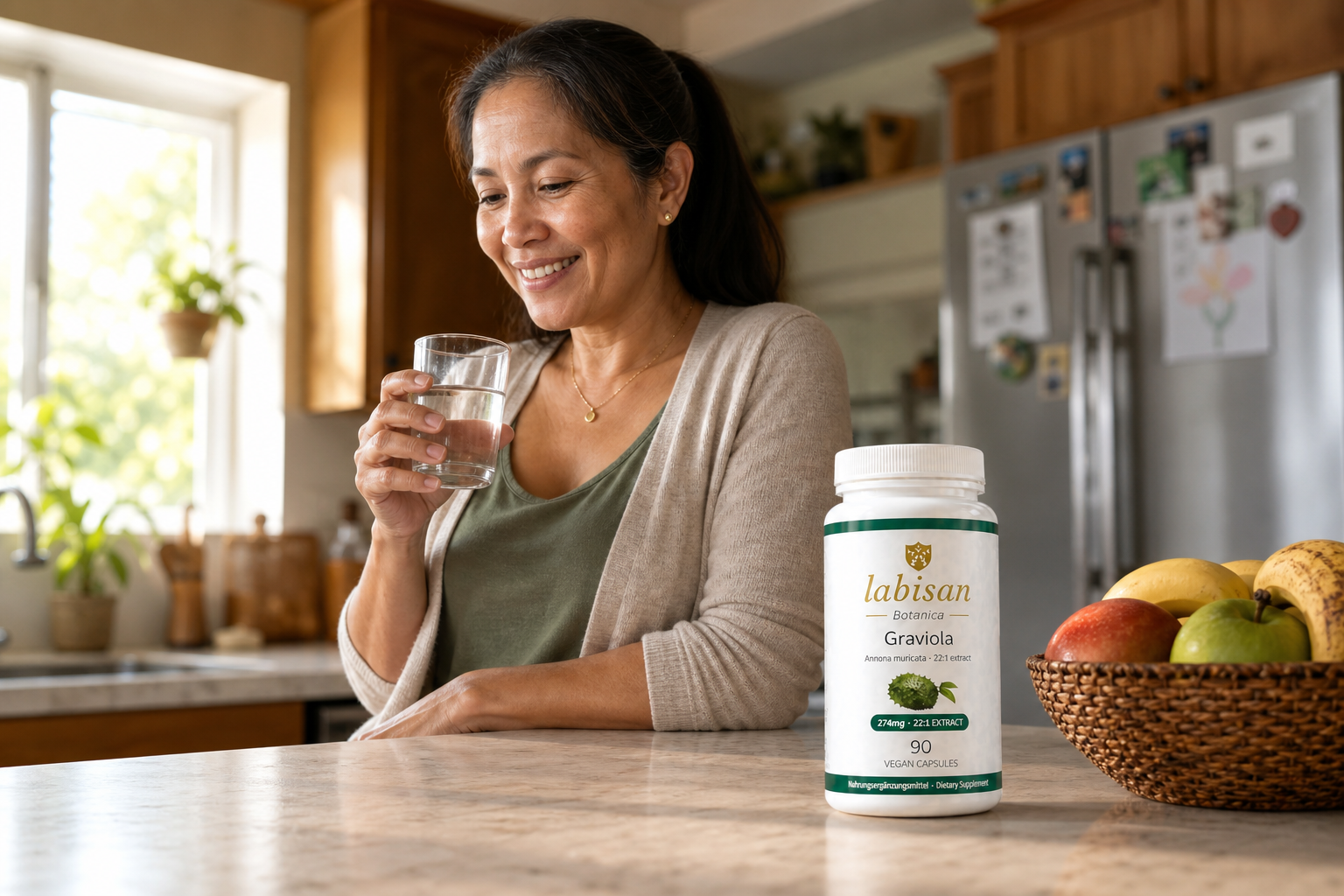
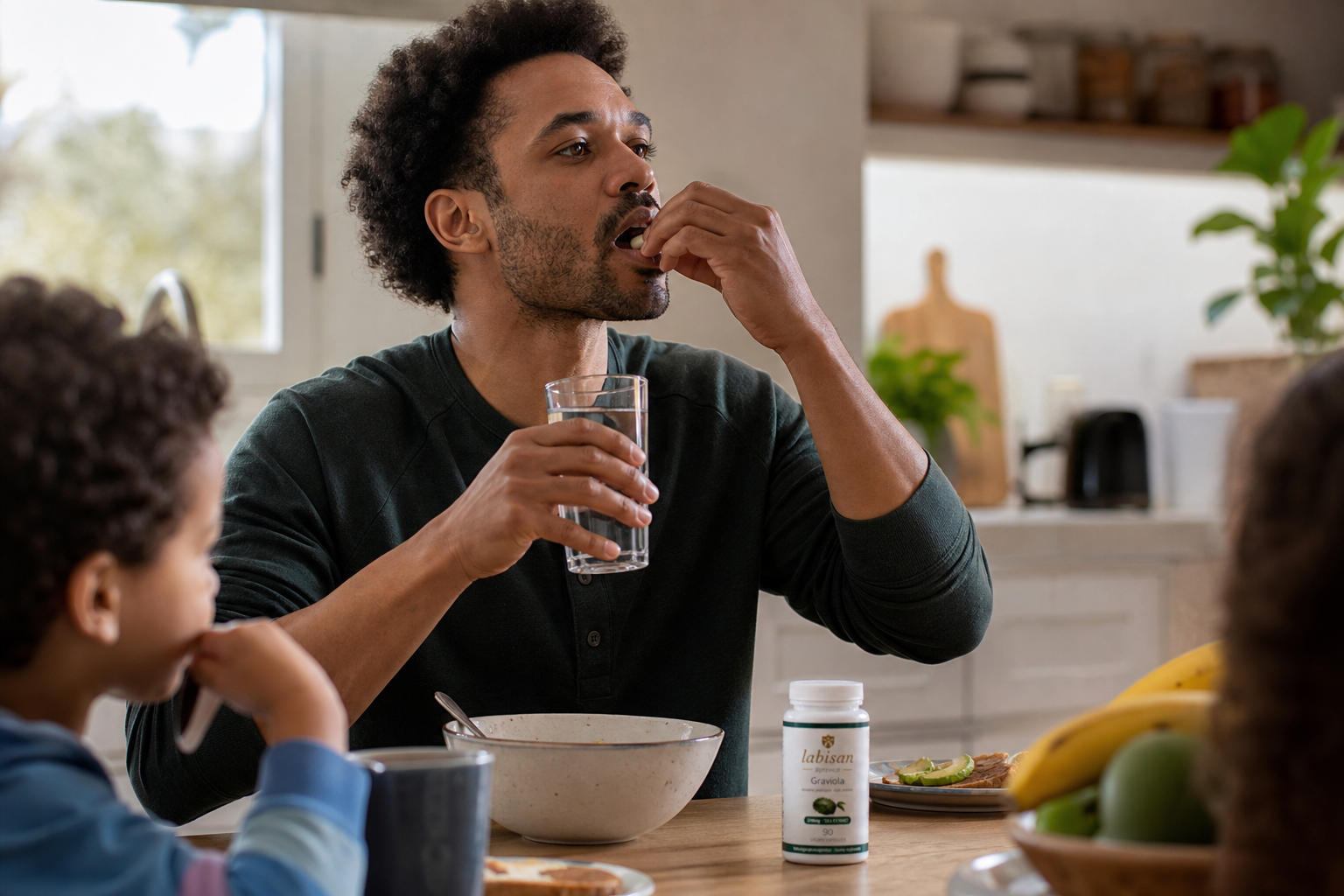
Labisan Graviola Capsules 22:1 Fruit Water Extract
Single bottle (90 capsules, one month): $44.99 | 3x Bundle: $119.97 | 5x Bundle: $179.95
Free shipping on orders over $49. 30 day money back guarantee.
Shop Graviola CapsulesWhy Labisan Formulates a Whole Extract, Not an Isolate
If the pharmacology says the anti-herpes activity belongs to the whole extract, the formulation has to deliver the whole extract. Three engineering choices follow.
First, ratio matters. Labisan uses a 22:1 water-only extraction from the fruit pulp of Annona muricata. Twenty-two kilograms of starting fruit material concentrate to one kilogram of finished extract. At three capsules per day, each carrying roughly 500mg of finished extract, the user receives the concentrated bioactive equivalent of approximately 33 grams of raw fruit pulp daily, which maps to an 8,000mg bioactive payload. The math is in the 8000mg dose protocol post. Most market products run 4:1 or 10:1 ratios at one capsule per day and deliver a fraction of the bioactive load.
Second, source tissue matters. The fruit pulp delivers a different acetogenin density and a richer polyphenol and flavonoid co-fraction than the leaf. The leaf extract concentrates acetogenins more aggressively but loses the antioxidant layer and runs the chronic-exposure neurotoxicity risk harder. The fruit vs leaf safety analysis explains the engineering decision in full.
Third, extraction solvent matters. Water extraction preserves the polar polyphenol layer that ethanol or hexane extractions strip. Quercetin, kaempferol, and gallic acid all carry independently documented antiviral activity in the herpes literature and would be partly lost in an ethanol process. The full flavonoid profile post is the deep dive on that layer.
The result is a capsule that preserves the chemical matrix the in-vitro anti-herpes data were generated on, not a stripped-down isolate that loses what made the extract active in the first place.
How to Read a Graviola Label
If a graviola supplement label claims a specific anti-herpes acetogenin, the label is ahead of the science. If it claims an undefined "high-potency leaf extract" with no extract ratio and no per-capsule mass, the label is hiding the dose. If it lists a 4:1 or 10:1 ratio at one capsule per day, the dose is below the threshold where the in-vitro anti-herpes data sit when scaled. If it lists a 22:1 fruit water extract at three capsules per day, the dose matches the published in-vitro range and preserves the whole-matrix pharmacology. Read the label that way.
The Combined Protocol that Actually Maps to the Pharmacology
Cold sores are a two-vector problem. The internal vector is HSV-1 latent in the trigeminal ganglion, reactivating under UV, stress, hormonal, or immune triggers. The external vector is the lip surface where the reactivated virus erupts and a barrier failure lets it linger. The honest protocol addresses both.
Daily graviola at the 22:1 fruit water extract dose addresses the internal vector by supporting immune resilience and adding the polyphenol-antioxidant layer to the host-cell environment HSV needs to replicate in. Daily Labisan Protective Lip Balm, applied at least three times a day with a 22 percent zinc oxide film, addresses the UV trigger and the barrier failure at the lip surface. The combined system reduces both the reactivation frequency and the severity of the outbreak when reactivation does occur. The 12-month outbreak reduction post walks through the mechanism in detail and the hybrid system post covers the daily protocol.
Bottom Line
There is no single anti-herpes acetogenin in graviola. The activity is a whole-extract property of the Annona muricata chemical matrix, which is why the formulation choice between an isolate, a low-ratio extract, and a high-ratio whole-matrix extract is the choice that actually changes user outcomes. Labisan Graviola Capsules are a 22:1 water extract from the fruit pulp, manufactured in Austria under EU GMP standards, in pharmaceutical-grade HPMC capsules, with batch-level certificates of analysis available on request. Three capsules per day, one with each main meal. Free shipping on orders over $49, 30 day money back guarantee.