The pharmacokinetic answer and the useful answer are completely different, and conflating them is why so many people conclude a supplement did nothing after ten days.
The pharmacokinetic answer is fast. Quercetin, one of graviola's principal flavonoids, has a reported terminal elimination half life in humans in the region of 11 hours for glycoside forms, with shorter figures reported for other preparations. Apply the standard rule that steady state arrives after roughly three to four half lives of consistent dosing and you get to a stable circulating level within one to two days. By any laboratory measure, graviola is in your system almost immediately.
The useful answer is slow, because a stable plasma level is an input, not an outcome. Nothing you care about, whether that is how often you get run down, how you tolerate a stressful month, or how frequently a cold sore shows up, changes on a two day timescale in response to a botanical. So the honest planning number is 8 to 12 weeks, and this article explains why that number is what it is, what genuinely shifts it, and how to run the window so that you finish it with an actual answer rather than a vague impression.
What a Realistic Timeline Looks Like
| Window | What is actually happening | What you can reasonably expect to notice |
|---|---|---|
| Days 1 to 3 | Flavonoid levels reach steady state. Your gut meets a new capsule | Tolerance, nothing else. Mild stomach upset here means take it with food |
| Weeks 1 to 2 | Dosing habit forms or fails. This is where most supplement trials quietly end | Whether you can actually keep taking it. Anything else you notice is expectation |
| Weeks 3 to 6 | Enough elapsed time for one full skin turnover cycle and a normal stress cycle | Still too early for a frequency judgement. Keep logging, do not conclude |
| Weeks 8 to 12 | The window where published botanical trials measure their endpoints | Enough data to compare against your baseline and make a keep or stop decision |
| Beyond 12 weeks | Diminishing information from continuing without a decision point | If nothing has changed against baseline, stop. That is a valid result |
Why 8 to 12 Weeks Rather Than Two
Three separate reasons stack up, and none of them is about graviola specifically. They apply to any botanical taken for a general wellness outcome.
The outcomes are rate outcomes, not event outcomes. If you are taking graviola for immune support, the thing you would be measuring is how often something happens, not whether a single thing happens today. Measuring a rate requires enough elapsed time for events to accumulate. If you average one cold sore every six weeks, a two week trial contains, on average, one third of one event. There is no statistical universe in which that produces an answer.
Biological turnover is slow. The epidermis renews on roughly a monthly cycle. Red blood cells turn over across about four months. Any change that runs through tissue renewal or through adaptation of a regulatory system rather than through direct receptor action is measured in weeks at minimum.
The published trials themselves run this long. The most instructive example is the flavonoid trial literature. Nieman and colleagues published a randomised, double blinded, placebo controlled community trial of quercetin supplementation in 2010, with 1002 participants aged 18 to 85 taking 500 mg or 1000 mg daily or placebo for 12 weeks, logging upper respiratory tract infection symptoms daily. The headline result for all subjects combined was no significant influence on infection rates or symptomatology. A pre specified subgroup of 325 participants aged 40 and over who rated themselves in the fitter half showed 36 percent lower symptom severity and 31 percent fewer total sick days on 1000 mg.
We cite that study deliberately, because it is the shape of the honest answer. It took 12 weeks and a thousand people to detect an effect that did not appear in the overall population and only emerged in a subgroup. That is what a real effect from a flavonoid looks like: modest, slow, and not universal. It is a long way from what supplement marketing implies, and it is also a long way from nothing.
What Actually Changes the Timeline
Extract strength, which is not the number on the front of the bottle
The biggest variable in how long graviola takes to do anything is how much graviola you are actually taking, and that is much harder to determine than it should be. A bottle claiming 8000 mg almost never contains 8000 mg of material per capsule. It is a raw herb equivalent derived from a concentration ratio, so a 10:1 extract at 500 mg of actual extract is labelled as 5000 mg equivalent. That is legitimate and standard, but it is only interpretable when the ratio is printed alongside the actual extract weight.
The scale of the resulting variability is documented. A 2023 quality assessment published in the Journal of Pharmacy and Pharmacology tested seven commercial Annona muricata leaf products and found the marker compound annonacin ranging from 1.05 to 3.09 mg per gram across products, recommended total daily doses spanning 500 mg to 4000 mg, and the difference between labelled and actual weights running from minus 57 percent to plus 33.1 percent, with one product containing less than half its stated content.
Multiply a threefold concentration range by an eightfold dosing range and two people can both be taking graviola daily for three months while receiving wildly different actual exposures. Before you conclude that graviola did not work for you, establish that you were taking a meaningful amount of it. We walk through how to read a label properly in is graviola effective in capsule form and score products on these criteria in best graviola supplement top 5.
Whether the capsule opens on schedule
United States Pharmacopeia standards expect an immediate release capsule to disintegrate within roughly 30 minutes under test conditions. Gelatin shells are protein based and can cross link over time on exposure to trace aldehydes, humidity or heat, which stiffens the shell and delays release. HPMC shells are plant derived and far less prone to this. A bottle that has spent six months in a warm bathroom is a plausible reason a supplement underperformed, and you can test it by dropping a capsule in body temperature water and watching whether it softens and opens well inside half an hour. More on that in why the capsule shell matters more than the active.
Whether you take it with fat
Graviola's acetogenins are lipophilic by structure, and lipophilic plant compounds absorb considerably better in the presence of dietary lipid, which stimulates bile release and micelle formation. Flavonoids behave similarly, and human crossover work on quercetin has shown higher plasma concentrations when co-ingested with a fat containing meal than with a fat free one. Taking capsules with meals rather than on an empty stomach is the cheapest available improvement to your own timeline, and it also reduces the mild nausea some people report on a large single dose.
Whether you split the dose
Splitting the daily total across two or three doses flattens the peak, which improves tolerability, and holds levels in a more useful range across the waking day rather than spiking and clearing before lunch. Our three capsule structure is set out in the 8000 mg daily dose protocol.
Why You Should Not Expect Drug-Like Effects
This deserves saying plainly, because it is the expectation that ruins most people's supplement experience.
Consider the benchmark. Docosanol 10 percent, a licensed over the counter antiviral with a large randomised trial programme behind it, produced a median healing time of 4.1 days against placebo in the pivotal trial published by Sacks and colleagues in 2001, a difference of about 18 hours. High dose short duration valaciclovir, a prescription antiviral, reduced median episode duration by roughly half a day to one day in its published trials.
Those are approved medicines with defined molecular targets, measured in properly powered trials, and their effect sizes are hours. A botanical extract taken for general wellness support is not going to outperform that, and it is not going to announce itself with a sensation. If a supplement produces an immediate, unmistakable, drug-like effect, the reasonable first hypothesis is that it contains something undeclared, not that it is unusually potent.
What a botanical can plausibly do is shift a rate slightly over months. That is a genuinely worthwhile outcome, and it is also an outcome you can only detect by counting, which brings us to the part that actually matters.
How to Run a Window That Produces a Real Answer
Do this before you start, not after you finish. The reason most people cannot tell whether a supplement worked is that they never recorded what normal looked like.
Step one, write down your baseline. Three numbers, covering the previous 90 days. How many episodes or run down periods did you have. How long did each one last. What were your two most reliable triggers. If you are taking graviola in a cold sore prevention context, most people's honest answer to that last one is ultraviolet exposure and sleep debt.
Step two, fix the variables you can fix. Same product, same daily dose, taken with food, split across meals, for the whole window. Changing dose or brand halfway through destroys the comparison.
Step three, log lightly but consistently. A one line note per week is enough. Detailed daily journalling makes you hypervigilant, and hypervigilance manufactures signal that is not there.
Step four, mind the confounders. Two are worth naming. Seasonality, because if your triggers are ultraviolet driven then starting in autumn and reviewing in winter will show an improvement that has nothing to do with what you swallowed. And regression to the mean, because people start supplements after a bad stretch, and bad stretches are followed by better ones regardless of intervention. Comparing against a 90 day baseline rather than against the worst month of your year is the defence against both.
Step five, decide at week 12. Compare the same three numbers. If they have not moved, stop. A clean negative result after a properly run window is more valuable than an indefinite continuation on hope, and it is also cheaper.
What Graviola Will Not Do, On Any Timeline
It will not cure anything. It does not eliminate herpes simplex virus, which persists in nerve ganglia for life regardless of what you take. It is not a treatment for any disease, and any product marketed to you on that basis is making a claim the evidence does not support.
It is also not right for everyone. Graviola is not suitable in pregnancy or breastfeeding, should be avoided by anyone with a movement disorder or a family history of one, and warrants a conversation with your prescriber if you take blood pressure or glucose lowering medication. We set out the full picture, including the annonacin literature that drives those cautions, in graviola side effects and safety. Read that before you start a 12 week window, not during it.
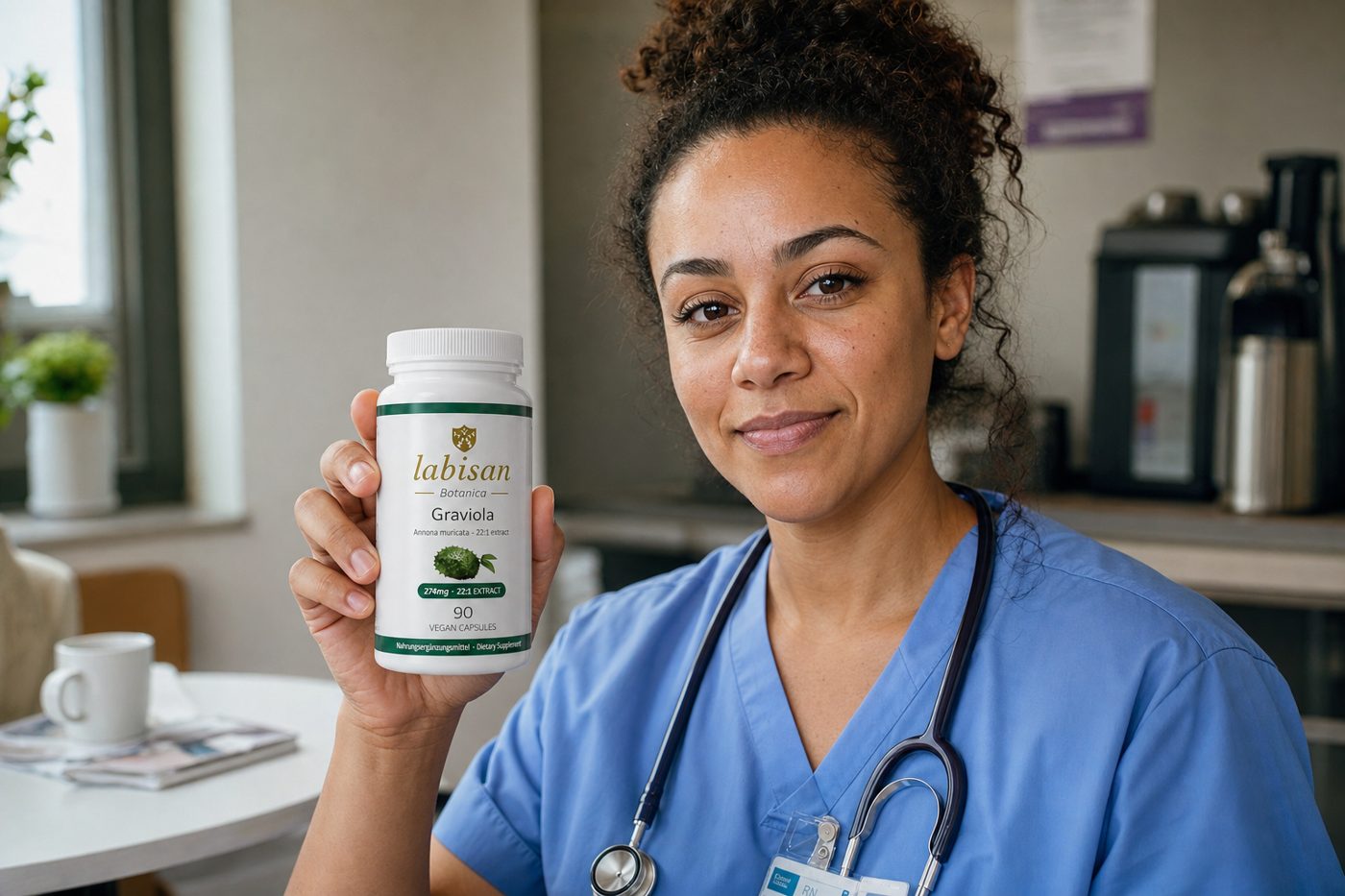
Within those limits, our position is simple. Labisan Graviola Capsules are built so that the dose is knowable: leaf material rather than fruit or seed, a stated extract ratio alongside the actual extract weight per capsule, and HPMC shells that resist the cross linking that stiffens gelatin over time. Knowing the dose is what makes a 12 week measurement window meaningful. Without it, you are testing an unknown quantity and calling the result evidence.
Run a Proper 12 Week Window, With a Dose You Can Actually Name
Labisan Graviola Capsules
Single: $44.99 | 3-Pack: $119.97 | 5-Pack: $179.95
Free EU shipping over $49, $19.99 worldwide. 30 day satisfaction guarantee.
Shop NowFrequently Asked Questions
How long until graviola works?
Plan on 8 to 12 weeks before making any judgement. Flavonoid levels reach steady state within one to two days of consistent dosing, but that is a laboratory measure rather than an outcome. The endpoints people actually care about are rates, meaning how often something happens, and measuring a rate needs enough elapsed time for events to accumulate. Published flavonoid trials use 12 week windows for exactly this reason.
Should I feel something in the first week of taking graviola?
No, and if you do, the most likely explanations are expectation or a gastrointestinal response to a new capsule rather than a therapeutic effect. Compare the benchmarks: licensed antivirals for cold sores shift episode duration by roughly 18 hours to one day in properly powered trials. A botanical taken for general wellness support is not going to produce a larger or faster perceptible effect than an approved medicine with a defined target. Slow and modest is the realistic shape of any genuine benefit.
Does a stronger extract ratio mean faster results?
A higher actual dose of extract can matter, but the number on the front of the bottle is usually not that. Large milligram figures are typically raw herb equivalents derived from a concentration ratio, so a 10:1 extract at 500 mg per capsule is labelled 5000 mg. What matters is the actual extract weight and the stated ratio together. Published testing of commercial Annona muricata leaf products found marker compound content varying threefold between products and recommended daily doses varying eightfold, so verify what you are taking before concluding anything about how fast it works.
How do I know whether graviola is actually doing anything for me?
Write down a baseline before you start, covering the previous 90 days: how many episodes or run down periods, how long each lasted, and your two most reliable triggers. Then keep the product, dose and timing constant for 12 weeks, log lightly once a week, and compare the same three numbers at the end. Watch for two confounders: seasonality, if your triggers are sun related, and regression to the mean, since people start supplements after a bad stretch and bad stretches tend to be followed by better ones anyway.
What should I do if nothing has changed after three months?
Stop taking it. A clean negative result from a properly run window is a real answer and a useful one. Before you stop, check two things that commonly invalidate a window: whether the product stated an extract ratio and actual extract weight rather than only a raw herb equivalent, and whether you took it consistently with food rather than sporadically on an empty stomach. If both were sound and nothing moved, graviola is not doing anything measurable for you, and continuing on hope is just an expense.
This article is educational and is not medical advice. Graviola is a food supplement and is not intended to diagnose, treat, cure or prevent any disease. Talk to a doctor or pharmacist before starting graviola, particularly if you are pregnant or breastfeeding, take prescription medication, have a movement disorder, or have surgery scheduled.