Two of the most common questions about recurrent cold sores are whether oral L lysine helps and whether topical docosanol 10 percent is worth using. The honest answer from the published literature is that docosanol has the stronger regulatory standing and a small, measurable effect on healing time, while lysine has a plausible mechanism and mixed trial results that systematic reviewers have repeatedly called insufficient. Neither prevents the next outbreak.
What docosanol is, and what the trials measured
Docosanol 10 percent is a saturated fatty alcohol sold over the counter in the United States. It is the only over the counter topical the FDA has approved to shorten the healing time of recurrent herpes labialis. It is not an antiviral in the way aciclovir is. Rather than attacking the virus directly, it is understood to interfere with fusion between the viral envelope and the host cell membrane, which limits entry into cells.
The approval rests on two pivotal randomised, placebo controlled trials reported together in 2001, covering 737 patients. Median healing time was about 4.1 days on docosanol against 4.8 days on placebo. That difference, roughly 18 hours, was statistically significant. It is also, in plain terms, modest. The benefit depended on starting treatment in the prodrome stage, the tingling or itching window before a blister appears. Applied later, the measured advantage largely disappears.
What lysine is, and why the evidence stays unsettled
L lysine is an essential amino acid. The rationale for using it against HSV 1 comes from cell culture work showing that herpes simplex replication depends on arginine, and that lysine competes with arginine for absorption and transport. That is a coherent mechanism, and it is why the idea has persisted since the 1970s.
The clinical picture is far less tidy. Several small trials from the 1980s reported fewer or less severe recurrences at daily doses in the region of 1,000 to 3,000 mg, while other trials of similar size found no meaningful difference against placebo. The studies vary in dose, duration, outcome definition and quality, which is precisely why pooled analyses struggle. Cochrane's review of preventive interventions for recurrent herpes labialis in healthy people concluded there was insufficient evidence to support lysine for prevention. Lysine is not approved by the FDA to treat or prevent cold sores.
Two things follow. First, lysine is not a proven treatment, and anyone presenting it as one is going beyond the data. Second, the absence of strong evidence is not the same as evidence of no effect. At typical supplemental doses lysine is generally well tolerated in healthy adults, which is why some people continue to use it. That is a personal risk and cost judgement, not a clinical recommendation.
Comparing them fairly
They are not really alternatives to one another. Docosanol is a topical applied to an outbreak that has already begun, aiming to shorten it. Lysine is usually taken orally over time, aiming to reduce how often outbreaks happen. Comparing them head to head implies a choice that the evidence does not frame.
What can be said side by side is the strength of support behind each claim:
- Docosanol 10 percent. FDA approved for shortening healing time. Two pivotal trials, 737 patients. Effect size around 18 hours, conditional on starting at the first tingle.
- Oral L lysine. No FDA approval for this use. Small trials with conflicting results. Systematic reviewers have judged the evidence insufficient. Mechanism plausible, effect unproven.
The part both of them miss
Both are answers to an outbreak that has already started, or to a recurrence rate you are trying to nudge downward. Neither addresses the most reproducible trigger in the literature.
Ultraviolet exposure is one of the best documented triggers of HSV 1 reactivation on the lips. The most instructive study here is a randomised, double blind trial from 1991 in which participants with a history of sun induced recurrence were exposed to experimental UV light. In the group using sunscreen, no recurrences occurred. In the placebo group, 71 percent had a recurrence. Few interventions in this field produce a contrast that clean.
The lips are unusually vulnerable to this. The vermilion border has a thin stratum corneum, no functioning sebaceous protection across most of its surface, and very little melanin, so it takes UV dose that other facial skin shrugs off. It is also the area people most reliably forget to protect.
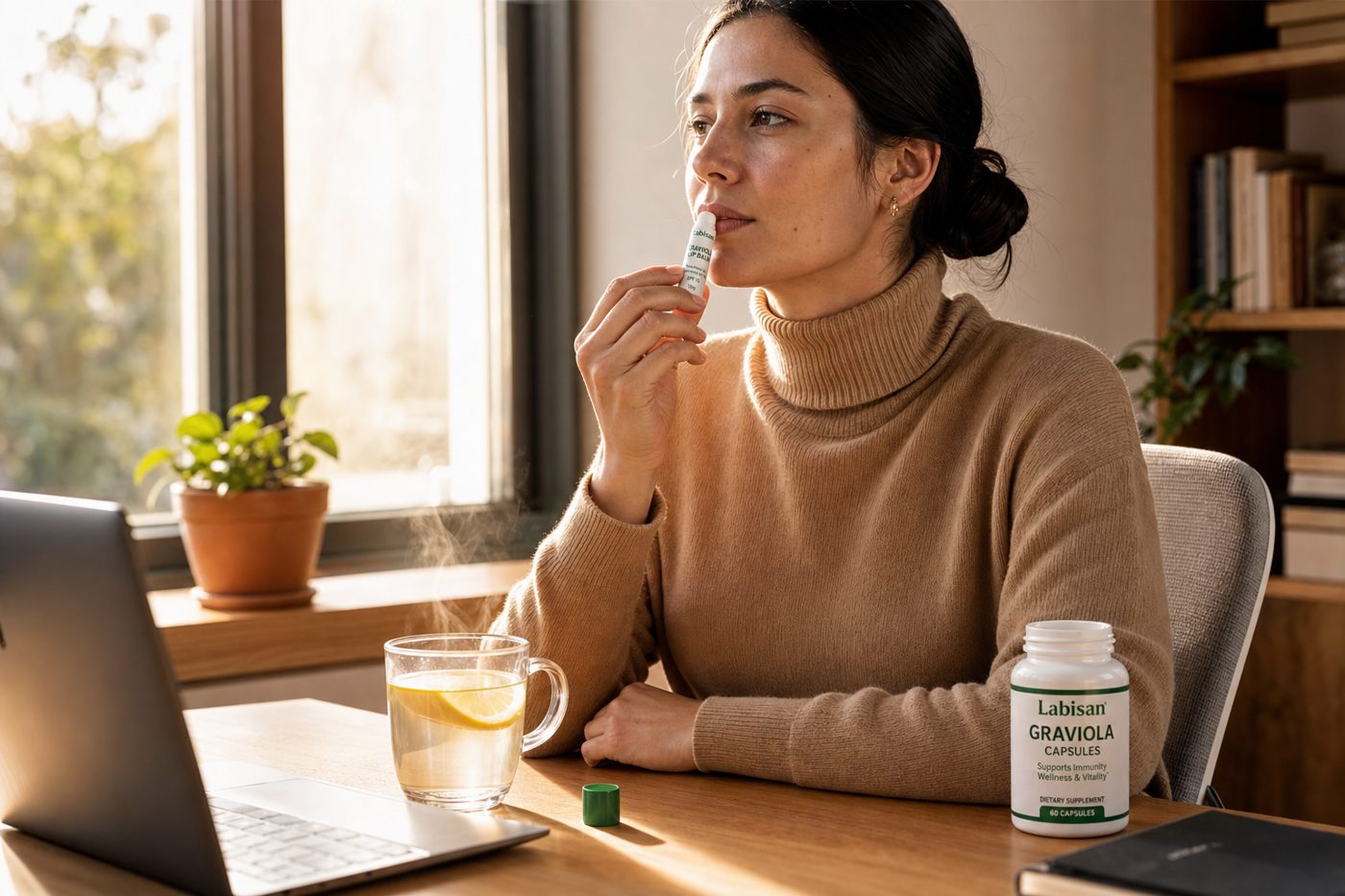
This is the reasoning behind a prevention first routine, and it is the part of the problem our own product addresses. A mineral SPF lip balm applied every morning and reapplied through sun exposure targets the trigger rather than the outbreak. It will not treat an active cold sore, and we would not claim it does. It is not a cure for HSV 1, which stays latent in the nerve for life. What it does is reduce one well evidenced provocation.
Practical reading of the evidence
- If an outbreak has already begun and you want to shorten it slightly, docosanol has the best supported over the counter case, and only if you start at the tingle.
- If you are considering lysine, treat it as unproven rather than recommended, and discuss it with a pharmacist, especially alongside other medication.
- If outbreaks are frequent, severe or spreading, prescription oral antivirals are a conversation for your doctor and sit well outside anything sold over a shop counter.
- If your outbreaks follow sun, snow, altitude or holidays, daily lip SPF is the intervention with the most striking trial contrast, and the cheapest to adopt.
Sources
- Sacks SL et al. Clinical efficacy of topical docosanol 10 percent cream for herpes simplex labialis: a multicenter, randomized, placebo controlled trial. Journal of the American Academy of Dermatology, 2001.
- US Food and Drug Administration. Docosanol 10 percent cream, over the counter monograph and approval documentation.
- Chi CC et al. Interventions for prevention of herpes simplex labialis (cold sores on the lips). Cochrane Database of Systematic Reviews, 2015.
- Rooney JF et al. Prevention of ultraviolet light induced herpes labialis by sunscreen. The Lancet, 1991.
- Griffith RS et al. Success of L lysine therapy in frequently recurrent herpes simplex infection. Dermatologica, 1987.
Written by the Labisan Research Team and edited by Alex, founder. Labisan has produced protective lip care in Austria since 1931. This article summarises published literature and cites its sources. It has not been reviewed by a licensed clinician, and it is not medical advice. Last updated 9 August 2026.