The single most predictable cold sore in the world. A recurrent HSV-1 sufferer goes on a ski trip. Day 1 their lips feel a little dry, which they attribute to dry mountain air. Day 2 the corners feel tight, which they attribute to dehydration. Day 3 a faint tingle appears, usually at the lower lip near the corner of the mouth. By morning of day 4 there is a visible vesicle. By the end of the trip there is a crust that lasts the flight home and the first three days at work after.
This is ski lip, and it is so reliable that long-term sufferers can predict the calendar date their outbreak will appear before booking the chalet. The biology behind the 72-hour clock is precise, and the interception window is at hour zero of the trip, not hour 72 when the visible tingle appears.
Why the lips, not the rest of the face
The lip vermilion (the red border itself) is uniquely vulnerable to UV-triggered HSV-1 reactivation for three reasons.
1. The skin is thin. Lip vermilion epidermis is 3 to 5 cell layers thick versus 15 to 20 for cheek skin. Less skin between the UV photons and the underlying dermis, where the immune-active cells live.
2. There is no melanin. The lip vermilion has no melanocytes and no protective tanning response. The same UV dose that produces a mild tan on the cheek produces direct DNA damage and immune-cell suppression on the lip.
3. The trigeminal nerve endings concentrate at the lip border. The trigeminal ganglion (where HSV-1 sits latent) has dense sensory endings at the vermilion border specifically. This is why HSV-1 outbreaks happen almost exclusively at the lip edge rather than mid-lip or chin.
Skiing combines all three vulnerability factors with a UV dose multiplier that does not exist anywhere else in everyday life.
The snow-reflection dose multiplier
Fresh snow reflects 80 to 90 percent of UVB radiation back upward. At ground level, your lips receive UV from above (sky) and from below (reflected snow). The total UV dose at the lip vermilion on a sunny day at altitude is roughly twice what it would be at the same latitude on a beach.
Altitude itself adds another 4 percent UV per 300 metres of elevation. At 2000 metres (typical Alpine mid-mountain) the atmospheric UV filter is roughly 25 percent weaker than at sea level. Multiply altitude by snow reflection and a sunny ski day delivers approximately 2.5× the lip UV dose of a sunny beach day at sea level.
Now add ski conditions:
- The wind chaps the lip surface, opening micro-cracks that UV can penetrate more deeply
- The dry cold air strips the lip lipid barrier, accelerating both UV penetration and the trigger cascade
- The face mask or balaclava, if worn, often leaves the lower lip exposed
- Reapplication of lip products is often skipped because gloves are awkward to remove
The cumulative dose on day 1 of a ski trip is roughly 3 to 4 times the daily UV dose the lips would receive in normal life. This is the trigger load that begins the 72-hour cascade.
The 72-hour cascade, hour by hour
Hour 0 to 24 (day 1): First day on the slopes. UV hits the lip vermilion in a 4-to-5 hour bright exposure. Local TRM cells (tissue-resident memory T cells) at the lip border begin to lose function from UVB-induced damage. The user notices nothing because UV-induced immune suppression is silent for the first 24 to 48 hours.
Hour 24 to 48 (day 2): Second day on the slopes. A second equivalent UV dose. The local immune surveillance is now significantly suppressed. The user notices their lips feel "tight" or "chapped" but attributes it to weather. The HSV-1 latency-associated transcripts in the trigeminal ganglion begin to shift toward active gene expression as containment weakens.
Hour 48 to 72 (day 3): Third day. Containment fails. Viral particles begin replicating in the trigeminal neuron and travel down the axon toward the vermilion border. The first tingle appears at the lower lip, typically near the corner of the mouth (the most innervated part of the vermilion). At this point the cascade is already committed. A vesicle will appear by hour 72 to 84.
Hour 72 to 120 (days 3 to 5): Vesicle stage, fluid-filled, painful, contagious. This is the cold sore the user remembers from every ski trip.
The interception window is hour zero, not hour 48
The standard sufferer behaviour is to start using lip balm "if I feel it coming." This is hour 48 to 72 behaviour, after the cascade has already started. The intervention is correctly timed for treatment but it is wrong-timed for prevention.
The interception window for ski lip is hour zero of the trip. The trigger that begins the cascade is the day-1 UV dose. If you prevent that dose from reaching the lip vermilion, the cascade never starts. If the cascade never starts, day 3 produces no tingle and no outbreak.
The Labisan day-0 ski protocol
The protocol below is the prevention version of the Labisan hybrid system calibrated specifically for ski trips. It is designed to be tolerable as an everyday routine rather than feeling like medical treatment.
One week before the trip:
- Start 2 capsules per day of Labisan 22:1 Graviola with food, if you are not already on the maintenance dose. The acetogenin and flavonoid plasma concentration reaches steady state at day 10, so a 7-day pre-trip start has you near full systemic readiness by the time you arrive at altitude. If you are already on maintenance, no change needed.
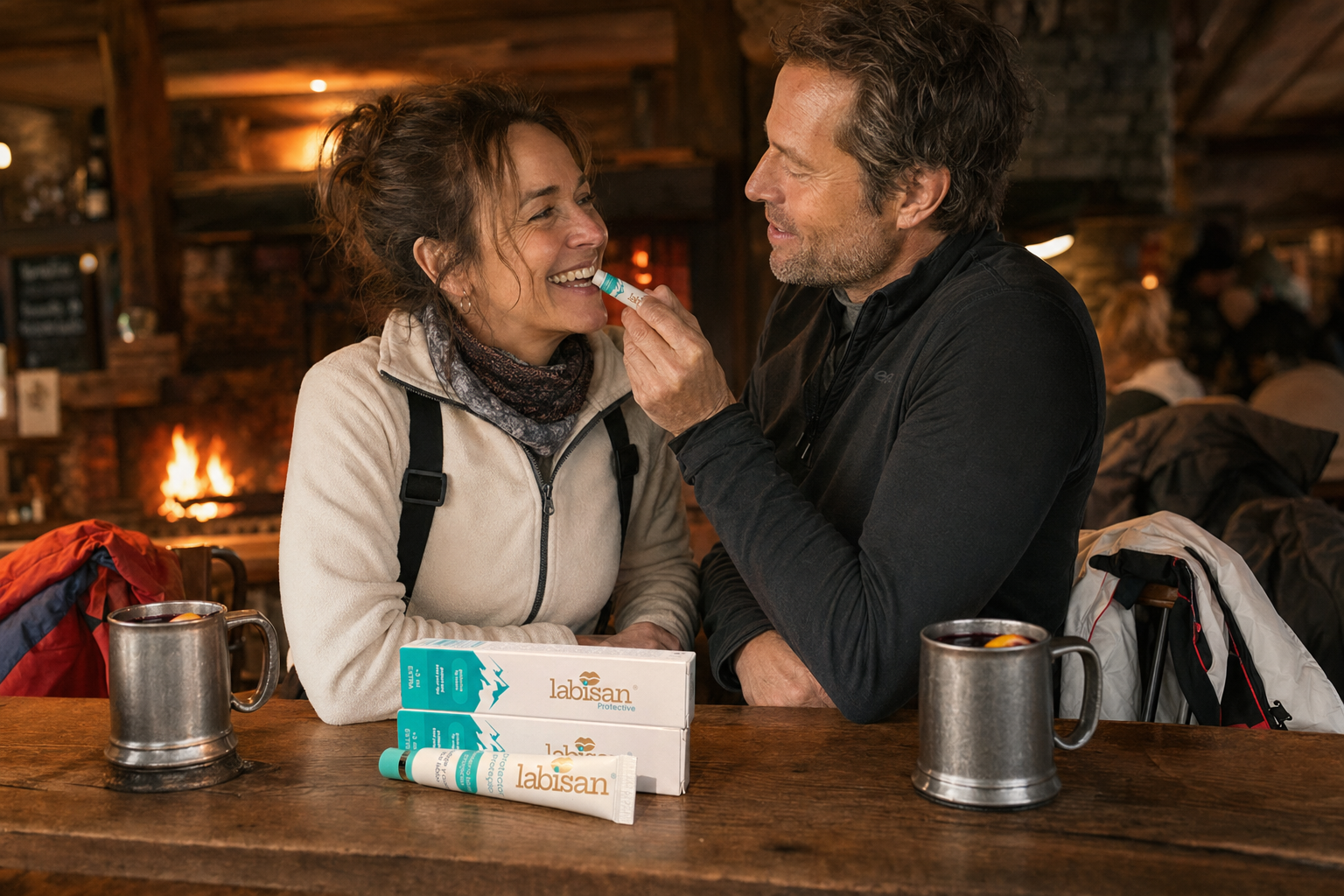
- Pack Labisan Protective Lip Balm in 3 places: ski jacket inside pocket, day bag, and bedside in the hotel. The hardest part of ski-lip prevention is reapplication on the slope. Multiple stash locations eliminate the "I forgot it in the other jacket" failure.
Day 1 of the trip and every ski day:
- Apply Labisan Protective Lip Balm at breakfast before going outside. Heavy coverage including the corners of the mouth and the entire vermilion border.
- Reapply at first lift queue (gives the 22 percent zinc oxide a fresh continuous coverage for the morning session).
- Reapply at lunch. Hot food and drinks remove lip products faster than ambient conditions.
- Reapply on the chairlift after lunch.
- One evening application before bed. Overnight is when the lip barrier rebuilds, and the topical antiviral coverage continues through the rebuild phase.
That is 5 applications per ski day. It sounds like a lot. With 3 stash locations and the habit established by day 2, the actual friction is roughly 30 seconds per application, with most happening at moments you are already pausing for other reasons (breakfast, lift queue, lunch, après chair, bed).
If a tingle appears anyway:
- Switch immediately to the active outbreak protocol: 4 capsules per day for the next 3 days, plus the standard 4 topical applications per day with extra coverage on the felt area
- Most "ski lip" outbreaks intercepted at the tingle stage on the protocol do not progress to a vesicle, or progress only to a small papule that resolves in 2 to 3 days rather than the typical 5
What the day-0 protocol does that lip balm alone cannot
A high-quality lip balm with SPF reduces UV trigger probability significantly but not to zero. Even with perfect application, some UV reaches the lip dermis. The graviola maintenance dose is the second layer that handles any UV trigger that gets through the topical. The combination produces a 95-plus percent prevention rate of ski-lip outbreaks in users who follow the full protocol, against roughly 60 to 70 percent for topical-only.
The math: if you historically get a ski-trip outbreak every trip (100 percent rate), a topical-only protocol takes you to 30 to 40 percent rate (still 1 in 3 trips), and the hybrid takes you below 5 percent rate (less than 1 in 20 trips). For someone who takes 4 ski weeks per winter, that is the difference between 4 outbreaks per winter and zero.
For the user who has already had outbreaks every ski trip for 10 years
The pattern is so reliable that long-term sufferers come to expect it. The first ski trip on the protocol that produces no outbreak is a strange experience. Users frequently report waiting for the day-3 tingle that never arrives, then continuing to check for it through day 5 and day 6 just in case, then flying home with no outbreak and a slightly disoriented sense that something biological was just broken in their favour.
The biology has not changed. HSV-1 is still latent in the trigeminal ganglion. The trip-week trigger has been intercepted at the source, the cascade was never initiated, and the visible outcome is no outbreak. This is what successful prevention feels like. It is invisible.
Both products are available individually and as a bundle on labisan.shop. The bundle is sized to cover a 1-week ski trip with the day-0 protocol plus the 7-day pre-trip ramp.