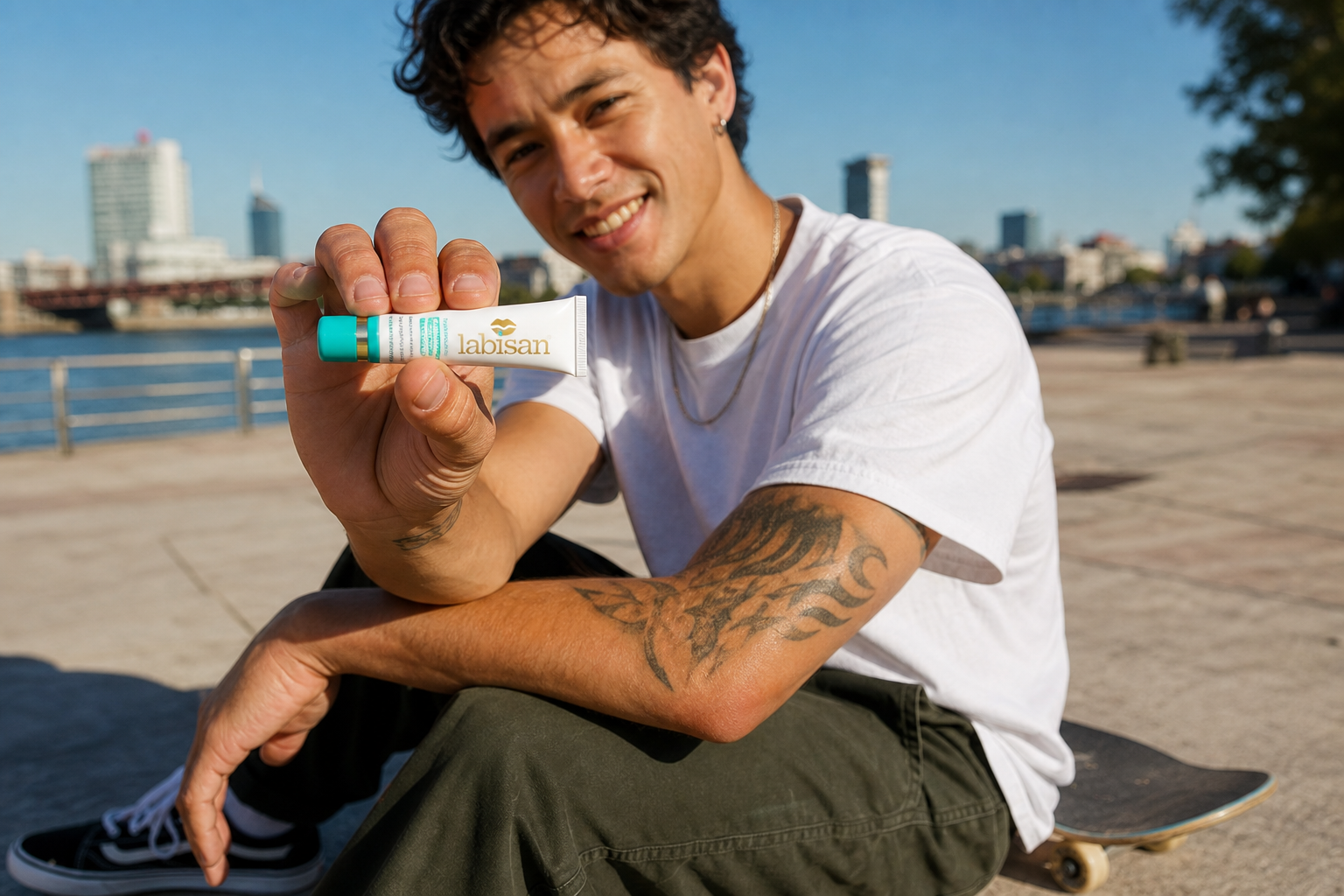
The vermilion of the lip, the pink or reddish zone between the wet mucosa inside your mouth and the ordinary haired skin of your face, is structurally unlike anything else on the body's surface. Its stratum corneum, the dead-cell shield that does most of the physical work of blocking ultraviolet radiation, is commonly described in dermatology texts as roughly 3 to 5 cell layers thick, against about 16 layers on the cheek and trunk. Functional studies of lip vermilion, notably the work of Kobayashi and Tagami published in 2004, found that the vermilion carries a markedly higher transepidermal water loss and lower stratum corneum hydration than adjacent facial skin, which is the biophysical signature of a weak barrier. The vermilion also has no sweat glands and essentially no sebaceous glands, aside from occasional ectopic Fordyce granules, so it produces no protective sebum film. And critically, it contains very few functional melanocytes. Since epidermal melanin supplies an intrinsic ultraviolet protection factor measured by Kaidbey and colleagues at about 3.4 in lightly pigmented skin and 13.4 in darkly pigmented skin, a tissue with almost no melanin is starting from close to zero. Thin, dry, unoiled, unpigmented, and anatomically angled toward the midday sun: that is why lips burn faster than the skin two centimetres away.
This matters far beyond cosmetics. The lower lip accounts for roughly 90 percent of actinic cheilitis cases and around 90 percent of lip squamous cell carcinomas, a distribution that tracks cumulative ultraviolet dose almost perfectly. And for the estimated 3.8 billion people under 50 living with HSV-1 according to World Health Organization figures published for 2020, ultraviolet exposure at the lip is one of the best-documented triggers of recurrent herpes labialis. Understanding the anatomy is the first step toward protecting it; if you have ever wondered why your lips crack and split in winter while your face stays intact, the same structural deficits are behind cold weather chapped lips and lip barrier failure.
How Thin Is Lip Skin, Really?
Skin thickness is not one number. The stratum corneum on the palms and soles can exceed 400 micrometres. On the trunk and face it is typically 10 to 20 micrometres, arranged in roughly 15 to 16 corneocyte layers. The vermilion is the outlier: a thin, only partially keratinised epithelium sitting over dermal papillae that push capillary loops unusually close to the surface. That vascular proximity is exactly why lips look red. Light passes through a shallow, poorly scattering layer of tissue and reflects off the haemoglobin underneath.
The same optical fact that makes lips attractive makes them vulnerable. A thick, dry, keratin-dense stratum corneum is an excellent ultraviolet attenuator: it scatters and absorbs a meaningful fraction of incoming UVB before any photon reaches a living keratinocyte nucleus. Strip that layer down to a few cells and a much larger share of the incident dose lands on proliferating basal cells and, over years, on the DNA within them.
The missing chemical shields
Thickness is only half the story. Normal stratum corneum contains trans-urocanic acid, a filaggrin breakdown product that functions as an endogenous ultraviolet-absorbing chromophore, along with the rest of the so-called natural moisturising factor. A thin, sebum-free, chronically dehydrated vermilion holds less of this chemistry. Lips therefore lack the physical shield (corneocyte layers), the pigment shield (melanin), and a good share of the chemical shield (urocanic acid and lipids) all at once. There is no other exposed site on the body where all three deficits stack.
Why Lips Have Almost No Melanin
Melanin is the body's evolved sunscreen. Melanocytes in the basal layer package melanin into melanosomes and hand them off to surrounding keratinocytes, which arrange them as microscopic parasols over the cell nucleus. In vermilion, melanocyte density and melanin transfer are low, particularly in Fitzpatrick skin types I to III. This is not a defect; it is the trade-off that produces the visible red colour that makes lips a signalling structure. But it means the tissue never tans in any meaningful protective sense. Facial skin responds to repeated ultraviolet exposure by thickening its stratum corneum and increasing pigment, gaining a modest ultraviolet protection factor over a season. Lips do not acclimatise. Day one of a ski week and day seven carry the same intrinsic vulnerability.
People with more deeply pigmented vermilion do have measurably more protection, and epidemiological data on lip cancer reflect that. But no one has enough lip melanin to make sun protection optional, and the ultraviolet-triggered immune events described below occur regardless of pigmentation.
The Geometry Problem: Why the Lower Lip Burns First
Anatomy compounds histology. The lower lip presents a broader, more horizontally oriented surface to the sky than the upper lip, which sits shadowed under the nose and philtrum for much of the day. Around solar noon, when ultraviolet flux peaks, the lower lip is close to perpendicular to the incoming beam while the upper lip is close to parallel and partially shaded. The result is a substantially larger cumulative dose to the lower lip over a lifetime, and it is precisely why actinic cheilitis, the precancerous scaly, blurred-border change dermatologists look for, is overwhelmingly a lower-lip disease.
Reflected ultraviolet makes this worse in specific environments. Fresh snow reflects up to about 80 percent of incident UVB back upward, and ambient ultraviolet rises roughly 10 to 12 percent per 1,000 metres of elevation. A skier at 2,500 metres is receiving a direct overhead dose plus a strong upward-reflected dose that hits the underside of the lower lip, the exact surface that a hat brim cannot shade. Wax-only products offer no defence here at all, as we covered in our breakdown of why beeswax-only lip balm fails at altitude.
From Sunburn to Cold Sore: The UV-HSV Link
Herpes simplex virus type 1 establishes latency in the trigeminal ganglion. Reactivation requires a trigger, and ultraviolet radiation is among the most reproducible ones ever tested. Experimental studies from Spruance and colleagues in the 1980s showed that controlled ultraviolet exposure to the lip induced recurrent herpes labialis in a large proportion of susceptible volunteers, turning an unpredictable condition into something researchers could schedule.
The mechanism is two-sided. Ultraviolet B causes local immunosuppression: it depletes Langerhans cells from the epithelium, drives keratinocyte release of immunosuppressive cytokines including IL-10, and isomerises trans-urocanic acid into cis-urocanic acid, a known immunomodulator. At the same time it stresses the epithelium and the sensory nerve endings feeding back to the ganglion. Reduced local immune surveillance plus neuronal stress is a permissive window for viral replication to escape control.
The clinical proof point is the crossover trial by Rooney and colleagues published in The Lancet in 1991: under experimental ultraviolet exposure, 27 of 38 placebo-treated subjects developed herpes labialis lesions, compared with 0 of 35 in the sunscreen-treated arm. Honesty requires the counterweight: a separate field study of skiers by Mills and colleagues in 1987 did not reproduce the effect under real-world conditions, most plausibly because field sunscreen application to the lip is thin, patchy, and rarely reapplied after eating, drinking, or lip licking. The lesson is not that ultraviolet blocking fails; it is that it only works if the film is actually present on the lip when the ultraviolet arrives, which is the entire rationale behind the 90-minute lip SPF reapplication rule.
Why the Labisan Dual Protocol Is the Smarter Long-Term Answer
Look honestly at what the cold sore aisle actually contains. Docosanol creams such as Abreva, acyclovir and valacyclovir, hydrocolloid patches, lysine tablets: every one of them is deployed after you feel the tingle. They shorten or soften an episode that has already begun. None of them touches the upstream ultraviolet trigger, and none of them was designed to. If your reactivations cluster around ski trips, beach days, sailing, altitude hiking, or the first strong spring sun, a treatment-only strategy means you are guaranteed to keep having the outbreak and then racing to shorten it.
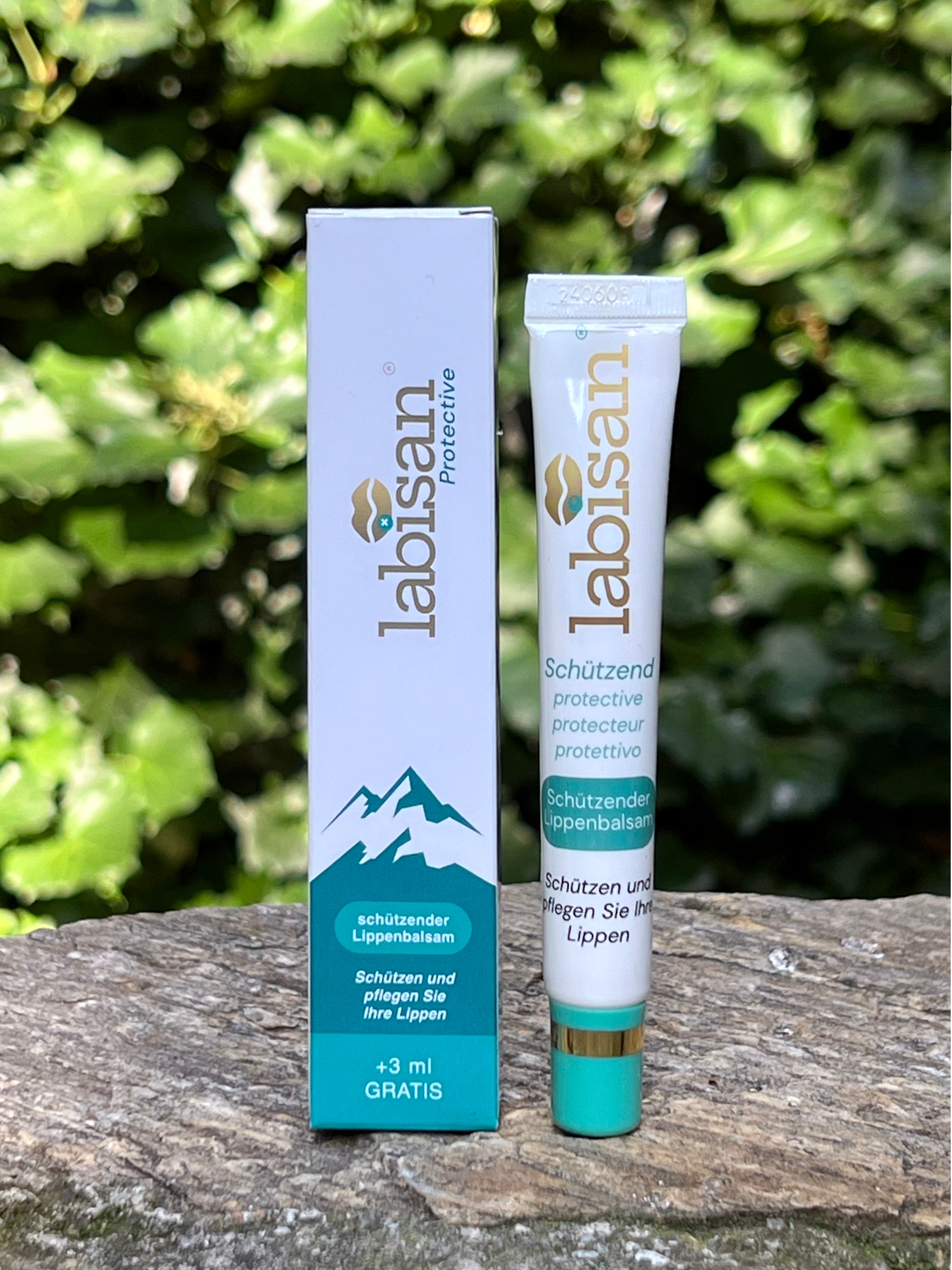
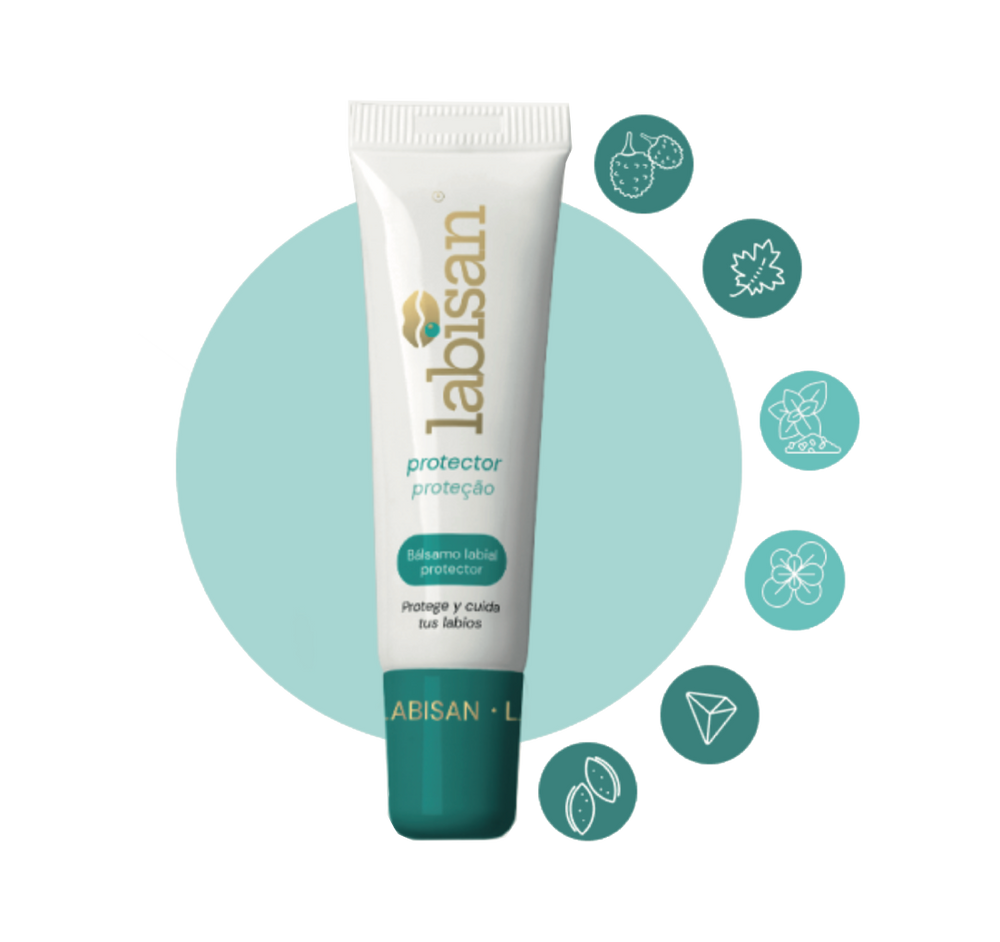
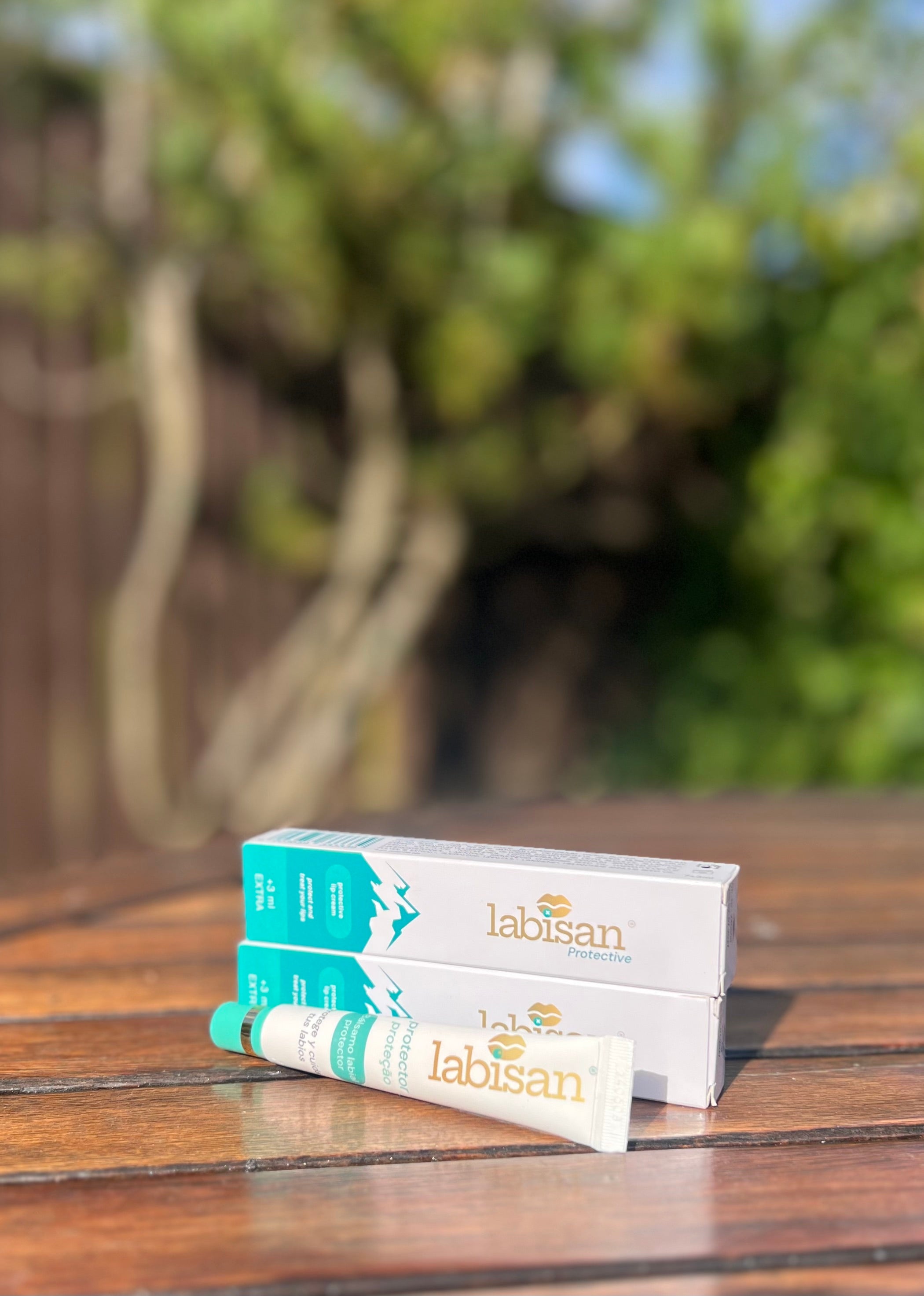
Labisan is built the other way around. The Labisan Protective Lip Balm SPF 20 puts a non-negotiable mineral barrier where the vulnerability actually is. Its 22 percent zinc oxide load is a broad-spectrum, photostable physical filter that sits on the surface and reflects and absorbs both UVA and UVB, which is exactly the right technology for a tissue with no melanin and only a few corneocyte layers of its own. Shea butter and occlusive waxes rebuild the lipid film the vermilion cannot produce, and manuka and oregano botanicals contribute the antiviral and anti-inflammatory dimension we detail in the full Labisan formula breakdown. The goal is straightforward: remove the largest and most predictable HSV-1 reactivation trigger before it fires.
The second half of the protocol works from the inside. Labisan Graviola Capsules support general immune resilience, with the honest and limited aim of reducing outbreak frequency over time. Graviola is not an antiviral drug, it does not eradicate latent virus in the trigeminal ganglion, and nothing available anywhere cures HSV-1 or HSV-2. What it does is support the immune function that keeps latency stable between exposures. Blocking the trigger externally while supporting immune control internally addresses both halves of the reactivation equation, rather than only the aftermath. If an outbreak does break through, you still treat it properly using the 5-day cold sore lifecycle protocol; prevention and treatment are complements, not rivals. The difference is that with Labisan, treatment is the exception rather than the seasonal routine.
Give Your Thinnest Skin the Protection It Cannot Make Itself
Labisan Protective Lip Balm SPF 20
Single: $24.99 | Adventure Pack (3x): $59.97 | Family Bundle (5x): $89.95
Free EU shipping over $49, $19.99 worldwide. 30 day satisfaction guarantee.
Shop NowFrequently Asked Questions
Why do lips burn easily compared with the rest of my face?
Three deficits stack in the same tissue. The lip vermilion has a stratum corneum of roughly 3 to 5 cell layers instead of about 16, so there is far less physical attenuation of ultraviolet light. It has very few functional melanocytes, so it lacks the pigment shield that gives facial skin an intrinsic ultraviolet protection factor of roughly 3 to 13 depending on skin type. And it has essentially no sebaceous or sweat glands, so it produces no protective lipid film and holds less of the ultraviolet-absorbing urocanic acid found in normal stratum corneum.
Can lips tan or build up tolerance to the sun?
Not meaningfully. Facial skin adapts to repeated exposure by thickening its stratum corneum and increasing melanin production. The vermilion does neither to any useful degree, which is why the last day of a sun holiday carries the same risk as the first and why sun protection at the lip has to be continuous rather than front-loaded.
Does blocking UV actually reduce cold sores?
Under controlled ultraviolet challenge, yes: the 1991 Rooney trial in The Lancet recorded lesions in 27 of 38 placebo subjects versus 0 of 35 with sunscreen. A 1987 field study of skiers did not reproduce that result, most likely because real-world lip application is thin and rarely reapplied. The practical conclusion is that ultraviolet blocking works when the film is genuinely present and maintained, so reapply roughly every 90 minutes and always after eating, drinking, or wiping your mouth.
Why does my lower lip burn before my upper lip?
Geometry. The lower lip is broader and faces more directly upward, so near solar noon it sits close to perpendicular to the incoming beam, while the upper lip is shaded by the nose and philtrum. Snow and water also reflect ultraviolet upward onto the lower lip's underside, a surface no hat brim can shade. That dose difference is why roughly 90 percent of actinic cheilitis and lip squamous cell carcinoma cases occur on the lower lip.
Do Graviola capsules treat an active cold sore?
No. Labisan Graviola Capsules are an immune support supplement intended to help reduce outbreak frequency over time, not a treatment for an active lesion and not a cure for HSV-1 or HSV-2. Nothing currently available cures herpes simplex. Use the capsules as ongoing support alongside daily SPF lip protection, and treat any active outbreak with an appropriate topical protocol. If you are pregnant, breastfeeding, or taking prescription medication, speak with your doctor before starting any supplement.