The American Academy of Dermatology's core sunscreen instruction is unambiguous: apply a broad-spectrum, water-resistant sunscreen with an SPF of 30 or higher, and reapply approximately every two hours, or immediately after swimming or sweating heavily. The AAD applies the same logic to lips, recommending a lip balm carrying SPF. What most articles leave out is why two hours is the number. It is not a measure of how long a UV filter chemically survives; it is a practical estimate of how long a continuous film stays on skin under normal wear, and lips are the single worst-case site for film survival on the entire body. The vermilion has a stratum corneum roughly three to five cell layers thick compared with about fifteen or more on the cheek, almost no melanin, essentially no hair follicles or sweat glands, and only sparse sebaceous glands, so it has neither the pigment defence nor the natural lipid film that the rest of your face gets for free. It is also in near-constant mechanical contact: talking, eating, drinking, wiping, and licking all strip product. That combination is why the lower lip, which sits at a more direct angle to overhead sun, accounts for roughly 90 percent of lip squamous cell carcinomas, and why actinic cheilitis is one of the most commonly missed premalignant findings in general dermatology. If you want the single most useful behaviour change, it is not chasing a higher SPF number; it is holding a continuous film, which is exactly what our breakdown of the 90 minute reapplication rule for SPF lip balm covers in field conditions.
What the AAD Guidance Actually Says, Precisely
The AAD's public guidance has three parts that matter for lips, and they are usually collapsed into one sentence by the time they reach a search result. Taken separately:
One: the two hour interval is a maximum, not a target. The AAD wording is "reapply approximately every two hours." It is the outer bound of a reasonable interval under ordinary conditions, and the same guidance immediately qualifies it with "or after swimming or sweating." Two hours is what you get on a calm, dry, low-activity day. It is not what you get on a chairlift or at a lakeside lunch.
Two: water resistance is a 40 or 80 minute claim, not a waterproof claim. Under FDA labelling rules, no sunscreen may be marketed as waterproof or sweatproof. A "water resistant (80 minutes)" label means SPF was maintained through a defined immersion protocol for 80 minutes. On lips, drinking from a bottle is functionally an immersion event every time.
Three: the SPF number on the tube assumes a laboratory application density you almost certainly are not achieving. SPF testing under FDA and ISO 24444 protocols uses 2 mg per square centimetre. Repeated consumer-behaviour studies find real-world application at roughly 0.5 to 1.0 mg per square centimetre, meaning about a quarter to a half of the tested dose. Because protection does not scale linearly with thickness, under-application costs far more than the arithmetic suggests. This is the reason reapplication frequency, not headline SPF, is the variable that decides your actual exposure.
What if my lip balm is SPF 20 rather than SPF 30?
Worth stating plainly: the AAD recommends SPF 30 or higher. The honest arithmetic is that a correctly applied SPF 20 filters about 95 percent of incident UVB, SPF 30 about 96.7 percent, and SPF 50 about 98 percent. The gap between 20 and 30 is roughly 1.7 percentage points of UVB when both are applied at test density. The gap between a film that is present and a film that wore off two hours ago is 95 percentage points. A thick, opaque, mineral lip film reapplied on schedule outperforms a higher-SPF product applied thinly at breakfast and never touched again. Both facts are true at once, and the practical conclusion is the same either way: reapply.
Why Lips Lose SPF Faster Than Any Other Site
There are four distinct loss mechanisms operating on the vermilion, and they stack.
Ingestion and transfer. Every sip, bite, and napkin wipe physically removes product. A single coffee removes a meaningful proportion of the film; a full meal removes most of it. No other sunscreened site on the body has a comparable removal rate.
Licking. Saliva contains amylase and lipase, and the evaporative cooling of a wet lip drives further water loss from the tissue underneath. Compulsive licking in dry conditions is both a film-removal mechanism and an independent driver of barrier damage, which is why cold weather chapped lips are a barrier failure problem rather than a simple hydration problem.
Ambient reflection and altitude. Fresh snow reflects up to 80 percent of incident UV, and UV intensity rises roughly 10 to 12 percent per 1,000 metres of elevation. On a spring ski day the lower lip receives both the direct overhead beam and a strong upward-reflected beam, which is precisely the angle a wearing-off film stops covering first.
Formulation drift. Wax-heavy balms with no meaningful filter load can feel present long after they have stopped protecting, which is the failure mode described in our field notes on why beeswax-only lip balm fails at altitude. A lip feeling smooth is not evidence of an intact UV filter layer.
A Lip-Specific Reapplication Protocol
Translate the AAD's two hour ceiling into lip terms by treating events, not the clock, as your triggers. Reapply at whichever comes first.
Baseline, ordinary day: every two hours of daylight exposure, plus once before you leave the building. Two hours is the ceiling here, not a stretch goal.
After any oral event: immediately after eating, after finishing a drink, and after wiping your mouth. This is the rule that does the most work, because it is the one people skip.
Snow, water, or high altitude: every 60 to 90 minutes. Reflection plus wind plus sweat under a helmet strap compresses the useful film life well below the two hour general-purpose figure. Practically, that means a reapplication at the top of most lifts, not at lunch.
Endurance activity: every 45 to 60 minutes when sweating heavily, and always after a water station.
Technique: apply a visible, slightly opaque layer, and roll it out onto the vermilion border and the skin just above it. That border is where actinic damage concentrates and where most people stop applying. If you cannot see a faint film, you have applied a fraction of the tested dose.
Reapplication Is Also a Cold Sore Question
For anyone carrying HSV-1, the two hour rule stops being a skin cancer conversation and becomes an outbreak-frequency conversation. UVB exposure is a well-documented reactivation trigger for herpes labialis: it suppresses local Langerhans cell surveillance in the epidermis and appears to promote viral reactivation from the trigeminal ganglion. The cleanest experimental evidence comes from Rooney and colleagues, published in The Lancet in 1991, in which volunteers with a history of sun-induced recurrences were exposed to controlled UV under sunscreen or placebo in a crossover design; lesions developed in a large majority of placebo exposures and in none of the sunscreen-protected exposures.
Honesty requires the counterweight: subsequent field trials of sunscreen lip balm during real skiing holidays did not reproduce that clean result, almost certainly because free-living participants did not maintain a continuous film across a day of eating, drinking, and wind. That is not evidence that UV protection fails. It is evidence that intermittent UV protection fails, which is the entire argument for taking the reapplication interval seriously. If you already know what your prodrome feels like, pair prevention with the staged response in our 5 day cold sore lifecycle protocol.
Why the Labisan Dual Protocol Is the Smarter Long-Term Answer
Almost every well-known cold sore product is a reaction, not a prevention. Docosanol creams such as Abreva, antivirals such as acyclovir and valacyclovir, hydrocolloid patches, and lysine supplements all start working only once reactivation has already happened. They can shorten an episode by a day or so when started early, and that is genuinely useful. But by the time you reach for them, the trigger has already fired.
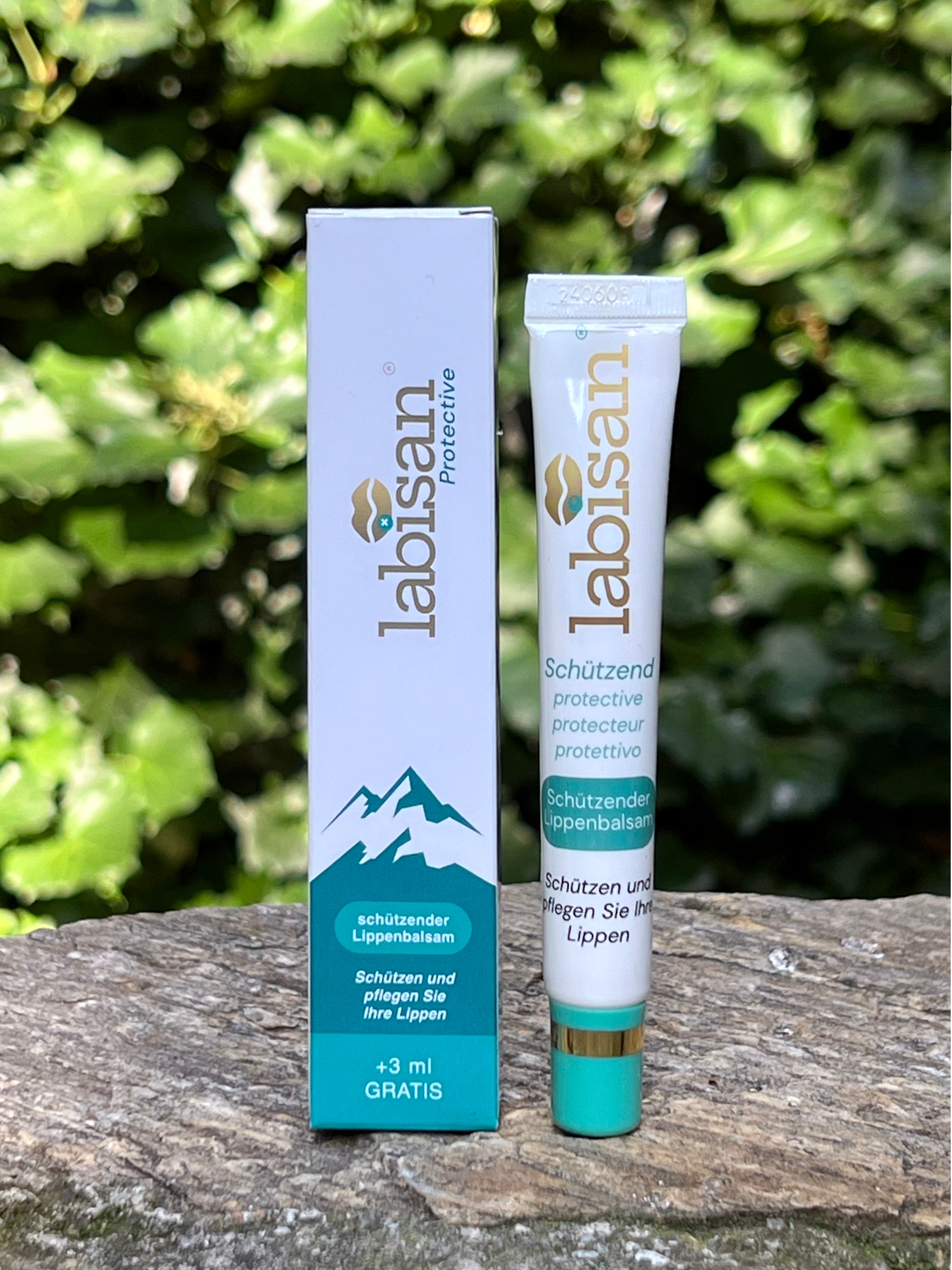
Labisan Protective Lip Balm SPF 20 attacks the problem one step earlier. It is built around a 22 percent zinc oxide load, a photostable mineral filter with genuine broad-spectrum UVA and UVB coverage, in a shea butter and beeswax base engineered to hold a film through wind and cold rather than melting off it. Zinc oxide sits on the surface and scatters, so it does not need to be absorbed to work and does not photodegrade over the day; manuka oil and supporting botanicals round out the formula, as detailed in our breakdown of the 22 percent zinc oxide, graviola, manuka and oregano formula. The point of the AAD two hour rule and the point of this formula are the same: keep an unbroken barrier over the single largest reactivation trigger at the lip.
The second half of the protocol works from the inside. Labisan Graviola Capsules are an immune-support supplement intended to help reduce how often outbreaks occur over time, for people whose recurrences track with stress, illness, and run-down periods rather than sun alone. To be explicit: graviola is not a cure for HSV-1 or HSV-2, it does not eliminate latent virus, and no supplement can. Herpes simplex remains lifelong once acquired. What the dual protocol offers is a defensible pair of levers on frequency: block the external trigger at the lip surface, and support immune resilience internally, rather than waiting to treat lesion number nine of the year. That is a better long-term position than any treat-after-onset product can offer on its own, and it is compatible with them if you also want an antiviral on hand.
Hold the Film. Block the Trigger.
Labisan Protective Lip Balm SPF 20
Single: $24.99 | Adventure Pack (3x): $59.97 | Family Bundle (5x): $89.95
Free shipping over $49. 30 day satisfaction guarantee.
Shop NowFrequently Asked Questions
Does the AAD really say to reapply SPF lip balm every 2 hours?
The AAD's sunscreen guidance is to apply broad-spectrum SPF 30 or higher and reapply approximately every two hours, or immediately after swimming or sweating, and it recommends using a lip balm with SPF for the lips. So the two hour interval is the general sunscreen recommendation applied to a site that loses product faster than average. For lips specifically, treat two hours as the maximum and reapply sooner after eating, drinking, or sweating.
Why do lips need reapplication more often than the rest of the face?
Three reasons: the vermilion has a much thinner stratum corneum and almost no melanin, it has minimal sebaceous and no sweat gland output to help hold a film, and it is in constant mechanical contact through eating, drinking, talking, and licking. A cheek keeps its sunscreen layer largely intact for the full two hours. A lip often does not survive one coffee.
Is SPF 20 enough for lips if the AAD recommends SPF 30?
SPF 30 is the AAD's stated floor and is a reasonable target. In practice, correctly applied SPF 20 filters about 95 percent of UVB versus about 96.7 percent for SPF 30, while typical under-application costs far more protection than that 1.7 point difference. A thick, opaque, broad-spectrum mineral film reapplied on schedule is the higher-value behaviour. Application density and reapplication frequency dominate the outcome.
Can reapplying SPF lip balm prevent cold sores?
It can meaningfully reduce one major trigger, not eliminate the condition. UV is a documented reactivation trigger for herpes labialis, and controlled UV-exposure studies showed sunscreen preventing induced lesions. Field studies were less convincing, most likely because participants did not maintain continuous coverage. Consistent reapplication is the difference between the two results. No lip balm cures HSV-1 or removes latent virus.
Does frequent lip balm use make lips dependent on it?
No. There is no physiological dependency mechanism; the perception usually comes from occlusive, low-substance formulas that mask barrier damage without repairing it, or from flavour and menthol driving a lick-reapply loop. A mineral SPF balm with a repairing lipid base does not create that cycle, as explained in our piece on the lip balm addiction myth and mineral SPF.