The most useful number in lip photoprotection is zero. In a double blind, placebo controlled crossover trial published in The Lancet in 1991, Rooney and colleagues exposed 38 adults with a documented history of sun triggered herpes labialis to experimental ultraviolet light on the lip. After the placebo balm, 27 of 38 subjects (71 percent) developed a cold sore. After an SPF 15 sunscreen applied to the same lip under the same UV dose, the number of lesions was 0 of 35. Not fewer. None. That single result is the strongest piece of evidence in the entire cold sore literature that the most common reactivation trigger is also the most preventable one, and it is the reason a four hour round of golf deserves a lip strategy rather than a lip afterthought.
Golf is where that evidence collides with reality. An average 18 hole round runs roughly 4 hours to 4 hours 30 minutes. There is no chairlift break, no lodge, no halfway house for most of it, and unlike skiing or the beach, nothing about the environment signals danger: the grass is cool, the temperature is pleasant, and the sun feels manageable. That mismatch between perceived risk and delivered dose is exactly why golfer lip sunburn is so common and so consistently untreated. If you want the general timing principle behind everything below, our breakdown of why lip SPF fails at the 90 minute mark covers the wear mechanics; this article applies that math to a scorecard.
Golf Is a High Dose Sport That Never Feels Like One
Run the radiometry. One Standard Erythemal Dose (SED) equals 100 joules per square metre of erythemally weighted UV. A UV Index of 1 corresponds to 25 milliwatts per square metre, so a clear summer day at UV Index 8 delivers about 7.2 SED per hour of ambient exposure on a horizontal surface. A four hour round played across the middle of that day therefore sits inside an ambient budget of roughly 20 to 28 SED. Not all of that reaches your lip: head angle, hat brim and posture cut it substantially. But even at a deliberately conservative 25 percent of ambient reaching the vermilion of the lower lip, you are looking at 5 to 7 SED. Fair skin burns at about 2 to 3 SED. A single unprotected round can hand your lower lip two to three times a burn dose, and that is before you count the back nine of a 36 hole day, a summer league, or a golf holiday where you do it five days running.
Two more numbers matter here. First, roughly 60 percent of a day's total UV arrives between 10am and 4pm, which is precisely the tee time window most amateurs book. Second, on a clear day, diffuse sky radiation, meaning UV scattered by the atmosphere rather than arriving straight from the sun, accounts for around half of total ground level UV, and a larger share of UVA. This is the fact that quietly defeats hats. A wide brim can cut UV to the nose and forehead by something on the order of 50 percent, but its performance falls off sharply for the chin and lower lip, which sit below the brim line and are irradiated by scattered light coming from the open sky and, to a lesser extent, from the ground.
Golf Course UV Lips: Reflection Is Not the Villain, Duration Is
It is worth being accurate rather than alarmist about surfaces. Turfgrass is a poor UV reflector, bouncing back only about 2 to 5 percent. Water reflects roughly 5 to 10 percent at typical mid morning and afternoon sun angles. Dry sand is the outlier at about 15 to 25 percent, which is a genuine, if modest, argument for the golfer who finds three bunkers a round. Compare that to fresh snow at up to 80 to 90 percent, and it becomes obvious that golf course UV lips is not a reflection story like skiing is. Golf's exposure problem is pure dwell time: low reflectance, low shade, very long duration, and a sport that punishes you for wearing anything that interferes with your eyeline or your grip. Elevation adds a modifier, since erythemal UV rises roughly 10 to 12 percent per 1000 metres of altitude, so a course in the Alps, Colorado or the Sierra Nevada is materially harsher than a coastal links at the same UV Index reading.
Why the Lower Lip Fails Before the Rest of Your Face
The vermilion of the lip is not skin in the way your cheek is skin. Its stratum corneum is only a few cell layers thick against roughly 15 to 16 on facial skin, it carries little to no melanin protection, and it is functionally devoid of the sebaceous and sweat gland density that keeps the rest of the face lubricated. The consequence is a barrier that loses water several times faster than adjacent cheek skin and has almost no intrinsic defence against photons. This is why the lower lip, which is anatomically tilted upward toward the sky, accounts for the overwhelming majority of lip cancers, on the order of 90 percent of lip squamous cell carcinomas, and why chronic sun damage there has its own diagnosis: actinic cheilitis, a premalignant change presenting as persistent dryness, scaling, blurring of the vermilion border and a whitish, leathery texture that never quite resolves.
Add golf's secondary insults. Wind on an exposed links accelerates transepidermal water loss. You drink repeatedly over four hours, and every bottle takes a film of product with it. You wipe your face with a towel between shots. You lick your lips while reading a putt, and evaporating saliva leaves the lip drier than before, along with digestive enzymes that further degrade an already compromised barrier. The mechanical failure of lip products, and why simple waxes are the worst offenders in dry, windy, high output conditions, is covered in detail in our analysis of how the lip barrier actually fails under environmental stress.
The Real Reapplication Math for 18 Holes
Sunscreen SPF is measured in laboratories at an application density of 2 milligrams per square centimetre. Real world users typically apply between 0.5 and 1.0 mg/cm2. Because protection does not scale linearly with thickness, applying at half the test density does not give you half the SPF; it gives you considerably less. A labelled SPF 20, applied thinly and once, is plausibly delivering single digit real world protection by the time you reach the second green. The FDA and dermatology bodies including the American Academy of Dermatology recommend reapplying sunscreen at least every two hours, and immediately after swimming, sweating or towelling. The lip is a worse case than the arm on every one of those variables.
The Scorecard Protocol
Do not try to remember a clock over four hours; anchor the schedule to the course itself, which is what golfers already track. Five applications cover a standard round:
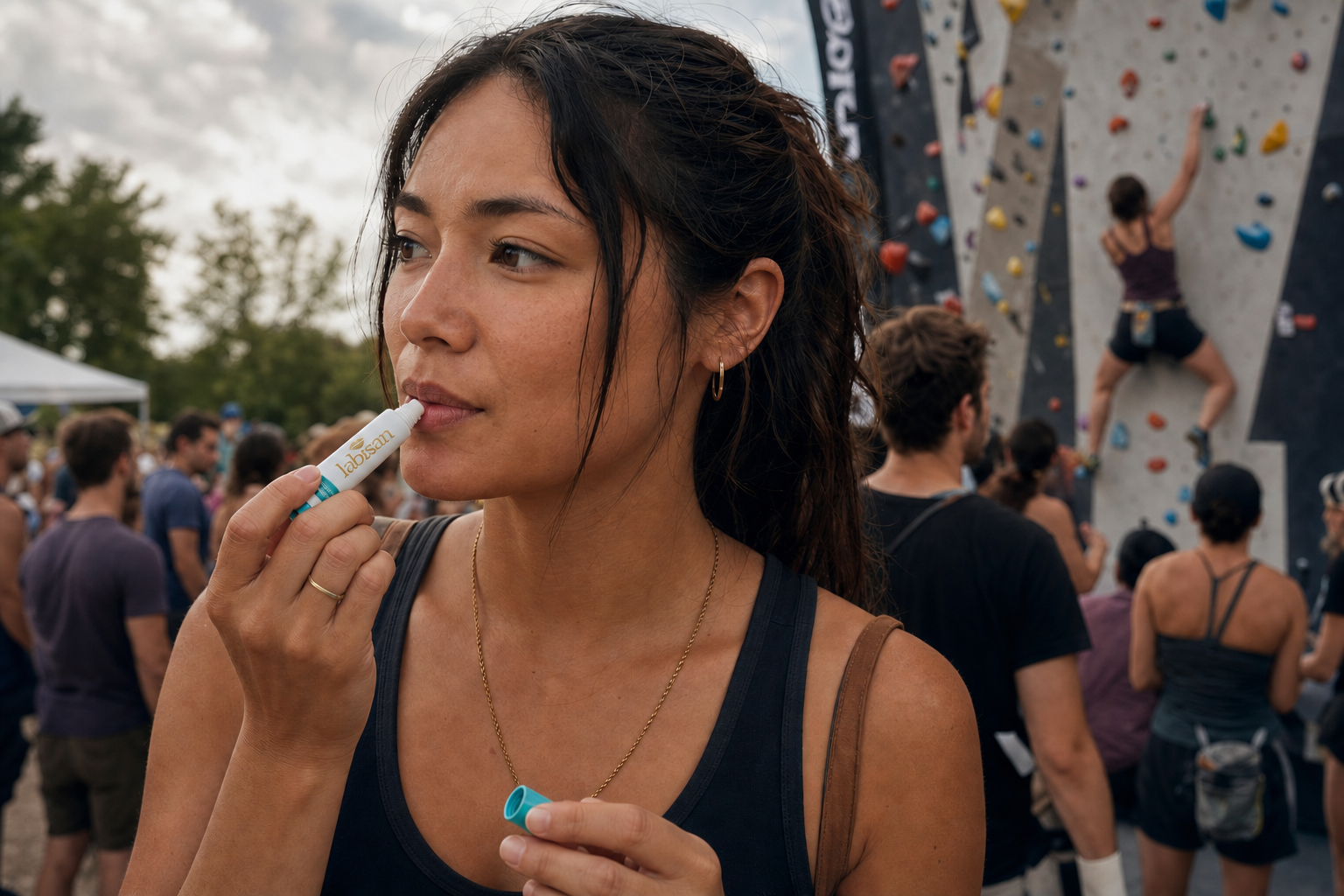
Application 1, on the practice green or in the car park: the most important one, because it is the only application made to a clean, dry lip with time to set. Apply 15 to 20 minutes before your tee time, and cover the full vermilion plus 1 to 2 millimetres past the lip border, since that transition zone is where actinic damage concentrates. Application 2, walking off the 4th or 5th green: this is the roughly 60 to 75 minute mark and the point at which a single early layer is measurably degraded. Application 3, at the turn: the 9th is a natural break, and it is also where most golfers eat, which strips whatever is left. Reapply after food, not before. Application 4, around the 13th or 14th: the back nine of a summer round frequently coincides with the highest UV Index period of the afternoon. Application 5, after the final putt: post round application is not sun protection, it is barrier repair on a lip that has just spent four hours dehydrating; occlusive butters and waxes here reduce the overnight water loss that produces next morning cracking.
Five applications over 4 hours 15 minutes works out to one roughly every 50 minutes. If that sounds excessive, compare it to the number of times you reset your glove, and note that a single stick lives permanently in the ball pocket at zero cognitive cost. Formulation matters as much as frequency: the reason Labisan builds on 22 percent zinc oxide rather than a chemical filter set is that mineral zinc oxide is photostable, meaning it does not degrade under the very UV it is blocking, it works from the moment of application with no absorption lag, and it provides genuinely broad spectrum coverage across UVB and long wave UVA out past 380 nanometres. Chemical filters can degrade over hours of continuous irradiation, which is a real consideration for a four hour sport.
What a Burned Lip Actually Sets Off
For roughly two thirds of the global population under 50 who carry HSV-1, a sunburned lip is not just a sunburned lip. The virus persists latently in the trigeminal ganglion, held in check by resident CD8 positive T cells. Ultraviolet B exposure does two things at once: it damages the epithelium, and it induces local immunosuppression, notably by depleting and functionally impairing epidermal Langerhans cells. The current working model of UV triggered recurrence is that this local immune suppression removes the brake on reactivation, which is why lesions typically emerge 24 to 72 hours after the exposure rather than during it. That delay is precisely why golfers so rarely connect Saturday's round to Monday's cold sore, and why the diagnosis of the trigger is so often missed.
Once a lesion has started, the clock is unforgiving: the prodrome to crusting sequence is largely predetermined, which is what our five day cold sore lifecycle protocol maps stage by stage. Antivirals started at first tingle shorten an episode by roughly a day. Prevention, per the Lancet trial that opens this article, removed the episode entirely under experimental conditions. Those are not comparable magnitudes of benefit.
Why the Labisan Dual Protocol Beats Treating After the Fact
Look honestly at what the cold sore aisle actually sells. Docosanol creams such as Abreva, hydrocolloid patches such as Compeed, lysine supplements, and prescription antivirals including acyclovir and valacyclovir are all, without exception, reactive. They are designed to be deployed once replication is already underway, and within their design brief several of them are genuinely useful; nobody should stop carrying what works for them during an episode. But every one of them starts its stopwatch after the trigger has already fired. None of them address the exposure that fired it. For a golfer, that means the entire category is structurally incapable of helping you during the four hours in which the actual damage is being done.
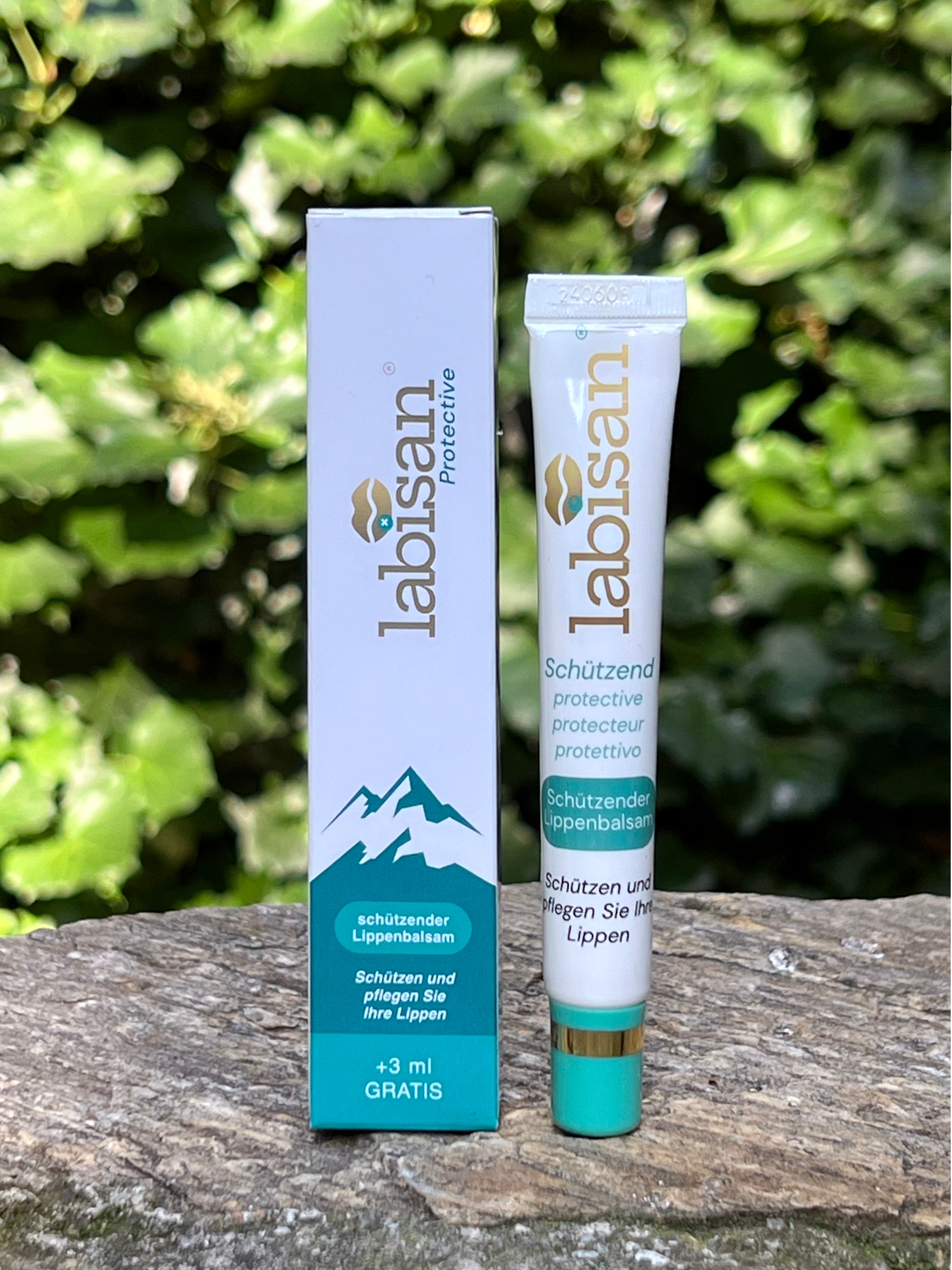
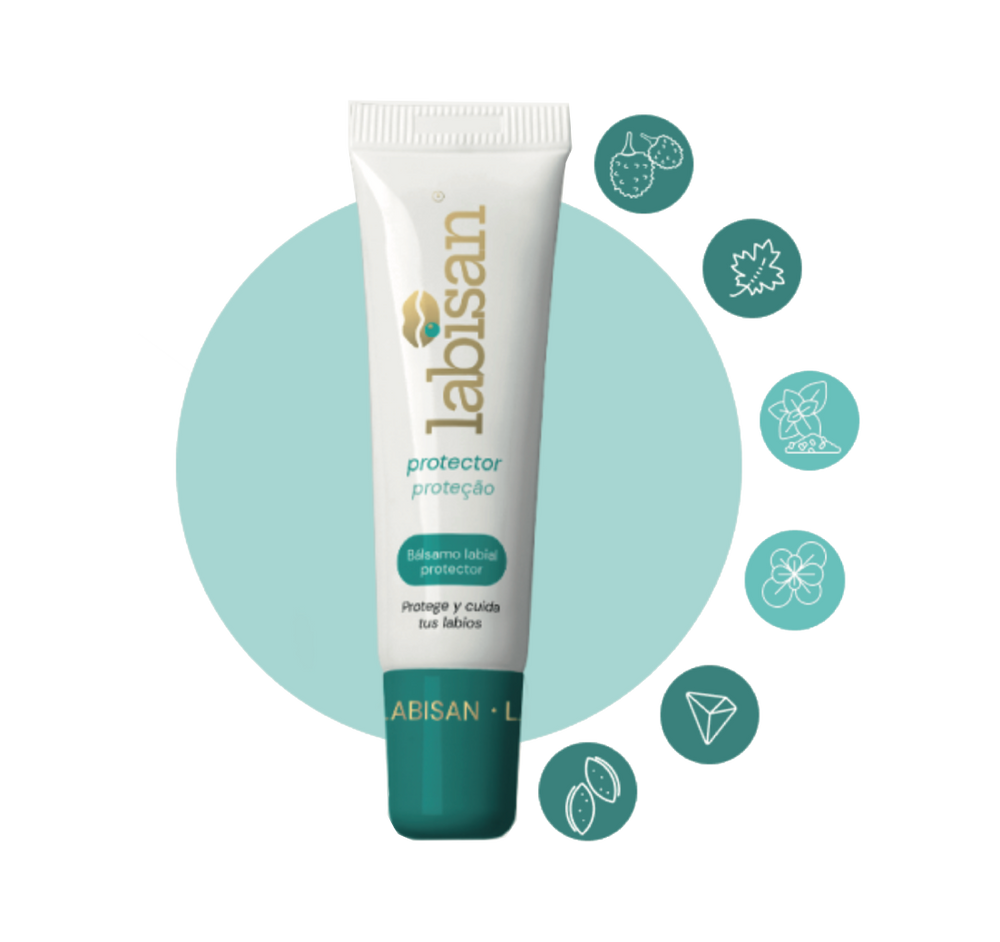
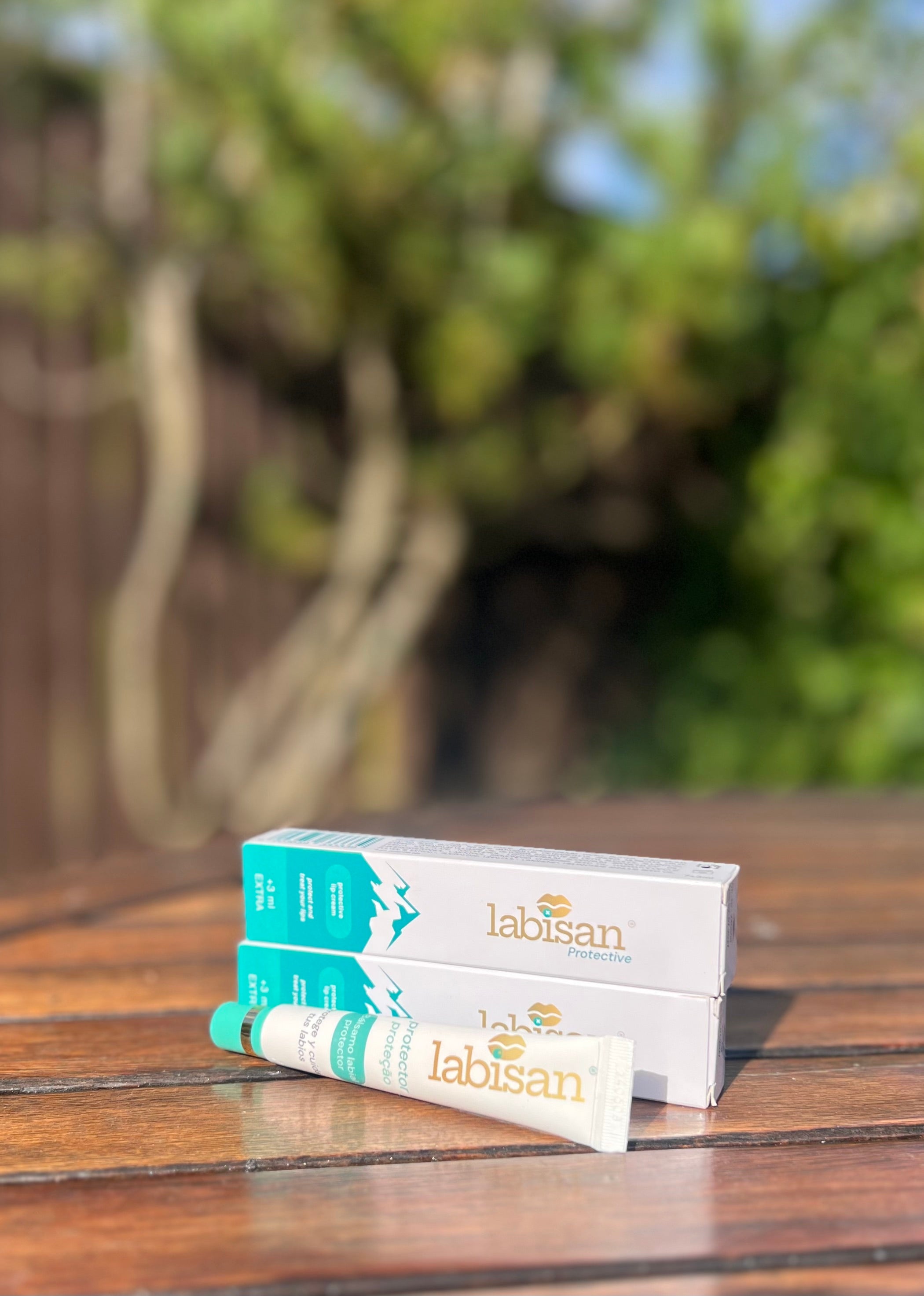
Labisan is built the other way round, as a two part system that addresses the outside and the inside. Outside, Labisan Protective Lip Balm SPF 20 puts a 22 percent zinc oxide mineral barrier between the vermilion and the single largest documented reactivation trigger for HSV-1, while shea butter restores the lipid barrier that wind and repeated wiping strip away, and manuka and oregano botanicals contribute the antimicrobial and antiviral properties examined in our review of the science behind manuka oil in antiviral lip care. Inside, Labisan Graviola Capsules support general immune function, which is the system that maintains latency at the ganglion in the first place. We want to be precise about that claim, because precision is the only thing worth having here: graviola is an immune support supplement intended to help reduce outbreak frequency over time. It is not a treatment, it does not shorten an active lesion, and neither Labisan product is a cure for HSV-1 or HSV-2. No product is. Herpes simplex is a lifelong latent infection, and any brand telling you otherwise is telling you something untrue.
The argument for the dual protocol is simply this: reactivation is driven by a local trigger and gated by immune control, so a sensible strategy addresses both, and does so before the lesion rather than after it. The golfer who reapplies zinc oxide five times a round for a season has taken the one intervention with a controlled trial behind it and applied it to the exact sport where the exposure is longest. The golfer who carries only a treatment cream has taken no preventive position at all, and is relying on a product that, by design, cannot act until the round is already three days behind them.
Play the Whole Round Without Paying for It on Tuesday
Labisan Protective Lip Balm SPF 20
Single: $24.99 | Adventure Pack (3x): $59.97 | Family Bundle (5x): $89.95
Free EU shipping over $49, $19.99 worldwide. 30 day satisfaction guarantee.
Shop NowFrequently Asked Questions
How often should I reapply lip balm during a round of golf?
Roughly every 50 to 75 minutes, which works out to five applications across a standard 4 hour 15 minute round: before you tee off, walking off the 4th or 5th, at the turn after you eat, around the 13th or 14th, and once more after the final putt for barrier repair. Anchoring reapplication to holes rather than a clock is far more reliable, because you are already counting holes.
Does my golf hat protect my lips from the sun?
Partially, and less than you think. A wide brim performs well for the forehead and nose, cutting exposure there by roughly half, but its effectiveness drops considerably for the chin and lower lip, which sit below the brim line. On a clear day, around half of ground level UV is diffuse light scattered by the sky rather than direct beam, and diffuse light reaches under a brim. A hat is a useful layer, not a substitute for SPF on the lip.
Why does my lip burn on the golf course when the grass does not reflect much UV?
Because golf's risk profile is duration, not reflection. Turfgrass reflects only about 2 to 5 percent of UV, far below sand at 15 to 25 percent or snow at up to 80 to 90 percent. What golf provides instead is four or more continuous hours of low shade exposure, usually inside the 10am to 4pm window that carries about 60 percent of the day's total UV.
Can sun exposure on the course actually trigger a cold sore?
Yes, and it is one of the better documented triggers in the literature. In a double blind crossover trial, 71 percent of susceptible subjects developed herpes labialis after experimental UV exposure with a placebo, versus none of those who used SPF 15 sunscreen on the lip. Lesions typically appear 24 to 72 hours after the exposure, which is why the connection between a Saturday round and a Monday outbreak is so often missed.
What is the difference between preventing a cold sore and treating one?
Treatment products, including docosanol creams, patches and prescription antivirals, act only after viral replication has begun, and typically shorten an episode by around a day. Prevention targets the trigger before anything starts. Labisan Protective Lip Balm SPF 20 blocks UV at the lip, and Labisan Graviola Capsules support immune function to help reduce outbreak frequency over time. Neither is a cure for HSV-1 or HSV-2, and neither replaces medical treatment for an active or severe outbreak.